The short answer: in Ontario there is no waiting time that is guaranteed safe or legal, so the only dependable plan is to decide how you’re getting home before you use. Health Canada says there is no standard waiting time to drive after cannabis and advises people who use it not to drive at all. The law is just as firm: impairment to any degree is an offence, fixed THC limits apply on top of that, and Ontario’s penalties got tougher on July 1, 2026. Here’s how it all works, so you can enjoy cannabis and keep your licence.
We deliver across Durham Region and the GTA in about an hour, so your cannabis comes to you and you don’t need to get behind the wheel for it. The rest of this guide covers what you need to know about the rules.
TL; DR
- Driving with a drug-impaired ability, even slightly, is a Criminal Code offence, and separate THC blood limits start at 2 ng per mL.
- There is no official safe waiting time. Health Canada gives none, and effects of inhaled cannabis can last up to six hours and sometimes 12, longer with edibles.
- Drivers 21 and under, novice drivers and commercial drivers face zero tolerance in Ontario.
- Since July 1, 2026, a first criminal conviction means at least a one-year licence suspension and at least a one-year ignition interlock.
- Plan the ride home first: a sober driver, a taxi, transit, a rideshare or staying put.
Table des Matières
- What the law says about driving after cannabis
- The THC limits in plain numbers
- Ontario’s zero-tolerance rule
- Combien de temps devez-vous attendre ?
- How police check for impairment
- What happens if you’re caught: Ontario penalties
- Smoking, vaping or eating cannabis in a vehicle
- A plan that keeps you legal
- Order in, stay in
- Notre prendre
- QFP
- Références
What the law says about driving after cannabis
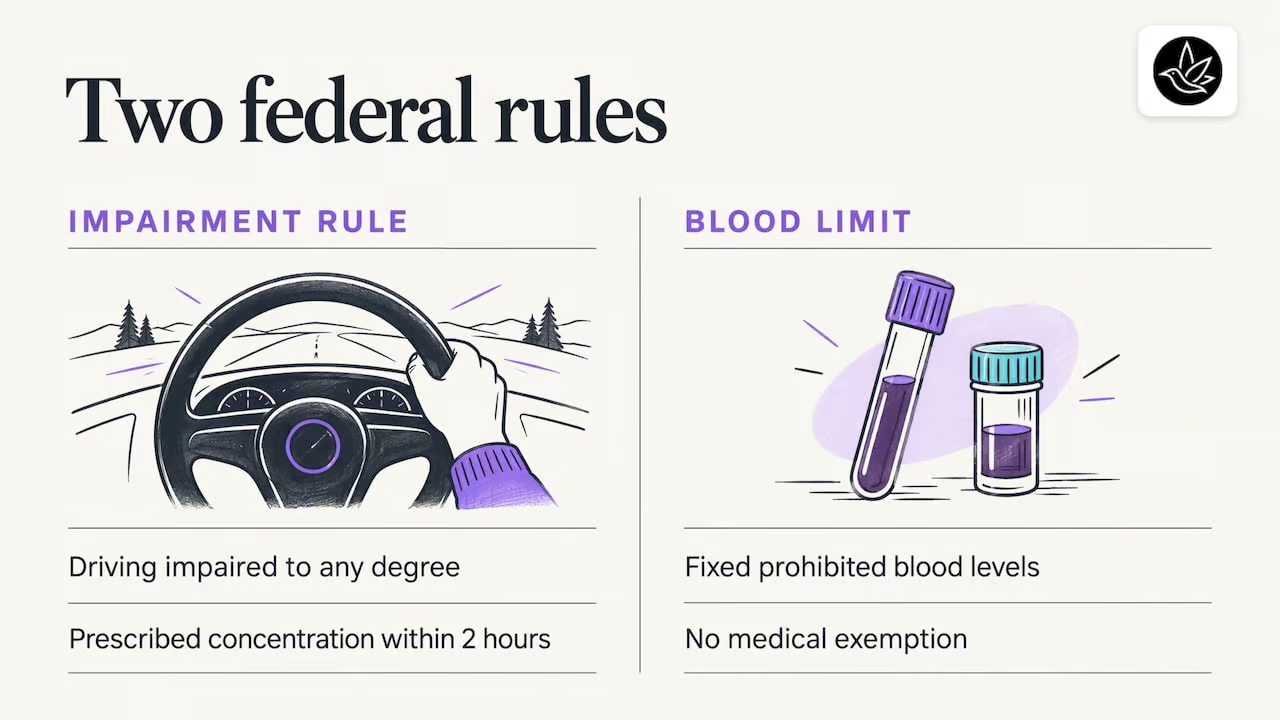
Two rules sit side by side in Canada, and you can break either one.
The first is the impairment rule. Section 320.14 of the Code criminel makes it an offence to operate a conveyance while your ability is impaired to any degree by a drug. It also covers having a prescribed blood drug concentration within two hours after you stop driving. “To any degree” matters: police and courts don’t need you to be wildly high, only impaired.
The second is the blood limit. These are fixed numbers, and they apply even if you feel fine.
The federal government explains the reasoning plainly: science can’t yet tell drivers how much cannabis is safe or how long to wait, so the law takes a cautious approach. It sets prohibited levels and, deliberately, includes no medical exemption. That last point is worth underlining for medical patients: a prescription does not make impaired driving legal.
What counts as a vehicle
It isn’t only cars. Ontario’s impaired driving information sheet says the Criminal Code applies to all motorized vehicles, including cars, trucks, motorcycles, boats, snowmobiles, off-road vehicles, lawn tractors, golf carts, mopeds and low-speed vehicles. The same sheet says you can’t have an open container of alcohol or cannabis in a car while driving, and you can’t be impaired inside your car even if it is parked.
The THC limits in plain numbers
Le ministère de la justice sets out the prohibited blood levels, measured within two hours of driving:
| Blood level | Ce que cela veut dire |
|---|---|
| 2 ng to under 5 ng THC per mL of blood | Summary conviction offence (the less serious category), maximum fine of $1,000 |
| 5 ng or more THC per mL | Hybrid offence (the Crown can proceed as either a summary or an indictable offence) |
| 2.5 ng or more THC per mL plus 50 mg or more alcohol per 100 mL of blood | Separate hybrid offence |
The hybrid offences carry the same mandatory minimums as alcohol-impaired driving: a $1,000 fine for a first offence, 30 days in jail for a second and 120 days for a third.
A nanogram (ng) is a billionth of a gram. You can’t feel or estimate it, which is exactly why “I feel fine” isn’t a test. THC levels in blood don’t map neatly onto how impaired you are, and that is one reason the law also looks at observed impairment.
The alcohol combination
The third row deserves attention. The combined limit is lower for THC (2.5 ng) and, for alcohol, set at 50 mg per 100 mL, which is well under the usual 80 mg alcohol limit. Having a drink or two on top of cannabis can put you over a line you wouldn’t cross with either alone. We cover how the two interact in our guide to mélanger du cannabis et de l'alcool.
Ontario’s zero-tolerance rule
Ontario adds its own layer. Under zero tolerance, drivers 21 and under, novice drivers (G1, G2, M1, M2) and commercial drivers can’t have any cannabis or other drugs in their system. Ontario’s official page confirms that these zero-tolerance laws apply to cannabis as well as alcohol, and that the penalties for cannabis-impaired driving match those for alcohol.
Le Bureau de santé du comté de Windsor-Essex notes that a medical authorization the police accept can exempt a driver from zero tolerance, but not from the impairment penalties. If you’re a licensed medical user and a novice driver, that distinction matters.
If you’re a young driver, the practical message is simple: for you, a positive result is enough, whether or not you were driving badly.
Combien de temps devez-vous attendre ?
This is the question behind most searches, and the honest answer is that nobody can give you a number that works for everyone.
Sécurité publique Canada says there is no official guidance on how long to wait because impairment varies with how you consume, how much, how recently, how often you use and the THC level of the product. Health Canada adds that some effects, such as drowsiness, peut durer jusqu'à 24 heures.
What researchers and health bodies do say:
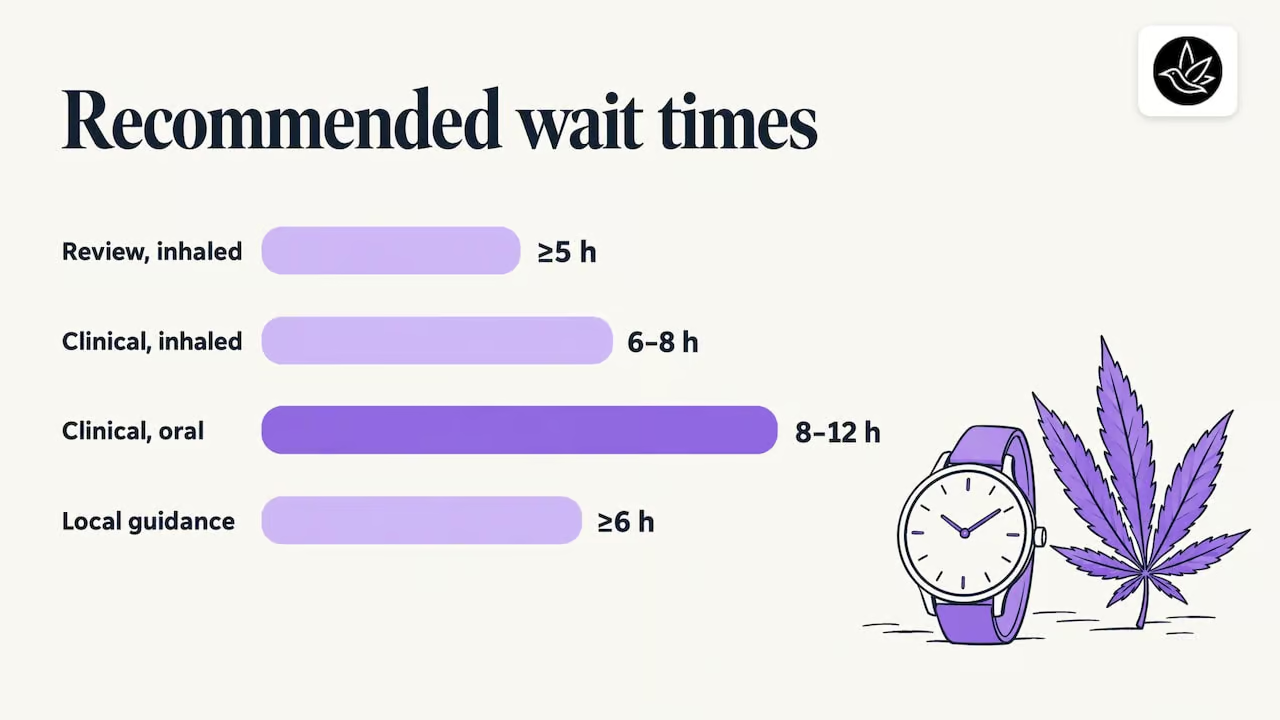
- Inhaled cannabis (smoking, vaping): CAMH says effects can last up to six hours and sometimes up to 12.
- Edibles and other oral products: CAMH says effects last longer than with smoked or vaped cannabis, and likely longer still with high-potency products and newer oral products such as sprays and sublingual strips.
- Revue de recherche : a 2026 review of the science found impairment is consistently seen in the first hour and remains detectable for about four to five hours after inhalation. It recommends waiting at least five hours after smoking or vaping, and longer after oral THC.
- Recommandations cliniques : a clinician brief from Cannabis Evidence notes that guidelines suggest waiting six to eight hours after inhalation and eight to 12 hours after oral ingestion.
- Local public health: le Bureau de santé du comté de Windsor-Essex advises waiting at least six hours, and says driving after cannabis more than doubles your chance of a collision.
These are research and public health guidance, not a legal safe harbour. You can still be charged at any point if police believe you’re impaired.
Why “I’m a regular, so I’m fine” doesn’t hold
A common assumption is that experienced users handle it better. The Cannabis Evidence brief cautions that higher-tolerance users may not be any safer to drive after use than infrequent users. It also points to two misperceptions: comparing cannabis with alcohol, and believing that driving slower makes up for impairment.
The 2026 review also notes that study participants were often willing and ready to drive shortly after use while objectively impaired. Feeling capable is not the same as being capable.
Edibles, drinks and slow-onset products
Edibles and cannabis drinks are where timing gets hardest to read. They can take a while to kick in and last well beyond what an inhaled session would. Our edibles guide walks through doses and onset, and our primer on boissons au cannabis covers the same for drinks. The takeaway for driving: if you’ve had an edible, treat the whole day as a no-driving window unless you’ve been told otherwise by a doctor.
How police check for impairment
If an officer reasonably suspects a drug in your body, they can demand an oral fluid sample. The Department of Justice says that suspicion can rest on objective signs such as red eyes, muscle tremors, agitation or abnormal speech. A positive oral fluid result confirms the drug is present and, together with observed signs of impairment, can support a demand for a blood sample.
In practice, police can also demand a roadside Standardized Field Sobriety Test (balance and coordination tasks), and an officer trained as a Drug Recognition Expert can carry out a fuller evaluation. Refusing a demand is itself an offence with serious consequences, covered next.
What happens if you’re caught: Ontario penalties
There are two tracks, and they run at the same time. The roadside track is administrative and happens immediately. The criminal track goes through the courts.
Au bord de la route
Pour ontario.ca:
- Failing the Standardized Field Sobriety Test (the warn range): 7-day suspension, an 8-hour education course and a $250 penalty the first time. Repeat occurrences escalate to a 14-day suspension and $350, then a 30-day suspension and $450 with a six-month ignition interlock condition.
- Failing or refusing a drug test, or performing poorly in a Drug Recognition Expert evaluation: an immediate 90-day suspension, a 7-day vehicle impoundment and a $550 penalty at each occurrence.
A refusal is treated the same as a failure on the roadside side of things, so declining the test is no way out.
On conviction: the July 1, 2026 changes
Ontario’s criminal-conviction penalties changed starting July 1, 2026. According to ontario.ca:
| Déclaration de culpabilité | suspension de permis | verrouillage d'allumage | After interlock |
|---|---|---|---|
| Prénom | At least 1 year, plus mandatory education or treatment | Au moins 1 an | Minimum 6-month “P” condition (zero alcohol, zero drugs) |
| Second within 10 years | Au moins 3 ans | Au moins 3 ans | Minimum 6-month “P” condition |
| Troisième | Lifetime, reducible after 10 years | At least 6 years, plus mandatory medical evaluation | Minimum 6-month “P” condition |
| Quatrième | Lifetime, no reduction | n/a | n/a |
Add the federal side: the Criminal Code penalties above, and a criminal record. An interlock is a breath-testing device wired to your ignition, and you pay to have it installed and maintained. Because licence consequences reach into work, insurance and family life, the cost of one bad decision is far bigger than the fine.
If you’re facing a charge or a roadside suspension, speak to a lawyer who handles impaired driving cases. This guide explains the rules but can’t tell you how they apply to your situation.
Smoking, vaping or eating cannabis in a vehicle
Separate from impairment, Ontario restricts using cannabis in a vehicle at all. The Bureau de santé du comté de Windsor-Essex lists that it is illegal in Ontario to smoke or vape cannabis in a vehicle being driven or under your care and control, and to use non-medical cannabis in a vehicle. That includes the parked car with the engine off.
Carrying cannabis in a vehicle is a different matter, with its own rules on packaging and open products. Our guide to travelling with cannabis in Ontario covers cars, flights and borders, and if you want to double check how much you can legally possess, see the legal possession limits.
A plan that keeps you legal
The simplest approach is to make the decision before the first session, not after. Here’s a routine that works:
- Decide how you’re getting home or getting around first. A sober driver, a taxi or rideshare, transit or staying over are the options Santé Canada liste.
- Use at home. If you’re going out, wait until you’re back before you use.
- Keep dose and potency in mind. Higher THC and oral products mean longer effects. If you’re newer to cannabis, our daytime strains guide suggests starting low with inhaled products under 10% THC.
- Don’t stack alcohol on top. The combined limit is lower than either alone.
- If in doubt, don’t drive. Not today, and for edibles, not until the next day is the careful call.
The errand problem
Plenty of impaired-driving risk starts with the “quick run” to pick something up. Delivery removes that trip entirely. In Durham Region and the GTA, we deliver in about an hour, and our medical orders ship Canada-wide, so there’s no reason to drive anywhere for your order.
Order in, stay in
We’re an online cannabis retailer for adults in Ontario, with recreational and medical options: flower, pre-rolls, vapes, extracts, edibles, drinks, CBD and accessories. Our one-hour delivery in Durham Region and the GTA means you can sort your evening without a car, and our curated craft selection and weekly product drops keep it interesting. We’ve got a 4.9-star Google rating from customers who tell us they value the speed and the quality.
Parcourez la gamme complète en notre magasin, and if you’re new to the products, our vaping vs smoking guide is a good place to start. You must be 19 or older in Ontario, and ID is checked on delivery. Our age and ID guide explique comment cela fonctionne.
Notre prendre
We love cannabis, and we want you to keep loving it for years. That means treating driving as a separate decision from using, made well ahead of time.
The rules are strict because the science can’t give anyone a safe number. We think that’s a fair reason to simplify things: if you’re using, you’re not driving. Full stop. It’s the one rule that works for flower, vapes, edibles and drinks alike, for new users and long-time ones.
That’s also why we built our service around delivery. When your order arrives in about an hour in Durham Region and the GTA, there’s no trip to make, no keys to think about, and the evening can be what you planned. We pair that with detailed product information and a curated craft selection, so you know what you’re getting, including the potency that shapes how long effects last.
Choose your product, choose your ride, and enjoy yourself.
Nicolas
QFP
How long after smoking weed can I drive in Ontario?
There is no official safe waiting time. Health Canada says there is no standard time and advises people who use cannabis not to drive. Research reviews and health units suggest at least five to six hours after inhaling and longer after edibles, but you can still be charged for impairment at any point.
Can I drive with cannabis in my car in Ontario?
Yes, if it’s carried legally, but there can be no open container of cannabis in the car while driving, and you can’t use it in the vehicle at all. Keep it sealed and out of reach, and read our guide de voyage pour les détails.
Does a medical cannabis prescription let me drive after using it?
No. The federal law deliberately has no medical exemption for impaired driving. Medical authorization can exempt some drivers from Ontario’s zero tolerance rule, but not from impairment penalties. If you’re prescribed cannabis, ask your doctor or authorizing practitioner about driving.
What are the penalties for cannabis-impaired driving in Ontario?
Roadside, a drug test failure or refusal brings a 90-day suspension, 7-day impoundment and $550 penalty. On a criminal conviction since July 1, 2026, a first offence means at least a one-year licence suspension and at least a one-year ignition interlock, with fines and possible jail under the Criminal Code.
Références
- Code criminel, article 320.14
- Ontario: Information for Impaired Driving
- Department of Justice: Drug-Impaired Driving Laws FAQ
- Department of Justice: Impaired Driving Laws
- Health Canada: Cannabis impairment
- Public Safety Canada: Drug-impaired driving
- Ontario: Impaired driving
- Windsor-Essex County Health Unit: Cannabis-Impaired Driving
- CAMH: Cannabis and driving
- Recent Advances in the Science of Cannabis-Impaired Driving (2026)
- Cannabis Evidence: Cannabis and Driving Impairment