TL;DR:
- Vaping dry herbs at 180–200°C offers a lower-risk alternative to smoking, but device quality and sourcing remain important. Proper preparation, controlled temperature increments, and regular cleaning enhance safety and flavor. Buying from licensed Canadian retailers ensures product safety and compliance with legal regulations.
Grind your herb to a medium-fine consistency, pack the oven loosely, set your device to 180–200°C, and inhale slowly over 5–8 seconds. That’s the core of using a dry herb vaporizer safely and effectively. Health Canada confirms that vaporizing is lower risk than smoking but not risk-free, so device quality and legal sourcing matter from day one. Montrosecannabis offers same-day delivery of licensed dried flower and accessories across the Durham Region and GTA, making it a trusted starting point for Canadians ready to vape legally.
TL;DR: Grind → pack loosely → start at 180°C → inhale slowly → clean after every session. Never drive while impaired, and always source from a licensed retailer.
Pro Tip: Start with 0.1–0.2 g for your first session. You can always load more; you can’t undo too much.
Table of Contents
- What do you need before your first session?
- How do you use a dry herb vaporizer step by step?
- What types of dry herb vaporizers should beginners know about?
- What temperature should you vape dry herb at?
- How do you clean and maintain your vaporizer?
- Is vaping dry herb safer than smoking, and what are the Canadian rules?
- Quick tips for better flavour, efficiency, and discretion
- Key takeaways
- What most beginners get wrong about vaporizers
- Ready to stock up on legal flower and accessories?
- Useful sources
- FAQ
What do you need before your first session?
Getting your setup right before you power anything on saves a lot of frustration. Here’s what you need on hand:
- Dry herb vaporizer — (portable or desktop, fully charged)
How to check your herb’s moisture
Moisture level is one of the most overlooked factors for new users. Herb that’s too wet produces harsh, thin vapour and can clog your device. Herb that’s too dry burns fast and tastes acrid.
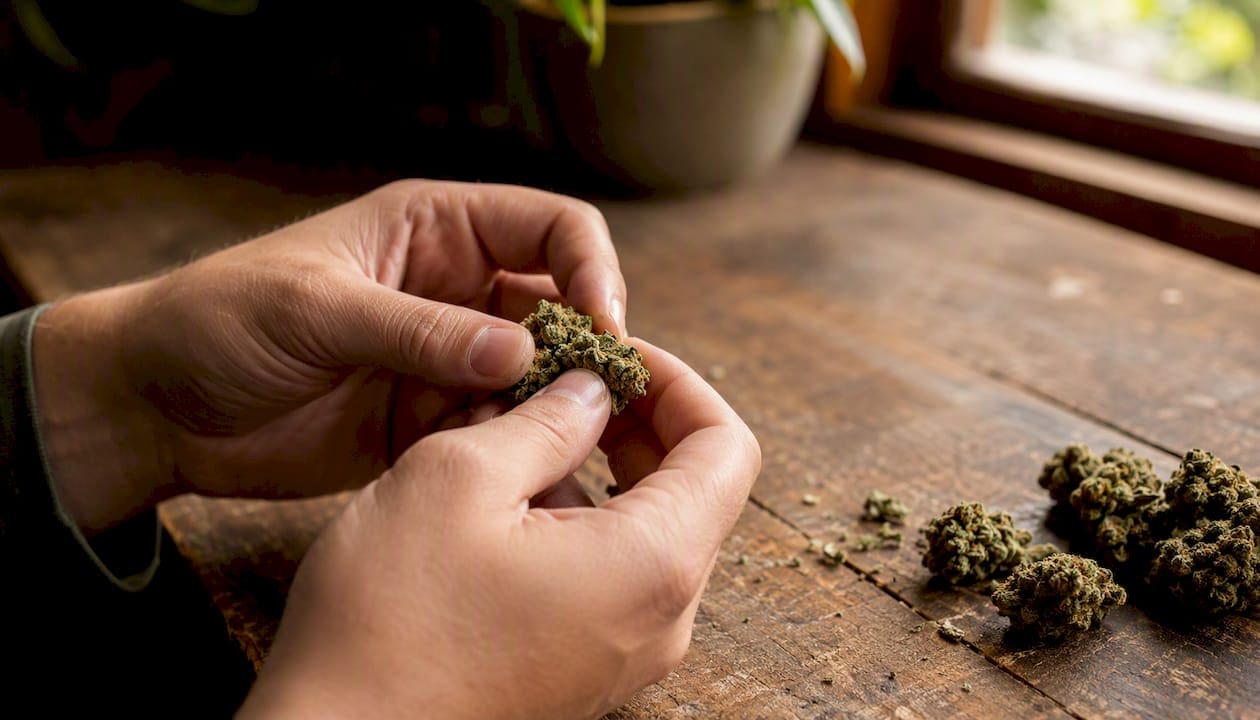
The squeeze-and-break test works well: pinch a small bud between your fingers. It should feel slightly springy, not crumbly or damp. When you break it apart, it should snap cleanly rather than crumble to dust or bend without breaking. If your flower is too dry, a proper storage routine with a humidity pack (Boveda 62% is a popular choice) can restore it over 24–48 hours.
Legal and age checks for Canada
Under the Cannabis Act, you must be 19 or older in Ontario (18 in Alberta and Quebec) to purchase or possess cannabis. Adults may possess up to 30 g of dried cannabis in public. Always buy from a provincially licensed retailer or a federally licensed online seller. Unlicensed product carries unknown contaminants and no regulatory oversight.
Pro Tip: For your first session, load only half the oven capacity. A smaller, controlled dose lets you gauge your tolerance before committing to a full chamber.
How do you use a dry herb vaporizer step by step?
Follow these steps on your first session and every session after. The order matters.
- Load the oven — Fill the chamber to about 70–80% capacity. For conduction vaporizers, pack the herb snugly so it contacts the heated walls. For convection models, pack loosely so air can flow through freely. Overpacking either type restricts airflow and produces weak, harsh vapour.
Pro Tip: “Start low, go slow” applies to both temperature and dose. Spend two or three sessions at 180–200°C before stepping up. You’ll learn your device and your tolerance at the same time.
Dosage reference
Consumer guidance suggests roughly 10–15 slow draws can approximate the effect of a 0.5 g joint, though this varies by device efficiency and potency.
| Oven size | Typical load | Approx. draw count | Comparison |
|---|---|---|---|
| Small (0.1–0.2 g) | Beginner dose | 5–8 draws | Less than half a joint |
| Medium (0.3–0.5 g) | Standard session | 10–15 draws | Roughly equivalent to a 0.5 g joint |
| Full (0.5 g) | Experienced users | 15–20 draws | Comparable to a full joint |
What types of dry herb vaporizers should beginners know about?
Choosing the right device shapes your entire experience. Two variables matter most: form factor and heating method.
Portable vs. desktop
Portable vaporizers run on a rechargeable battery and fit in a pocket or bag. They’re the practical choice for most beginners because they’re versatile, discreet, and widely available from Canadian retailers. Battery life typically allows for multiple sessions per charge, with exact duration depending on temperature and oven size.
Desktop vaporizers plug into a wall outlet and deliver consistent, powerful vapour through a whip or balloon bag. They’re better suited to home use where power access is reliable and session length isn’t a concern. The learning curve is slightly steeper, but flavour and vapour quality tend to be exceptional.
What temperature should you vape dry herb at?
Temperature is the single biggest variable in your session. Too low and you get thin, flavourless vapour. Too high and you risk combustion, which defeats the purpose entirely.
Pro Tip: If you see smoke instead of vapour, or smell something burning, your temperature is too high or your herb is too dry. Drop the temperature by 10°C and check your grind.
Temperature bands and what to expect
| Range (°C) | Experience | Best for |
|---|---|---|
| 180–200°C | Light, flavourful vapour; strong terpene presence; mild effect | First sessions, terpene exploration |
| 195–210°C | Balanced flavour and effect; moderate vapour density | Everyday use, dose titration |
| 215–230°C | Very dense vapour; maximum cannabinoid extraction; risk of combustion increases | End-of-session extraction only |
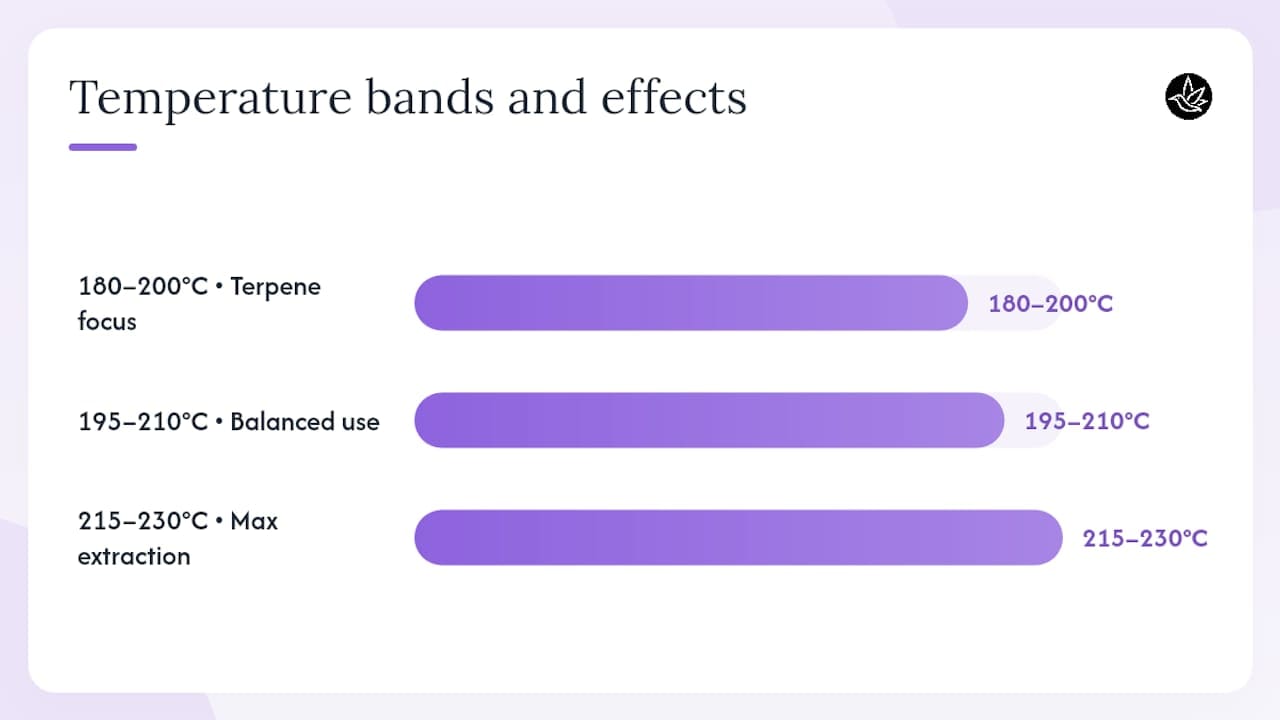
Canada Vapes guidance aligns with these bands, recommending 180–200°C for flavour and terpene preservation, 195–210°C for balanced effect, and 215–230°C for maximum extraction.
The step-up method works well: start at 180°C for your first few draws, then increase by 5–10°C increments between draws or sessions. This extracts terpenes early at lower heat, then cannabinoids more fully as temperature rises, giving you a more complete session from the same load.
Many guides reference Fahrenheit temperatures. For reference: 356°F = 180°C, 392°F = 200°C, and 446°F = 230°C.
How do you clean and maintain your vaporizer?
A clean device tastes better, lasts longer, and performs more reliably. Residue build-up is the most common reason for weak vapour and poor airflow.
What you’ll need
- Isopropyl alcohol (90% or higher; 99% is ideal for electronics-adjacent cleaning)
- Cotton swabs and pipe cleaners
- Small stiff-bristle brush (usually included)
- Replacement screens (oven and mouthpiece)
- Dry lint-free cloth
Step-by-step cleaning process
- Power off the device completely and let it cool for 10 minutes.
- Remove the mouthpiece and any removable screen or glass components.
- Soak removable non-electronic parts (screens, glass mouthpieces) in isopropyl alcohol for 20–30 minutes, then rinse with warm water and dry fully.
- Swab the oven walls with an isopropyl alcohol cotton swab. Do not flood the oven or allow liquid to reach the heating element or battery compartment.
- Run a pipe cleaner dampened with isopropyl alcohol through the airpath from mouthpiece end to oven end.
- Wipe all exterior surfaces with a dry cloth.
- Reassemble only when all components are completely dry.
- Run one short warm-up cycle at 180°C without herb before your next session to burn off any residual alcohol.
Regular cleaning also extends battery life indirectly: a clogged airpath forces you to draw harder, which strains the heating element and battery over time.
Is vaping dry herb safer than smoking, and what are the Canadian rules?
Vaping is not risk-free, but the evidence consistently shows it reduces exposure to combustion by-products compared with smoking. Health Canada acknowledges lower risk relative to smoking while warning that aerosol contaminants and device quality remain concerns. A peer-reviewed review found that vaporizing cannabis reduces exposure to polynuclear aromatic hydrocarbons and carbon monoxide, toxins produced by combustion, and some studies report fewer respiratory symptoms among users who switch from smoking.
Research published in the Harm Reduction Journal found that medical cannabis users in Canada who switched to vaporizers reported fewer respiratory symptoms and greater ability to control their dose. That dose-titration advantage is one reason practitioners favour vaporizers for therapeutic use.
“Vaporization of cannabis is associated with reduced exposure to combustion toxicants compared with smoking, and some evidence suggests improved respiratory outcomes for users who switch. However, vaporization is not risk-free, and device quality, product source, and user behaviour all influence outcomes.” — PMC peer-reviewed review
A 2023 clinical review in Drug and Alcohol Review recommends dried flower as the preferred vaporized product over e-liquids or concentrates, citing lower EVALI risk from adulterated or illicit liquids. Stick to licensed dried flower from a regulated Canadian source.
Canadian regulatory context
Health Canada classifies devices represented for medical cannabis delivery as medical devices under the Medical Devices Regulations, which means sellers making therapeutic claims must hold the appropriate licences. Recreational dry herb vaporizers sold as accessories fall under different rules, but buyers should verify that any device they purchase comes from a compliant Canadian retailer.
Practical safety actions every user should follow:
- Buy dried flower from a provincially licensed retailer or federally licensed online seller only.
- Avoid unregulated e-liquids, concentrates, or devices from unverified sources.
- Never drive or operate machinery while impaired. Cannabis impairment is illegal behind the wheel under the Criminal Code regardless of consumption method.
- Keep cannabis and devices stored securely away from children and pets.
This article provides general information, not medical or legal advice. Confirm current rules with Health Canada or a qualified professional.
Quick tips for better flavour, efficiency, and discretion
Small habits make a real difference over time.
- Carry legally and discreetly — In Canada, you may carry up to 30 g of dried cannabis in public. Use a smell-proof, child-resistant container. Many dispensaries sell purpose-built travel cases.
Pro Tip: For outdoor sessions, a portable hybrid vaporizer with a ceramic oven produces less visible vapour at lower temperatures (180–200°C) than a conduction device running hot. Cooler temperatures also mean less aroma.
Portable session checklist: Fully charged device, USB-C or proprietary charger, small cleaning brush, spare screen, smell-proof case, legal flower in a sealed container.
Key takeaways
Using a dry herb vaporizer safely comes down to three things: proper preparation, controlled temperature, and consistent cleaning.
| Point | Details |
|---|---|
| Prepare your herb | Grind to medium-fine consistency and check moisture before every session. |
| Start low on temperature | Begin at 180–200°C and step up in 5–10°C increments to balance flavour and effect. |
| Inhale slowly | Draw for 5–8 seconds at a gentle pace; hard pulls cool the oven and waste herb. |
| Clean regularly | Brush the oven after every session and deep clean every 5–10 sessions with 90%+ isopropyl alcohol. |
| Source legally in Canada | Montrosecannabis delivers licensed dried flower and accessories same-day across the Durham Region and GTA. |
What most beginners get wrong about vaporizers
The conventional wisdom says vaporizers are complicated. They’re not. The real problem is that most beginners treat a vaporizer like a pipe: pack it tight, hit it hard, and expect instant results. That approach produces exactly the weak, harsh draws that make people give up on the device after a week.
Temperature control is the feature that separates vaporizers from every other consumption method, and most beginners never use it intentionally. They pick a default setting and leave it there. The step-up method, starting at 180°C and moving up in small increments, isn’t just a flavour trick. It’s how you extract the full profile of a strain across a single session, terpenes first, then cannabinoids, then the heavier compounds at the top of the range. A session run that way from a 0.3 g load will outperform a full gram packed into a pipe.
The other thing worth saying plainly: vaping is not a zero-risk activity. It reduces combustion toxicants, and the evidence for that is solid. But device quality matters, product source matters, and impairment is real regardless of how you consume. Buying from a licensed retailer like Montrosecannabis isn’t just a legal formality. It’s the only way to know what’s actually in your flower.
Ready to stock up on legal flower and accessories?
Montrosecannabis makes it easy to get everything you need for your first session, or your fiftieth, without leaving home. With same-day cannabis delivery across the Durham Region and GTA, you get craft-quality dried flower from licensed growers, plus accessories suited for dry herb vaping, delivered in about an hour.

The selection covers recreational and medical options, and the team is genuinely knowledgeable about matching products to your device and tolerance. If you’re in the Durham Region, same-day delivery in Bowmanville and surrounding areas means you’re never far from a fresh supply. Browse the current selection and place your order at montrosecannabis.ca.
Useful sources
The safety and technical claims in this guide draw from the following primary sources. Each is worth reading if you want to go deeper.
- Government of Canada publication (H134-29-2022-eng.pdf)
- Are vaporizers a lower-risk alternative to smoking cannabis? — PMC
- Cannabis vaporisation: Understanding products, devices and risks (Drug and Alcohol Review 2023)
- How to Vape Dry Herbs: A Beginner’s Guide – Clutch Vape
- Dry Herb Vaporizers Guide: How to Use, Choose, and Benefit — Canada Vapes
| Resource type | Best for |
|---|---|
| Health Canada guidance | Safety, harm reduction, Canadian legal context |
| PMC peer-reviewed review | Evidence on toxicant reduction and respiratory outcomes |
| Harm Reduction Journal study | Medical user data, dose titration, Canadian context |
| Drug and Alcohol Review 2023 | Product and device risk comparison |
| Clutch Vape beginner guide | Step-by-step technique and packing tips |
| Canada Vapes device guide | Temperature settings and device type comparisons |
FAQ
How do you use a dry herb vaporizer for beginners?
Grind your herb to a medium-fine consistency, pack the oven to about 70–80% capacity, set the temperature to 180–200°C, wait for warm-up, then inhale slowly for 5–8 seconds. Clean the oven after every session to maintain flavour and airflow.
Does dry herb vaping get you as high as smoking?
Effects are comparable, though some peer-reviewed studies report that the subjective duration of effects can be shorter after vaping versus smoking. Potency depends on temperature, device efficiency, and the flower you’re using.
How many hits do you get from a dry herb vaporizer?
A medium load of roughly 0.3–0.5 g typically yields 10–15 slow draws, which consumer guidance suggests is roughly equivalent to a 0.5 g joint. Draw count varies by device efficiency and temperature setting.
Is a dry herb vaporizer better for your lungs than smoking?
The evidence suggests yes, with caveats. Vaporizing reduces exposure to combustion toxicants like carbon monoxide and polynuclear aromatic hydrocarbons, and some studies report fewer respiratory symptoms among users who switch from smoking. Health Canada notes lower risk relative to smoking while emphasising that vaporizing is still not risk-free.
Where can I legally buy dried flower for vaping in Canada?
Purchase from a provincially licensed retailer or a federally licensed online seller. Montrosecannabis delivers licensed dried flower and vaping accessories same-day across the Durham Region and GTA, with Canada-wide delivery available for medical orders.