Store vape cartridges upright, in a cool spot between 15°C and 21°C, away from direct light, and disconnect them from the battery whenever you won’t use them for a while. Heat, sunlight and moisture are the three things that wreck a cartridge fastest. Follow those rules and an opened cartridge typically stays good for several months, while an unopened one can hold up for a significantly longer time.
TL;DR:
- Store cartridges upright, cap on, and mouthpiece facing up to prevent leaks and Gunk buildup.
- Keep cartridges between 15°C and 21°C, avoiding hot cars and sunny windowsills that can thin oil and degrade flavor.
- Use opaque containers or dark storage to protect cannabinoids and terpenes from UV exposure over time.
- Avoid refrigeration, as cold thickens the oil and condensation risks damage; stable room temperature is ideal.
- Separate the cartridge from the battery for long-term storage to minimize accidental activation and battery strain.
Table of Contents
- What are the core rules for vape cart storage?
- How should you handle carts you’re using daily?
- How long do vape cartridges actually last?
- How should you handle the battery side of things?
- How do you travel with vape cartridges safely?
- What do spoiled or faulty cartridges look like?
- Who’s behind this storage guide?
- What the industry gets wrong about vape cart storage
- Get storage-friendly gear without the guesswork
- Sources
- FAQ
What are the core rules for vape cart storage?
Cartridges are simple devices, but the oil inside is sensitive. Get orientation, temperature, light and humidity right, and you’ll dodge the vast majority of problems people run into with clogging, leaking or flat-tasting hits.
Keep it upright. Storing a cartridge on its side or upside down lets oil seep toward the mouthpiece or down into the airflow path. That causes leaks, gunks up the coil, and can leave you pulling on a cart that tastes burnt before it’s actually done. Upright storage with the original cap on reduces this migration, though it won’t eliminate leaks entirely if the seal is already compromised.
Watch the temperature. The sweet spot sits between 15°C and 21°C, which is roughly a typical room temperature. Two spots wreck more cartridges than anything else: a hot car dashboard in July, and a sunny windowsill. Heat thins the oil, which can force it past the seals, and it speeds up the breakdown of the terpenes that give your cartridge its flavour. Cold isn’t much better. Retailer guidance in Canada points to stable room temperature as the target, not a fridge or a freezer.
Block the light. UV exposure degrades cannabinoids and terpenes over time, which is part of why most cartridges ship in dark or tinted packaging in the first place. If you’ve popped yours out of the box, drop it in a drawer or an opaque case rather than leaving it on a counter under a window.
Keep moisture out. Humidity can corrode battery contacts and, in some cases, affect the seal integrity of the cartridge itself. Bathrooms are the worst place in the house for this, thanks to shower steam. A bedroom drawer or closet shelf works fine. If you live somewhere genuinely humid, a small silica packet tossed into your storage box or case adds a cheap layer of protection.
- Store cartridges standing up, cap on, mouthpiece up.
- Keep them between 15°C and 21°C, out of hot cars and off sunny windowsills.
- Use opaque or dark storage to block UV.
- Add a silica packet in humid climates, and never store carts in a bathroom cabinet.
Pro Tip: Repeated temperature swings do more damage than one bad night in the cold. Moving a cartridge from a warm pocket to a cold car and back again several times a week thickens the oil faster than steady storage at a slightly imperfect temperature ever will.
How should you handle carts you’re using daily?
Day-to-day habits matter as much as where you tuck a cartridge away at night. A cart that lives in a jacket pocket, gets knocked around in a bag, or stays clipped to a battery for weeks between puffs, degrades faster than one treated with a bit of care.
A few habits go a long way:
- Cap the mouthpiece between sessions to keep out dust, lint and pocket debris.
- Power off or lock your device rather than leaving it live in a bag.
- Wipe the threaded connection with a dry cotton swab or an isopropyl wipe every few days. Cleaning contacts regularly prevents buildup that causes weak connections and burnt hits.
- Avoid leaving a cartridge screwed onto a battery for extended stretches when you’re not using it. Constant contact can trigger accidental activation and slowly drains the oil into the coil even when you’re not pulling on it.
- Keep daily carts in a stand, a padded pen case, or a silicone sleeve rather than loose in a bag.
Each accessory does something slightly different. A silicone sleeve protects against drops and scratches and adds grip, which matters if you’re prone to fumbling your device. A padded case is better if you’re carrying more than one cartridge or a battery alongside it, since it stops parts from knocking together. A mouthpiece cap is the cheapest and most overlooked option. It blocks lint, keeps the airway clean, and takes two seconds to use.
How long do vape cartridges actually last?
This is where expectations often go sideways. People assume cartridges last indefinitely because they don’t spoil the way food does, but the oil, the seals, and the hardware all age.
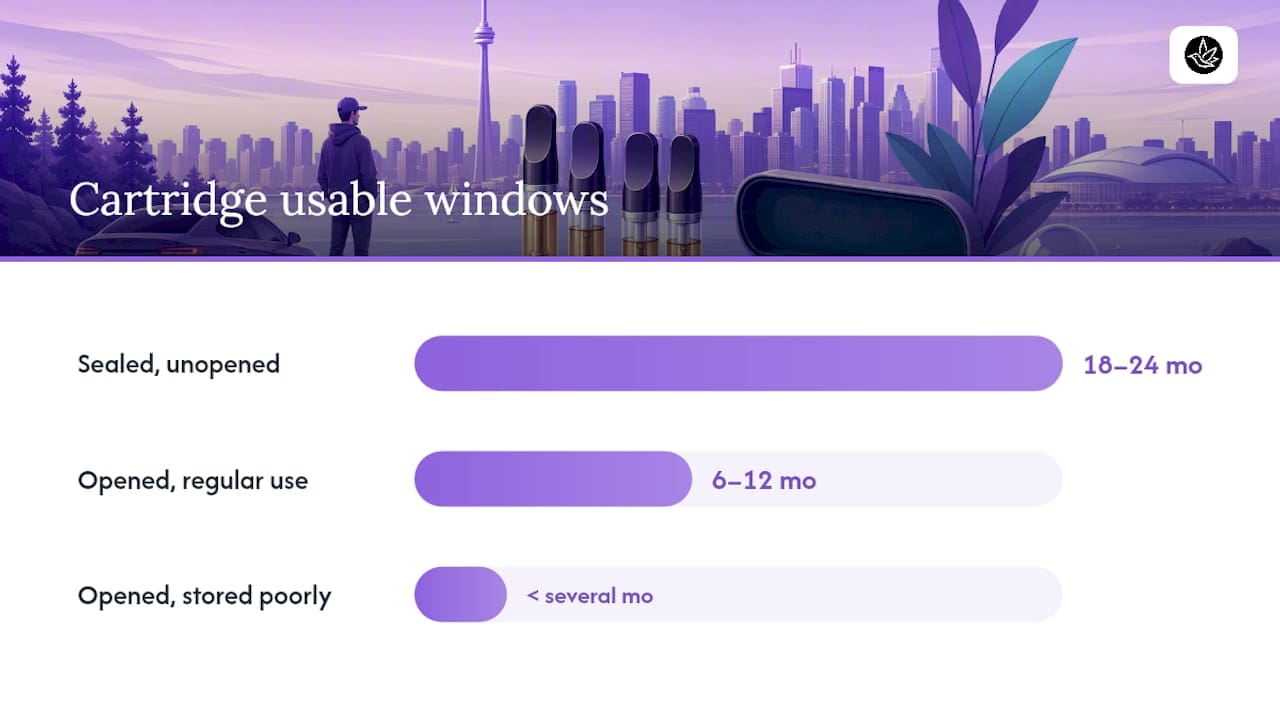
Most opened cartridges hold their quality for about six to twelve months with proper storage. Unopened, sealed cartridges can go longer, sometimes up to 18 to 24 months, because the seal keeps oxygen and light exposure to a minimum until you crack it open.
| Cartridge state | Typical usable window | Key factor |
|---|---|---|
| Sealed, unopened | Up to 18–24 months | Intact seal, no light or air exposure |
| Opened, in regular use | about six to twelve months | Storage temperature, light exposure, handling |
| Opened, stored poorly (heat/light/humidity) | Often under several months | Accelerated terpene loss, oil thickening, seal wear |
If you’re holding spares, keep them in their original sealed packaging, stored upright, in the dark, until you’re ready to open them. It’s worth jotting the purchase date on the box with a marker, especially if you buy a few at a time during a sale. That small habit means you’ll actually notice if a cartridge is starting to taste off before you’ve forgotten how long it’s been sitting.
Refrigeration comes up constantly in online forums, and it’s usually the wrong move. Cold storage causes the oil to thicken, which makes cartridges harder to draw from, and pulling a cold cartridge into a warm room creates condensation that can work its way into the hardware. Freezing is worse still. It risks cracking seals and warping plastic components. Unless a manufacturer specifically states a cold-chain requirement for a particular product, a stable room temperature beats the fridge every time.
How should you handle the battery side of things?
Cartridges get most of the attention, but the battery attached to them deserves its own set of rules, especially if you’re storing a device for weeks rather than days.
- If your battery is rechargeable, store it at a partial charge, roughly 40% to 60%, rather than fully charged or completely dead, if you’re putting it away for a long stretch.
- Power the device off completely rather than leaving it in standby.
- Keep loose batteries away from coins, keys or other metal objects that could bridge the contacts and cause a short circuit.
- Use a protective cap or a case with a dedicated battery slot instead of tossing it into a junk drawer.
- Separate the cartridge from the battery for storage longer than a few weeks. This limits accidental activation and reduces strain on both parts.
- If a battery looks swollen, feels hot without use, or won’t hold a charge anymore, stop using it and dispose of it at a battery recycling drop-off rather than the regular trash.
A reliable 510 thread battery that fits your cartridge properly also reduces the odds of a loose connection causing overheating in the first place.
How do you travel with vape cartridges safely?
Travel is where storage habits get tested the hardest, mostly because you lose control over temperature and handling the moment your bag goes into a car trunk or an overhead bin.
- Detach the cartridge from the battery before flying, where local rules permit it, and pack both in your carry-on rather than checked luggage. Pressure and cold in the cargo hold can cause leaks that checked bags won’t protect against.
- Never leave cartridges in a hot car. Even a short errand on a summer day can push interior temperatures well past the safe range.
- Use an insulated or opaque travel case, particularly in warm weather, and pack cartridges upright rather than loose at the bottom of a bag.
- Check local law before you travel with THC products. Rules on possession and transport vary by province and country, and that’s on you to confirm ahead of time, not something a case or a cap can fix.
What do spoiled or faulty cartridges look like?
Most people can spot a bad cartridge without any special tools. It’s just a matter of knowing what to check.
Watch for oil that’s turned dark or cloudy instead of the clear amber or gold it started as, a musty or chemical smell that wasn’t there before, visible leaking around the mouthpiece or base, or a cracked tank. Any of these signs means it’s time to stop using that cartridge, not push through it.
Before writing off a sluggish cart entirely, a couple of safe checks are worth trying:
- Look closely at the oil through the tank for colour and clarity.
- Gently warm the cartridge in your palm for a minute if the oil looks thick. This can help with viscosity without you needing to apply any real heat.
- Wipe the threaded connection with a dry swab in case a weak hit is actually a dirty contact rather than a spent cartridge.
If cleaning the threads and warming it slightly doesn’t fix a weak or clogged draw, the issue is more likely age-related oil breakdown than a device problem. That’s different from a battery that won’t fire at all, which usually points to the hardware rather than the oil. If a cart you just opened is already leaking or clogged, that’s a manufacturing or handling issue worth flagging to wherever you bought it rather than something to troubleshoot yourself.
Pro Tip: A cartridge that tastes slightly different after a few months isn’t automatically bad. Terpenes fade gradually with age, which changes flavour before it changes safety. Cloudiness, leaks and off smells are the signals that actually matter.
Who’s behind this storage guide?
This guide pulls together manufacturer packaging guidance, provincial retailer recommendations, and the kind of practical, everyday troubleshooting that comes from actually handling cartridges and fielding questions from customers day after day.
The advice is supported by a service that makes it easy to act on. Fast local delivery in Durham Region and the GTA helps avoid holding onto a degraded cartridge too long, and delivery covers medical orders outside that radius. High customer ratings and detailed product pages reflect a focus on providing real information to help with storage and accessory decisions.
What the industry gets wrong about vape cart storage
Most storage advice treats cartridges like they’re fragile lab samples that need constant monitoring. They don’t. The research and the retailer guidance both point to something far simpler: a stable room, upright orientation, and keeping cartridges out of direct sun. That’s the whole job for the vast majority of users.
Where conventional wisdom actually fails people is the fridge myth. It gets repeated constantly online as a way to “preserve” cartridges, and it does the opposite. Thickened oil and condensation cause more problems than they solve.
The other blind spot is battery neglect. People obsess over the oil and forget that a swollen or overheated battery is a genuine safety issue, not just an inconvenience. If you take one thing from this guide, prioritize separating your cartridge from your battery during any storage stretch longer than a couple of weeks. That single habit does more to protect both your gear and your safety than any amount of fussing over exact temperature.
— Nick
Get storage-friendly gear without the guesswork
Good storage habits only get you so far without the right hardware to back them up. Montrosecannabis carries a curated selection of vapes, batteries and accessories from top-tier growers and manufacturers, all with detailed product pages so you know exactly what you’re buying before it ships. That matters more than most retailers let on: a cartridge with a solid seal and a battery that fits properly gives your storage routine something worth protecting.

If you’re in Durham Region or the GTA, one-hour delivery means you’re never left improvising with a degraded cartridge while you wait for a replacement. Medical orders ship Canada-wide. Browse the full shop for vapes, batteries and cases, and get your next cartridge on its way today.
Sources
- Do weed pens expire? Here’s what you need to know | Weedmaps
- How to Store 510 Cartridges to Reduce Leaks, Clogs, and Premature Degradation – Cilicon
- Storage tips for cannabis vapes | SQDC
- Do THC and CBD Vape Cartridges Expire? | VersedVaper
FAQ
What is the best way to store vape cartridges?
Store them upright, in a dark spot, at a stable room temperature between 15°C and 21°C, and keep them away from humidity. Disconnecting the cartridge from the battery for longer storage stretches reduces accidental activation and strain on both parts.
How long can a vape cart sit unused?
An opened cartridge typically holds up well for about six to twelve months with proper storage, while an unopened, sealed one can last up to 18 to 24 months. How long it actually lasts depends heavily on temperature, light exposure and how it was handled before you put it away.
Should I refrigerate my vape cartridges?
No. Cold storage thickens the oil and can cause condensation when the cartridge warms back up, and freezing risks cracking seals. Retailer guidance points to stable room temperature as the better default for most cartridges.
How do I know if my vape cartridge has gone bad?
Look for oil that’s turned dark or cloudy, a musty or chemical smell, visible leaks, or a cracked tank. Any of these signs means it’s time to replace the cartridge rather than keep using it.
Does Montrosecannabis sell vape cartridges and storage accessories?
Yes, Montrosecannabis carries a curated selection of vapes and accessories from top-tier growers, along with detailed product information to help you choose the right fit. Current prices are listed on the shop page.