Yes, cannabis can interact with medications, and CBD can too. Health Canada lists many categories that may interact, including blood thinners, anti-seizure drugs, antidepressants, immunosuppressants and anything that causes drowsiness. The practical move is simple: tell your pharmacist or doctor exactly what you plan to use, then start low and go slow. Below we walk through how interactions happen, which medications deserve the most care, what symptoms to watch for and how to keep things safe.
TL;DR
- Both THC and CBD are processed by liver enzymes that also handle many prescription drugs, so levels of either one can rise or fall.
- Highest-attention medications include warfarin, anti-seizure drugs, immunosuppressants, and sedating drugs such as opioids and benzodiazepines.
- Alcohol, grapefruit, St. John’s Wort and nicotine can also play a part, so mention them too.
- Speak with your pharmacist or health care provider before you start, and again whenever a medication changes.
- If you feel unwell after overconsuming, call 1-844-POISON-X, call 9-1-1 or go to the nearest hospital.
Table of Contents
- How cannabis and medications interact
- Medications that call for extra care
- CBD versus THC: do the interactions differ?
- Does smoking, vaping or eating cannabis change the picture?
- Everyday substances that interact too
- Who should be especially careful
- Symptoms that could signal an interaction
- A safe-use checklist before you start
- Shop with the details in hand
- FAQ
- Sources
How cannabis and medications interact
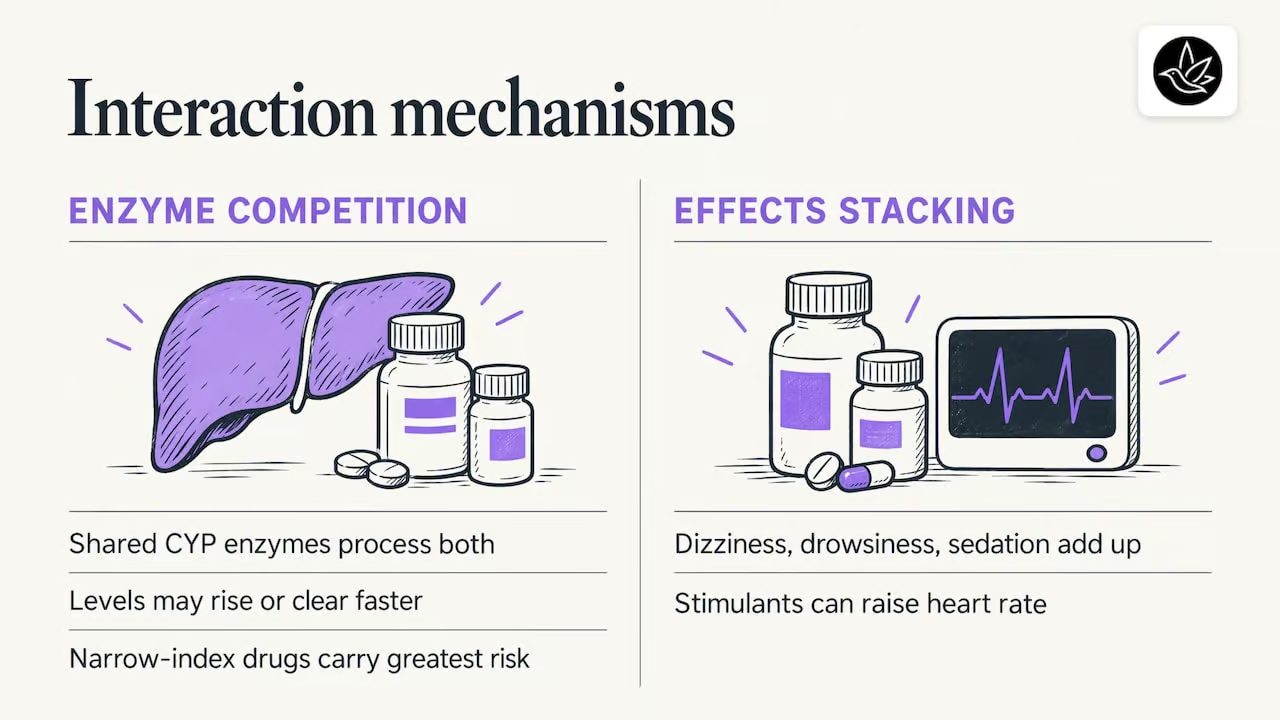
There are two main ways an interaction happens.
1. The liver handles them at the same time. A systematic review of drug-drug interactions explains that THC and CBD are metabolized by the same cytochrome P450 enzymes (CYP3A4, CYP2C9 and CYP2C19) that process most prescription medications. When two substances compete for an enzyme, one can build up in your blood or clear faster than expected. The risk is greatest with drugs that have a narrow therapeutic index, meaning the gap between a helpful dose and a harmful one is small.
2. The effects stack. Some medications and cannabis cause the same effects, so they add together. The Canadian Pharmacists Association notes potential for additive dizziness, drowsiness and sedation when cannabis is taken with opioids, benzodiazepines, anticholinergics or antihypertensives. Stimulating drugs can add to a faster heart rate in the same way.
The second type needs no lab knowledge to spot. If a medication already makes you sleepy, cannabis may make you sleepier.
Medications that call for extra care
Health Canada’s guidance names these groups among substances that may interact with cannabis: alcohol, antipsychotics, blood thinners, amphetamines, Saint John’s Wort, oral contraceptives, immunosuppressants, stomach acid inhibitors, anti-seizure medications, certain heart medications, antiretrovirals, mood stabilizers, grapefruit and grapefruit juice, oral antibiotics and antifungals, antidepressants, anti-anxiety medications and illegal drugs. That is a long list, and it is on Health Canada’s medical cannabis information page for a reason: ordinary, commonly used medications are involved.
The CCSA adds that prescription medications, over-the-counter products and natural health products can all interact, with examples covering anxiety, depression, colds and flu, allergies, pain, heartburn, sleep, ADHD and HIV/AIDS.
Here is a quick reference built from the published sources.
| Medication type | What the sources say | Why it matters |
|---|---|---|
| Warfarin and other blood thinners | A review of cannabinoid interactions reports increased INR and bleeding risk with marijuana | Bleeding risk can change without warning |
| Anti-seizure drugs (clobazam, valproate) | CBD can enhance active metabolites of clobazam; the CPhA flags higher liver-toxicity risk with CBD and valproic acid | Levels and liver health need monitoring |
| Immunosuppressants (tacrolimus, sirolimus, cyclosporine) | The systematic review found tacrolimus and sirolimus among the most widely reported interactions | Narrow therapeutic index |
| Opioids, benzodiazepines, sedatives, alcohol | Additive drowsiness, ataxia and cognitive impairment | Driving and falls |
| Stimulants, nicotine, anticholinergics | Additive racing heart and raised blood pressure | Cardiovascular strain |
| Some antipsychotics (clozapine, olanzapine) | Reduced efficacy reported in the Antoniou review | Symptom control |
| Antidepressants, e.g. tricyclics | The Merck Manual lists tricyclics among drugs whose levels CBD may raise | Stronger drug effects and side effects |
| Stomach acid reducers (omeprazole) | Also on the Merck Manual’s CBD list | Raised drug levels |
| Thyroid, lithium, methadone | Merck lists levothyroxine, lithium and methadone among medications CBD may raise | Narrow margins for each |
This table is a starting point for a conversation, not a verdict on your own regimen. Your pharmacist can check your exact list.
The drugs with the most published reports
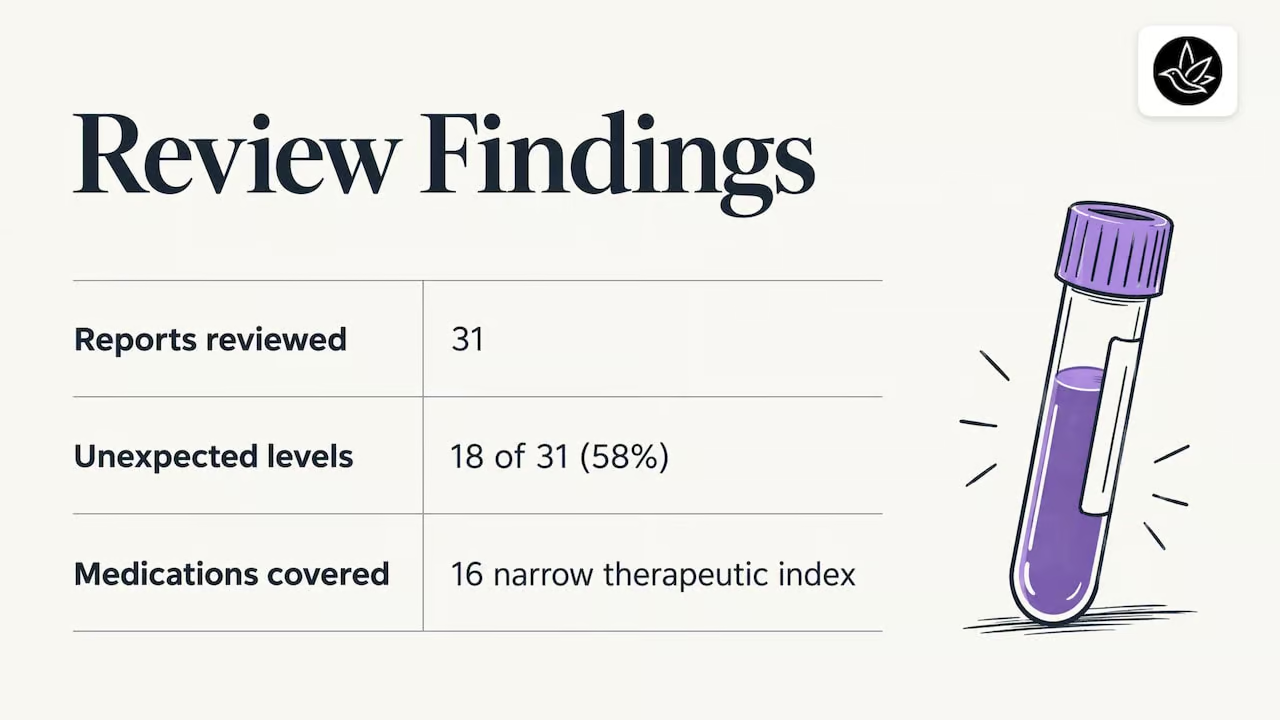
The systematic review looked at 31 reports where cannabinoids altered drug levels or caused adverse events, covering 16 narrow therapeutic index medications. Warfarin, valproate, tacrolimus and sirolimus came up most often and may pose the greatest risk. In 18 of those cases (58%), clinicians discovered an unexpected blood level of the prescribed drug. That is the strongest reason to tell your care team before you begin: they can order a level check or adjust a dose before a problem shows up.
CBD versus THC: do the interactions differ?
Mostly they overlap, with a few differences worth knowing.
- THC is metabolized mainly by CYP2C9 and CYP3A4. The Antoniou review notes that CYP3A4 inhibitors such as ketoconazole nearly doubled THC and CBD concentrations, and that CYP2C9 inhibitors (cotrimoxazole, fluoxetine, amiodarone) would be expected to raise THC exposure and psychoactive effects.
- CBD is metabolized by CYP3A4 and CYP2C19. According to the Merck Manual, taking it with medications that use or block those enzymes can raise concentrations of those medications or of CBD, with increased effects and a greater risk of adverse reactions. The CPhA adds that CBD can inhibit CYP2C19, CYP2D6, CYP3A4 and PGP.
- Sedation is common to both. The Merck Manual notes CBD can cause sleepiness and drowsiness, so combining it with benzodiazepines, phenobarbital, morphine or alcohol can be too much.
So “it’s only CBD” does not mean “it can’t interact.” Many people searching for CBD interactions with medications are surprised by this. For a deeper look at THC specifically, see our guide on THC and medication interactions.
Does smoking, vaping or eating cannabis change the picture?
The route matters in some respects, though no route removes the need to check.
- Smoking. According to the CPhA, smoked cannabis induces CYP1A2, and for drugs processed by that enzyme this can lower their concentrations, while for non-smoked cannabis the same substrates may rise. Smoking also brings cough and bronchitis, which the CPhA lists as smoking-only effects.
- Vaping. The enzymes involved are the same, since the cannabinoids are what matter. Our comparison of vaping versus smoking covers the other differences.
- Edibles, drinks and capsules. Swallowed cannabinoids pass through the digestive system and liver, which is also where many medications are processed. Effects arrive later and last longer, so a stacked sedative effect can show up hours after the dose. Our guide to how long edibles take to kick in explains why waiting matters.
If you take medication with food, or on a schedule, mention how you plan to use cannabis so the timing can be planned around it.
Everyday substances that interact too
Some of the most overlooked items are not medications at all.
- Grapefruit and grapefruit juice. Health Canada lists them, and the CPhA notes that grapefruit juice acts as a CYP3A4 inhibitor that can raise cannabis levels.
- Alcohol. It is a central nervous system depressant, so the effects add up.
- Nicotine. The CPhA notes additive tachycardic and stimulant effects.
- Saint John’s Wort. It appears on Health Canada’s list, and CYP3A4 inducers are noted by the CPhA as reducing cannabis levels.
- Cold and allergy remedies. Health Canada’s guidance for adults over 55 includes allergy and cold medications, heartburn and bladder products among health products that may interact.

Who should be especially careful
Health Canada’s guidance for adults over 55 says the body’s ability to process drugs changes with age, that older adults may be more sensitive to cannabis, and that the risk of side effects is higher, particularly with certain medical conditions. It advises talking with a health care professional first. The same is true if you take several medications at once, since each additional drug adds another possible overlap.
Health Canada also notes that legal cannabis products sold in Canada have not been reviewed by the department to determine whether they are safe or effective for treating specific diseases or symptoms, and that some health risks are not yet fully known. That is a good reason to keep your care team in the loop rather than guess.
Symptoms that could signal an interaction
Health Canada notes that side effects may be due to an interaction between cannabis and other medications or substances. Its side effects page describes possible CBD effects including tiredness or sleepiness, nausea, vomiting, diarrhea or constipation, decreased appetite and liver problems. Signs of liver trouble include fatigue, nausea, vomiting, loss of appetite, abdominal pain, dark urine or jaundice.
Watch for:
- Unusual drowsiness, dizziness or feeling faint
- A racing or irregular heartbeat, which Health Canada’s 2023 adverse reaction report lists among cardiovascular reactions (atrial fibrillation, palpitations, tachycardia)
- Confusion, severe anxiety, paranoia or hallucinations
- Unexpected bruising or bleeding if you take a blood thinner
- Return of symptoms your medication normally controls, such as seizures
If you overconsume and feel unwell, Health Canada’s consumer information page says to call 1-844-POISON-X (1-800-463-5060 in Quebec), call 9-1-1 or go to the nearest hospital. For seizures, severe bleeding, chest pain or fainting, do not wait: seek emergency care.
A safe-use checklist before you start
- Make a full list. Include prescriptions, over-the-counter products, supplements, natural health products, alcohol and nicotine.
- Talk to your pharmacist or doctor. Health Canada advises discussing cannabis use with your health care provider, telling them everything you take, and attending regular follow-ups.
- Name the product. Say whether it is THC, CBD or both, and whether you plan to smoke, vape or eat it.
- Start low and go slow. The CPhA recommends this approach, especially for drugs with a narrow therapeutic index. Our guide to starting at 2.5 mg shows what that looks like with edibles.
- Change one thing at a time. A new product and a new dose together make it hard to tell what caused a reaction.
- Recheck when anything changes. A new prescription, a dose change or a switch in product format is worth another call to the pharmacy.
- Plan around driving and risky tasks. Additive drowsiness is a real concern with sedating medications.
The Antoniou review also advises that when it is clinically feasible, a medication that does not interact should be chosen. That decision belongs to your prescriber, not to you alone, so never stop or change a prescription on your own.
If you are exploring medical access, our overview of how to get medical cannabis in Canada covers the process, and a medical practitioner is the right person to review interactions with you at the same time.
Our perspective
We deliver cannabis every day across Durham Region and the GTA, and the most common thing we hear from new customers is a quiet “I take something for my blood pressure, is this okay?” We are glad when people ask. It is exactly the right question.
Our view is simple. Cannabis works best when it is chosen with care, and care starts with clear product information: the cannabinoid content, the format, the dose. That is why we curate craft cannabis from growers we trust and show the details on every product page, so you can walk into a pharmacist’s office with specifics instead of guesses.
If you are on medication, begin with a low-dose product, give it time, and keep your care team informed. Low-THC and CBD options are available in our range, and our team is committed to compliance and education, so you can shop with confidence.
Nick
Shop with the details in hand
When you have talked it through with your pharmacist or doctor, we have you covered. Browse flower, pre-rolls, vapes, extracts, edibles, drinks and CBD products with full product information, and get one-hour delivery across Durham Region and the GTA.

Shop our full range here and note the format and cannabinoid content for your next pharmacy conversation.
FAQ
What medications should not be taken with weed?
No single list covers everyone, but Health Canada flags blood thinners, anti-seizure medications, immunosuppressants, antidepressants, anti-anxiety medications, antipsychotics, mood stabilizers and sedating drugs as groups that may interact. Alcohol, grapefruit and St. John’s Wort are on the list too. Ask your pharmacist to check your specific medications rather than relying on a general list.
Can CBD interact with medications?
Yes. CBD is metabolized by CYP3A4 and CYP2C19, and the Merck Manual notes it can raise levels of drugs such as clobazam, warfarin, tacrolimus and omeprazole. It can also add to sleepiness from sedatives. Tell your pharmacist you use CBD, even if it is a low-THC product.
Does it matter if I smoke, vape or eat cannabis?
Somewhat. Smoked cannabis induces the CYP1A2 enzyme, which can lower levels of drugs processed by it, while edibles pass through the liver and act later and longer. The same liver enzymes process THC and CBD whatever the route, so check any format with your care team.
Can I use cannabis if I take antidepressants or anxiety medication?
Health Canada lists antidepressants and anti-anxiety medications among substances that may interact with cannabis. Some, such as tricyclics, may reach higher levels with CBD. Speak with your prescriber before combining them, and do not adjust your prescription yourself.
What should I do if I feel unwell after combining cannabis and medication?
Stop using cannabis. If symptoms are mild, contact your pharmacist or doctor. If you feel seriously unwell, call 1-844-POISON-X or 9-1-1, or go to the nearest hospital.
Sources
- Cannabis for medical purposes: General information, Health Canada
- Cannabis for medical purposes: Side effects, Health Canada
- Consumer information: Cannabis, Health Canada
- Health effects of cannabis on adults over 55, Health Canada
- Data on cannabis adverse reactions: 2023 annual report
- Drug interactions with cannabinoids, PMC
- Systematic review of drug-drug interactions of cannabinoids, PMC
- Cannabis and Patient Care in Pharmacy, Canadian Pharmacists Association
- Medical Use of Cannabis and Cannabinoids, CCSA
- Cannabidiol (CBD), Merck Manual Professional Edition