A medical cannabis document is the signed authorization from a doctor or nurse practitioner that lets you access cannabis for medical purposes in Canada. It is not a prescription in the strict sense, but it works like one: you take it to a seller or to Health Canada, and it sets how much you can have. Once you hold a valid one, you can have your medical order delivered, and we deliver medical orders across Canada. Below is what the document must say, who can sign it, and what to do next.
TL;DR
- A medical document is an authorization, not a prescription, because Health Canada does not give cannabis a Drug Identification Number.
- Only a physician or a nurse practitioner can sign one, and some provinces add extra rules for them.
- It must state a daily amount in grams of dried cannabis and a period of use of up to one year.
- You can use it three ways: buy from a federally licensed seller, register with Health Canada to grow your own, or name a designated grower.
- Never take cannabis across the border, even with a document. Check Health Canada’s current rules before any trip.
Table of Contents
- What a medical document is, and how it differs from a prescription
- What a valid document must contain
- Who can sign your medical document
- Three ways to use your document
- Using your document with us
- Travelling with medical cannabis
- Common mistakes with medical documents
- Our perspective
- Ready to order
- FAQ
- Sources
What a medical document is, and how it differs from a prescription
You will hear people say medical cannabis prescription. The correct term is medical document. Physicians do not prescribe cannabis because it is not a Health Canada-registered medication with a Drug Identification Number. What the practitioner signs is an authorization for the use of cannabis for medical purposes.
A peer-reviewed review in the Journal of Pain Research describes the document as only partly like a prescription. It is closer to a recommendation into the medical cannabis program, since Health Canada neither approves nor prescribes the product.
In practice, three things follow:
- The practitioner can guide you on the form, strength and dose. The seller then determines the dispensed form, dose and titration (the gradual adjustment of dose), according to the Canadian family physicians’ guidance.
- Every patient needs a medical document to receive cannabis for medical purposes, as the Canadian Nurses Protective Society puts it.
- A hospital written order is a different thing. It authorizes a stated amount to be dispensed within a hospital and is not the same as a medical document.
What a valid document must contain
This is where most delays happen. A document missing one field can be sent back, and you lose weeks. Section 273 of the Cannabis Regulations lists what it must include:
- the practitioner’s name, profession, business address and phone number (plus fax and email, if they have them)
- the practitioner’s province and authorization number
- your name and date of birth
- the address where you were assessed
- the daily amount of dried cannabis in grams
- the period of use, up to one year
- a signature and a date, with a statement that the information is correct and complete
Health Canada also publishes a sample document that contains every required field. If you are helping your practitioner’s office prepare yours, that sample is a handy checklist.
Your daily amount sets your limits
The daily amount is the number that matters most. According to Health Canada’s information for practitioners, the federal rules do not cap the daily amount a practitioner may authorize. Your possession limit is the lesser of the equivalent of 150 grams or 30 times your daily amount. For these calculations, 5 grams of fresh cannabis equals 1 gram of dried.
Health Canada notes that surveys in the research literature suggest most people who use cannabis therapeutically report using the equivalent of up to 3 grams of dried cannabis per day. Your practitioner sets your number from your assessment. A figure that fits your condition and your actual use is the one to aim for, and it is the one least likely to draw extra attention if you later register to grow.
A worked example
Say your document authorizes 2 grams per day. Thirty times that is 60 grams, which is lower than 150 grams, so 60 grams is your possession limit. If it authorized 6 grams per day, thirty times that is 180 grams, so the 150-gram ceiling applies.
Who can sign your medical document
Under the Cannabis Regulations, a health care practitioner is a medical practitioner or a nurse practitioner who is not restricted by provincial law from authorizing cannabis. The Canadian Nurses Protective Society states that registered nurses, registered practical nurses and licensed practical nurses cannot issue medical documents.
Provinces add their own layers. The family physicians’ guidance notes that several provinces require physicians to:
- state your medical condition on the document
- register with their regulator as a cannabis authorizer
- send a copy to the regulator, or keep it in a separate record
Some provinces also limit authorizing to the physician managing your condition. Nurse practitioners face the same kind of limits: federal law gives them the authority, but each province and professional regulator can restrict it.
What this means for you, in Ontario or anywhere else in Canada: book the appointment with a physician or nurse practitioner who is able to authorize cannabis in your province. Ask at booking whether they authorize cannabis for your condition, so you do not spend a visit finding out they cannot.
What the appointment involves
Health Canada’s municipality guidance describes the first step simply: you visit a practitioner who assesses you. If cannabis is appropriate for you, they give you the signed document, which, like a prescription, indicates a daily amount of dried cannabis in grams.
Bring a short list for the visit:
- your diagnosis and the treatments you have tried
- any medications you take, including over-the-counter ones
- a realistic idea of how you want to use cannabis (inhaled, oral, topical)
- your health card, so the practitioner can record your details correctly
The practitioner decides whether cannabis suits you. Be open about your history, including any heart, lung or mental health conditions, and any other medicines, because that is what lets them set a safe amount.
Three ways to use your document
Health Canada describes three access routes once you hold a signed document:
- Buy from a federally licensed seller for medical purposes.
- Register with Health Canada to produce a limited amount for yourself.
- Designate another person to produce it for you.
For most patients, the first route is the practical one: no equipment, no growing space, no waiting for a harvest. You get products made and tested to a standard, with the dose on the label, which matters when you are titrating slowly.
Routes two and three: producing your own
Personal production is a paperwork route. For a first application or a renewal, Health Canada requires a completed registration form and an original medical document signed by your practitioner. All signatures must be original, and the package is mailed to the Access to Cannabis for Medical Purposes Program in Ottawa. The document must meet every requirement of subsection 273(1).
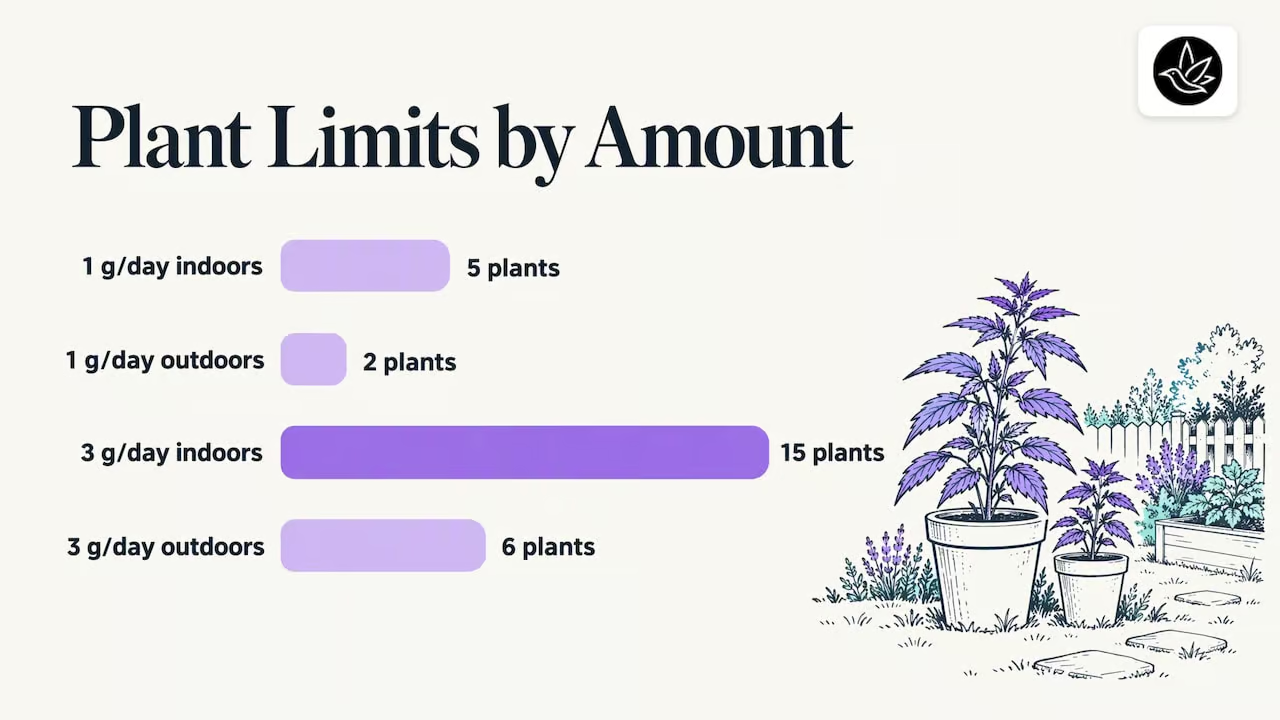
Your authorized daily amount sets how many plants you may grow. Health Canada’s examples: 1 gram per day allows 5 plants indoors or 2 outdoors, and 3 grams per day allows 15 indoors or 6 outdoors. A person may hold up to two registrations, and up to four registrations can exist at one address.
Health Canada also pays attention to this route. In 2022 to 2023 it carried out 170 inspections of personal and designated production registrants and revoked or refused 16 registrations. It applied closer verification where practitioners authorized high daily amounts, or where the growing site was not the applicant’s primary residence. If you plan to grow, make sure the amount on your document and the site you list are both genuine and consistent.
Using your document with us
If you want your medical cannabis delivered, our shop carries flower, pre-rolls, vapes, extracts, edibles, drinks, CBD and accessories, and medical orders ship across Canada. In Durham Region and the GTA, delivery can be as quick as one hour. We have laid out the process in our guides on how shipping works for medical cannabis and getting medical cannabis in Canada.
A practical routine once you have your document:
- Check every field against the list above before you leave the appointment. A missing authorization number or date is far easier to fix while you are still in the room.
- Keep a clean copy at home and a photo on your phone. Do not alter the original, and keep it unfolded and legible.
- Match your name and date of birth to your government ID. A mismatch, such as a nickname or a different spelling, is a common reason for a hold-up.
- Order within your authorized amount. Your daily gram figure and possession limit are the ceiling, not a target.
- Plan renewal early. The document lasts up to one year at most, so book the follow-up before it runs out, not after.
Start low with new products. Edibles in particular can take from 30 minutes to four hours to take effect, which is why we wrote about how long edibles take to kick in, and why a 2.5 mg starting dose is a sensible habit, as we explain in our THC and CBD edibles guide.
Travelling with medical cannabis
This is where patients get caught out, so be clear on one point. The Canada Border Services Agency warns that bringing cannabis across the border in any form, including THC or CBD oils, without a Health Canada permit or exemption is a serious criminal offence. A doctor’s note does not count as Health Canada authorization. Health Canada’s laws and regulations page also says that taking cannabis across the border is illegal, including cannabis for medical purposes.
Federal regulations were amended in 2025 and the changes took effect on 1 October 2026, so look at Health Canada’s official page for the rules that apply to your trip before you pack. For travel within Canada, including flights, see our guide to flying with cannabis in Canada. If you will be away from home, you may find it simpler to have your order shipped to where you are staying, which our medical cannabis shipping page explains.
Common mistakes with medical documents
- Expired period of use. The one-year maximum is firm. An expired document is not a valid one.
- Unsigned or undated copies. The document must be signed and dated by the practitioner.
- Photocopies for Health Canada registration. For personal production, signatures must be original.
- Assuming every clinician can sign. Nurses who are not nurse practitioners cannot.
- Treating the daily amount as a goal. It is a ceiling that also drives your possession and plant limits.
Our perspective
We hear the same thing from new patients: the paperwork feels harder than the cannabis itself. It does not need to be. A medical document is one page with a short list of required fields, and once you know that list, you can check it yourself in two minutes.
What we care about is what happens after. A patient with a valid document should be able to order without friction, get clear product information, and receive it quickly and discreetly. That is why we offer medical orders with delivery across Canada, and one-hour delivery in Durham Region and the GTA. It is also why we publish plain guides on dosing, edibles and shipping: we want you to feel confident, not rushed.
Our selection is curated from craft growers, and our customers have rated us 4.9 stars on Google. We take compliance seriously and we think education is part of good service. If you hold a document, or you are about to, we have you covered.
Nick
Ready to order
With your document in hand, you can browse flower, vapes, extracts, edibles, drinks and CBD in our online shop. We add new craft products through weekly drops, and our product pages carry the detail you need to choose.
If you are in Durham Region or the GTA, ask about one-hour delivery at checkout. Elsewhere in Canada, medical orders are shipped to you.
FAQ
Is a medical cannabis document the same as a prescription?
No. Cannabis has no Drug Identification Number, so physicians authorize rather than prescribe it. The document is signed and states a daily amount, like a prescription, but it is an authorization for medical use.
How long is a medical document valid?
The period of use can be up to one year, according to section 273 of the Cannabis Regulations. Your practitioner writes the actual period on the document, so check the date and book your renewal before it ends.
Who can give me a medical document?
A physician or a nurse practitioner who is not restricted by provincial law. Registered nurses and licensed practical nurses cannot. Some provinces add requirements such as registering as a cannabis authorizer, so ask the clinic whether they authorize cannabis before you book.
How many grams can I have with a medical document?
Your possession limit is the lesser of the equivalent of 150 grams or 30 times your authorized daily amount, per Health Canada. For example, 2 grams a day gives you a limit of 60 grams.
Can I take my medical cannabis on a trip outside Canada?
No, not without Health Canada authorization, and a doctor’s note is not that. Crossing the border with cannabis is a serious offence, so check Health Canada’s current travel rules first.
Sources
- Guidance in Authorizing Cannabis Products Within Primary Care, College of Family Physicians of Canada
- Medical cannabis, the Canadian perspective, Journal of Pain Research
- Access to Cannabis for Medical Purposes: What Every Nurse Should Know
- Cannabis Regulations, section 273
- Information for Health Care Practitioners, Health Canada
- Information for municipalities: Medical use of cannabis, Health Canada
- Registration with Health Canada: Production of Cannabis for Own Medical Purposes
- Compliance and enforcement report 2022 to 2023, Health Canada
- CBSA travel tips news release, 26 June 2023
- Cannabis laws and regulations, Health Canada