
Ontario AGCO cannabis rules: your 2026 compliance guide

- Ontario’s AGCO regulates cannabis retail by requiring licenses, strict operational standards, and compliance enforcement. Retailers must obtain both an Operator and Store license, source products from the Ontario Cannabis Store, and follow rules on store hours, security, and delivery. Non-compliance can lead to license suspension or revocation, with serious penalties for violations.
Ontario AGCO cannabis rules define the licensing, operational, and compliance framework for every legal cannabis retailer in the province. The Alcohol and Gaming Commission of Ontario, known as the AGCO, is the regulatory body responsible for overseeing cannabis retail under the Cannabis Licence Act, 2018. Whether you are a consumer wanting to know your rights or an operator building a retail business, understanding these rules protects you from costly mistakes. The legal purchase age is 19 years, and only licensed retailers and the Ontario Cannabis Store are authorised to sell cannabis in the province.
What licences does Ontario AGCO require to sell cannabis?
Operating a legal cannabis retail business in Ontario requires two separate authorisations from the AGCO. Two licences are mandatory: a Retail Operator Licence (ROL) and a Retail Store Authorization (RSA). The ROL approves you as a qualified operator, and the RSA authorizes a specific physical store location. You cannot open a store with only one of the two.
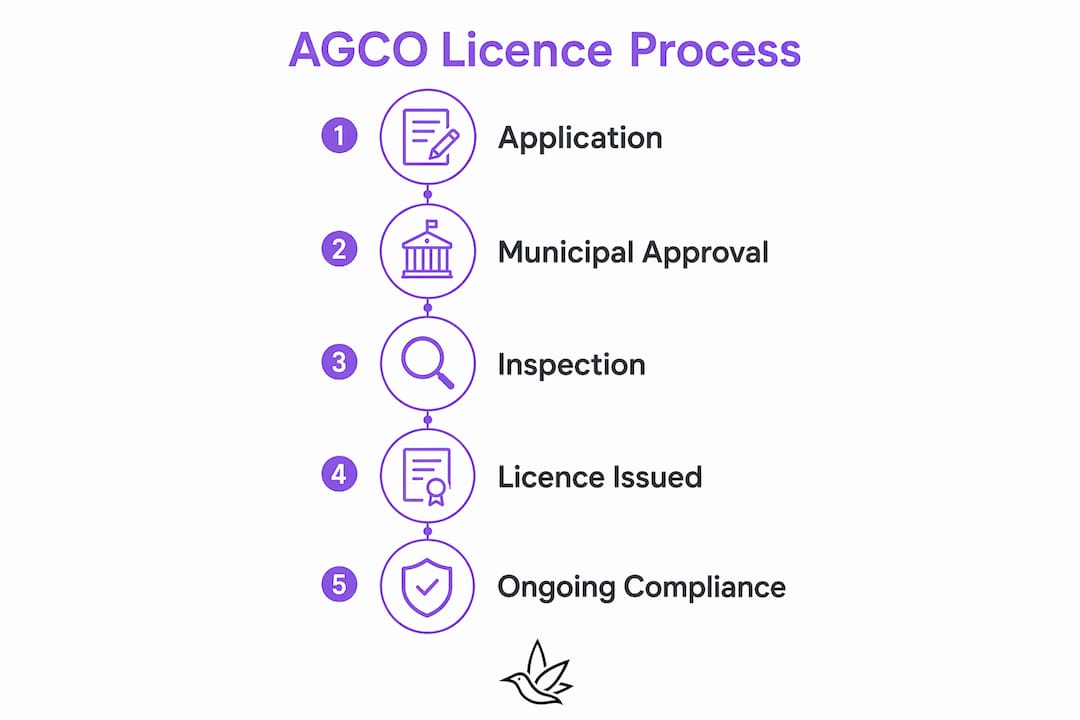
The application process involves several layers of scrutiny. The AGCO evaluates applicants not only on their business plans but also on their demonstrated ability to run a store responsibly, with a strong focus on safety and compliance. Here is what the process requires:
- Retail Operator Licence (ROL): Submit a completed application, pay the required fee, and pass a background check covering criminal history and financial integrity.
- Retail Store Authorization (RSA): Apply for each store location separately, provide proof of a valid lease or property agreement, and confirm the site meets municipal zoning requirements.
- Retail Manager Licence: Any person managing day-to-day store operations must hold this licence, which also requires a background check.
- CannSell certification: Every employee who handles cannabis or interacts with customers must complete the CannSell training programme, Ontario’s mandatory cannabis retail staff certification.
- Proof of funding: Applicants must demonstrate they have sufficient, legitimate funds to open and operate the business.
The table below summarises the three core licences and their primary requirements.
| Licence type | Who needs it | Key requirement |
|---|---|---|
| Retail Operator Licence (ROL) | Business owner or entity | Background check, proof of funds |
| Retail Store Authorization (RSA) | Each store location | Zoning compliance, lease documentation |
| Retail Manager Licence | Store manager | Background check, management experience |
Pro Tip: Verify municipal zoning before you sign a lease. Some Ontario municipalities have opted out of allowing cannabis retail entirely, and discovering this after committing to a location wastes significant time and money.
What are the operational rules for cannabis retail stores?
Licensed stores carry ongoing compliance obligations that go well beyond the initial application. The AGCO sets clear standards for daily operations, and continuous compliance is mandatory, covering everything from store hours to advertising practices.
The core operational requirements include:
- Store hours: Retailers may open as early as 7:00 AM and must close by 11:00 PM, seven days a week.
- Inventory sourcing: All cannabis products must be purchased exclusively from the Ontario Cannabis Store (OCS), the province’s sole wholesale distributor. No other supply source is permitted.
- Age verification: Staff must check government-issued photo ID for every customer who appears to be under 25 years old. Accepted ID includes a driver’s licence, passport, or provincial ID card.
- Advertising restrictions: Stores cannot use advertising that appeals to youth, makes health claims, or offers inducements such as discounts tied to purchase volume.
- Security standards: Licensed stores must maintain security cameras, controlled entry points, and proper storage for cannabis products.
The AGCO enforces these rules through unannounced mystery shopper audits, where trained compliance officers visit stores posing as customers. These audits test age verification procedures, staff conduct, and product handling. Failing a mystery shopper audit can trigger a formal compliance review and, in serious cases, licence action. This programme runs during all store hours, including slow periods when staff may be less vigilant.
Pro Tip: Build age verification into your point-of-sale workflow so it cannot be skipped. A digital prompt requiring staff to confirm ID was checked before completing a transaction adds a reliable layer of accountability.

For consumers, understanding cannabis safety recalls in Ontario is equally important, since the AGCO and Health Canada coordinate on product safety issues that affect licensed stores.
How does cannabis delivery work under AGCO regulations?
Cannabis delivery in Ontario is tightly regulated to prevent diversion and protect public safety. The rules are specific and non-negotiable for licensed retailers.
Key delivery requirements include:
- Who can deliver: Deliveries must be made only by the licensed store itself or its direct employees. Third-party couriers and delivery platforms are not permitted.
- Permitted hours: Delivery is allowed from 9:00 AM to 11:00 PM. This window is narrower than in-store hours, which begin at 7:00 AM.
- Delivery destinations: Cannabis may only be delivered to a private residence or another private place. Deliveries to public spaces are prohibited.
- Curbside pick-up: Stores offering curbside pick-up must ensure the pick-up area is covered by security surveillance. Staff must verify the customer’s age and identity at the point of pick-up, not just at the time of ordering.
- Record-keeping: Stores must maintain detailed records of every delivery and pick-up transaction, including the customer’s identity verification and the time of delivery.
These rules mean that legal cannabis delivery in Ontario operates very differently from food delivery apps. The licensed retailer bears full responsibility for every order from the moment it leaves the store to the moment it reaches the customer’s door.
What are the penalties for breaking Ontario cannabis regulations?
Non-compliance with AGCO cannabis regulations carries serious consequences. The AGCO has broad enforcement powers, and licence suspensions and revocations are the primary tools used against operators who break the rules.
Common violations that trigger enforcement action include:
- Operating a cannabis retail store without a valid ROL or RSA
- Failing to pay required licence fees on time
- Sourcing cannabis from any supplier other than the OCS
- Failing to verify customer age during a sale
- Ignoring standards set by the Registrar of the AGCO
- Allowing unlicensed staff to sell or handle cannabis
The AGCO distinguishes between suspension and revocation. A suspension is temporary and may come with conditions the operator must meet before reopening. A revocation permanently cancels the licence. Both actions follow a formal notice process, except in urgent situations.
The AGCO may issue an immediate suspension order without advance notice when public safety is at risk. Operators receive written notice after the fact and have the right to appeal, but the store must cease operations immediately upon receiving the order.
Maintaining an AGCO licence is an ongoing responsibility, not a one-time achievement. Operators who treat compliance as a background task rather than a daily priority are the ones most likely to face enforcement action. Keeping licence information current, including changes to ownership, location, or management, is a legal obligation.
Key takeaways
Ontario AGCO cannabis rules require licensed operators to hold both an ROL and an RSA, source all inventory from the OCS, verify customer age at every transaction, and maintain strict delivery and security standards to avoid suspension or revocation.
| Point | Details |
|---|---|
| Two licences required | Every cannabis retailer needs both an ROL and an RSA before opening. |
| OCS is the only supplier | All inventory must come from the Ontario Cannabis Store, no exceptions. |
| Age limit is 19 years | Customers must be 19 or older; staff must check ID for anyone appearing under 25. |
| Delivery has strict limits | Only store employees can deliver, from 9:00 AM to 11:00 PM, to private locations only. |
| Non-compliance risks licence loss | The AGCO can suspend or revoke licences, including immediately if public safety is at risk. |
What I’ve learned from watching operators get AGCO compliance wrong
The single most common mistake I see is operators treating the licence application as the finish line. They put enormous effort into the paperwork, pass their background checks, get their CannSell certifications in order, and then relax. That is exactly when things start to go sideways.
Municipal zoning is the issue that catches people off guard most often. Operators sign leases, spend money on build-outs, and then discover their municipality opted out of cannabis retail. Checking zoning is a 30-minute task that can save you six figures in wasted investment. Do it before you do anything else.
The mystery shopper programme is also more active than most operators expect. The AGCO does not telegraph when audits are coming, and they specifically target quieter periods when staff may be less focused. I have seen stores with strong compliance records fail an audit simply because a tired employee skipped the ID check for a customer who looked older. Build the check into your system so it is automatic, not optional.
Regulatory changes also move faster than many retailers track. Staying current with AGCO updates, whether on store hours, advertising rules, or product categories, requires a dedicated internal process. Assign someone on your team to monitor AGCO communications. That one step prevents a lot of avoidable surprises.
— Nick
Montrosecannabis: compliant cannabis delivery across Ontario
Montrosecannabis operates fully within Ontario AGCO cannabis regulations, offering same-day delivery across the Durham Region and GTA with a 4.9-star Google rating built on trust and consistency.
Whether you are a consumer looking for craft cannabis delivered to your door or a retailer exploring wholesale cannabis options that meet provincial sourcing standards, Montrose Cannabis has you covered. Every product in the catalogue comes from licensed producers and is fully compliant with Health Canada and AGCO requirements. You can also browse the Montrose Cannabis journal for ongoing guides on Ontario cannabis regulations, product education, and compliance updates written for both consumers and industry readers.
FAQ
What is the AGCO’s role in Ontario cannabis retail?
The AGCO is the provincial regulator that issues licences, sets operational standards, and enforces compliance for all legal cannabis retail stores in Ontario under the Cannabis Licence Act, 2018.
What is the legal age to buy cannabis in Ontario?
The Ontario cannabis age limit is 19 years. Licensed retailers must verify government-issued photo ID for any customer who appears to be under 25.
Can a cannabis store in Ontario use a third-party delivery service?
No. AGCO regulations require that deliveries be made only by the licensed store or its own employees, not by third-party couriers or app-based delivery platforms.
What happens if a cannabis retailer fails an AGCO inspection?
The AGCO can issue a formal proposal to suspend or revoke the licence, or in urgent cases, issue an immediate suspension order without advance notice. Operators have the right to appeal.
Do home growers need an AGCO licence in Ontario?
No. Ontario home grow rules allow adults 19 and older to grow up to four cannabis plants per household for personal use without an AGCO licence, in line with federal rules under the Cannabis Act.