Mixing weed and alcohol makes you more impaired than either one does alone, and it makes the experience harder to predict. Health Canada says the combination greatly increases impairment and the risk of injury or death from accidents. Below, we explain what happens in your body, whether the order matters, how long the effects last, what Ontario’s driving rules say and how to look after yourself and your friends.
TL;DR
- Cannabis and alcohol together compound impairment. Nausea, vomiting, dizziness, anxiety and panic are the common reactions.
- Order does not make it safe. Drinking first can push THC levels higher, and using cannabis first can hide how drunk you really are.
- Impairment can last 6 hours or more, and longer when the two are combined. Plan a ride home before you start.
- Ontario has a specific offence for alcohol plus THC in the blood within two hours of driving, plus zero tolerance for some drivers.
- Health Canada’s advice is simple: avoid mixing cannabis with alcohol or other substances.
Table of Contents
- What actually happens when you combine them
- Does weed make alcohol hit harder, or the other way around?
- Does the order matter?
- Edibles, drinks and the delay problem
- How long does the impairment last?
- Driving after weed and alcohol in Ontario
- How to lower the risk if you’re going to use both anyway
- Our perspective
- Choosing cannabis for a night without the alcohol
- FAQ
- Sources
What actually happens when you combine them
Both cannabis and alcohol act as central nervous system depressants. Dr. Diana Martins-Welch of Northwell Health explains that even low-dose cannabis can affect motor function, balance and cognition, and that adding alcohol compounds those effects. You can end up with unexpected sedation, dizziness, vomiting or panic.
The Province of Manitoba’s public health guidance lists increased nausea, vomiting, panic, anxiety and paranoia among the side effects of combining the two. It also notes that the substances affect people in different ways. Either one can feel stronger than expected, or you can get a reaction you have never had before.
That unpredictability is the real issue. You might have a comfortable sense of what two drinks does to you, and a comfortable sense of what a joint does. Put them together and neither number tells you much. People call the result “crossfading”, and it often shows up as the spins, a cold sweat, a heavy head and a sudden need to lie down.
What it can feel like
- A wave of dizziness or spinning when you stand up
- Nausea that arrives quickly, sometimes followed by vomiting
- Sweating, pale skin and a pounding heart
- Racing thoughts, anxiety or paranoia
- Heavy drowsiness, or trouble tracking a conversation
- Poor memory of the night afterward
If you feel any of these, stop using both, sit or lie down somewhere safe, sip water and ask a friend to stay with you. If someone is vomiting repeatedly, can’t be woken, has trouble breathing or is confused and getting worse, call 911.
Does weed make alcohol hit harder, or the other way around?
The science points both ways, which is why the mix is so hard to read. A 2017 review in PMC described two-way interactions. Cannabis slowed alcohol absorption, while a second study found plasma THC levels were significantly higher when people drank first.
A 1992 laboratory study found that after high-dose cannabis, peak blood alcohol was lower and came later than without it. A 2022 review reported that significantly higher blood THC and 11-hydroxy-THC are detected when alcohol is present. The authors say this may explain the extra impairment usually seen with the combination.
In plain terms:
- Alcohol can raise how much THC reaches your blood. Your high can come on stronger than you planned.
- Cannabis can delay the rise in blood alcohol. You may feel less drunk than you are, and keep drinking.
That second point matters most. Delayed alcohol absorption does not mean less alcohol. It means the effect catches up later, often after you’ve had more than you meant to.
Does the order matter?
A lot of people ask whether it’s better to smoke before you drink, or the reverse. Healthline summarizes the pattern this way. Drinking first can increase THC absorption, which may lead to a stronger high or a “green out” with sweating, dizziness, nausea and vomiting. Using weed first may slow alcohol absorption, so you feel less intoxicated than you really are and risk overdoing it.
So neither order is a safe order. The honest answer is that sequence changes which problem you’re likely to meet, not whether you meet one. Our advice on a night out is the same either way: pick one, and keep it modest.
| Sequence | What may happen | What to watch for |
|---|---|---|
| Alcohol first, then cannabis | Higher THC absorption, stronger or faster high | Green out, dizziness, nausea, panic |
| Cannabis first, then alcohol | Slower rise in blood alcohol, feeling less drunk than you are | Drinking more than planned, poor judgment |
| Both at the same time | Compounded impairment, unpredictable mix | Sedation, vomiting, loss of coordination |
Edibles, drinks and the delay problem
Edibles deserve their own warning. They take longer to work and longer to peak, so there is more time to add a drink while you wait. The Northwell piece notes that edibles can take 90 minutes or more to fully peak, which is exactly when people decide that nothing is happening and reach for another round.
If you use edibles, give them time before you do anything else. Our guide to how Canadian edibles kick in explains the range, and how long edibles last covers the other end of the timeline. If you want to keep the experience gentle, starting at a low dose helps, and starting edibles at 2.5 mg is a sensible place to begin for many people.
Cannabis-infused drinks are the same story. They look like a beer or a soda, so it’s easy to treat them as one more drink in the evening. Count them as cannabis, not as a beverage, and don’t stack them with alcohol.
How long does the impairment last?
Ontario’s official page says impairment from cannabis is almost immediate and can last up to 6 hours or more. It adds that the effects can last longer when cannabis is combined with alcohol.
A 2021 review notes that THC in plasma typically peaks within 5 to 30 minutes of consumption and tapers over two to four hours. Impairment may persist for three to six hours, depending on the route and the person. With edibles the timeline is slower and longer, and alcohol layers its own curve on top.
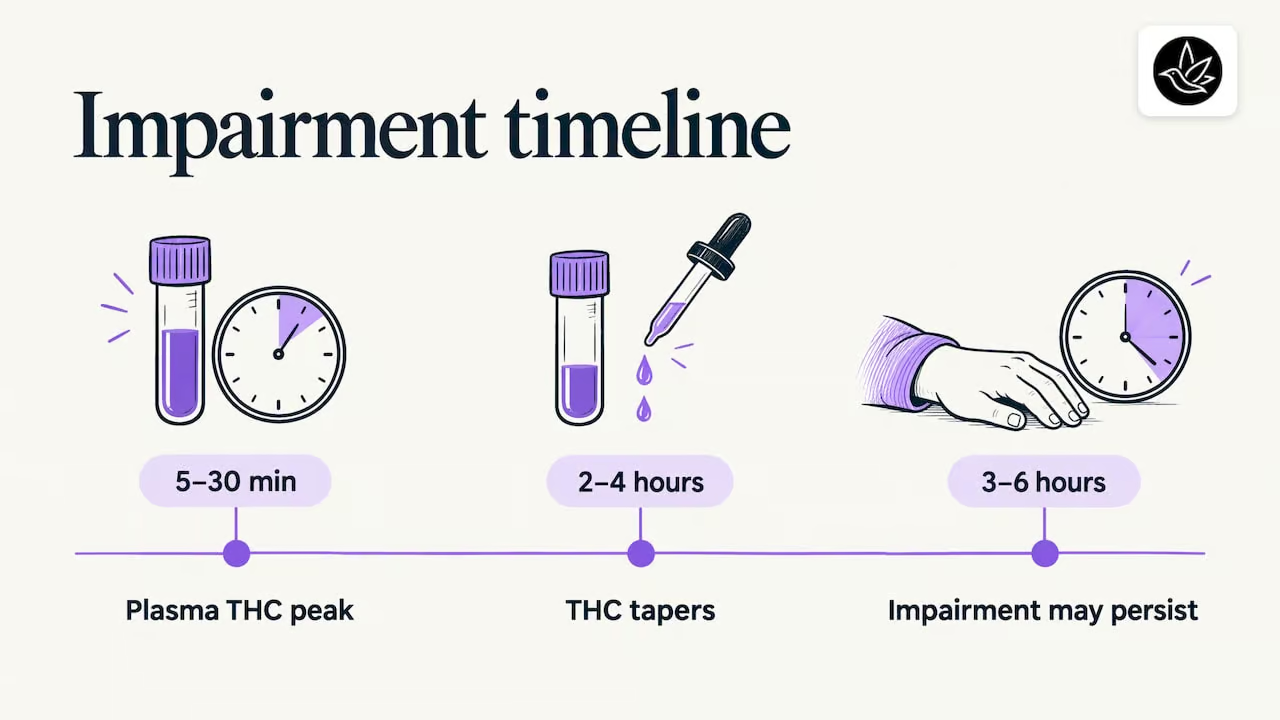
The 6-hour figure comes up a lot. Health Canada’s Lower-Risk Cannabis Use Guidelines FAQ explains it is a minimum, conservative estimate of when driving-relevant impairment subsides, and that applicable laws override the recommendation. Treat it as a floor, not a guarantee.
Driving after weed and alcohol in Ontario
The short answer: don’t. Research is blunt on this. A 2022 meta-analysis found the combination caused greater driving performance decline than either drug alone, including more drifting within the lane and more time out of lane compared with alcohol only. A 2020 review found strong evidence that even low levels of alcohol cause significant impairment when combined with cannabis.
The legal lines
Under the federal legislation, as summarized by Toronto Police Service, there are three offences for having a prohibited concentration in your blood within two hours of driving:
- 2 ng but less than 5 ng of THC per ml of blood
- 5 ng or more of THC per ml of blood
- 50 mg of alcohol per 100 ml of blood plus 2.5 ng or more of THC per ml
The third one is the combined offence, and it sets a lower THC threshold precisely because the two substances stack.
Ontario also applies zero tolerance. According to ontario.ca, no cannabis is allowed in your system if you are 21 or under, hold a G1, G2, M1 or M2 licence, drive a vehicle that requires an A to F licence or a CVOR, or operate a road-building machine. The same page stresses that barely high is still too high to drive, and that there is no way to know exactly how long to wait, even if you think the high has worn off.
One more point from the 2021 review: a person can exceed legal THC limits even after waiting six hours. Regular users in particular should not assume that a clear head means a clear blood test.
How to lower the risk if you’re going to use both anyway
Health Canada’s advice is to avoid mixing cannabis with alcohol or other substances. The same page says to arrange a safe way home ahead of time instead of driving. The Public Health Agency of Canada’s 10 ways to reduce risks repeats the point: wait at least six hours, and remember that combining the two makes you more impaired.
If you’re planning an evening and want to keep it manageable, here’s a practical checklist:
- Choose one substance for the night. This is the single most effective step.
- Plan your ride before the first sip or puff. A designated sober driver, a taxi, a rideshare or transit. Decide first, not at midnight.
- Go low and slow. If you do use cannabis, start with a small amount and wait. With edibles, wait well past the point you think nothing is happening.
- Don’t chase the feeling. If cannabis seems to have dulled the alcohol, that is a reason to stop drinking, not to keep going.
- Eat and drink water. It won’t cancel impairment, but it helps you feel steadier.
- Stay with people you trust. Tell a friend what you’ve had.
- Skip it entirely if you take certain medications. Check our guide to weed and medication interactions and speak with your pharmacist or doctor.
If you read French, our guide on cannabis and alcohol covers the same ground.
When to get help
Call 911 if someone who has mixed the two can’t be woken, is breathing slowly or irregularly, has a seizure or keeps vomiting. For a regular pattern of using both to cope with stress, sleep or mood, talk to your family doctor or a pharmacist. Dr. Martins-Welch warns that mixing regularly may signal self-medication and can slide into dependence.
Our perspective
We hear this question a lot, usually from people who are planning a night with friends and want to do it right. Our answer is the one we’d give a friend: keep it to one thing, and make that choice on purpose.
We built Montrose around fast, reliable access to quality cannabis and around clear information, because informed customers have better experiences. That includes being honest that cannabis and alcohol are a harder combination to predict than either alone. Health Canada’s guidance is to avoid mixing them, and we stand behind it.
If cannabis is your choice for the evening, plan it like you’d plan anything else you care about. Pick a product and dose you know, give it time to work, and have your ride home sorted. Our team can walk you through product types and potency so you know what you’re getting before it arrives.
Nick
Choosing cannabis for a night without the alcohol
If you’d like to keep your evening simple, we’ve got you covered. We deliver recreational cannabis across Durham Region and the GTA, with one-hour delivery, and offer medical orders Canada-wide. Our shop carries flower, pre-rolls, vapes, extracts, edibles, drinks and CBD, so you can choose a format that fits how you want the night to go. Browse the full range in our online cannabis shop.

Not sure what suits you? Product pages carry the details on format and strength, and our guides on edibles versus smoking explain why different formats feel different. You must be an adult to order, and delivery is only available where it’s legal.
FAQ
Does weed make you more drunk?
It can feel that way, and it can also hide how drunk you are. Research shows alcohol can raise blood THC levels, which strengthens the high, while cannabis can slow the rise of blood alcohol, so the effect arrives later. Either way, total impairment is greater than from one substance alone.
Is it better to smoke weed before you drink?
No order is safe. Using weed first may delay alcohol absorption, so you feel less intoxicated than you are and may drink more. Drinking first can increase THC absorption and trigger a green out. The lowest-risk choice is picking one for the night.
What do alcohol and weed feel like together?
Common reactions include dizziness, nausea, vomiting, sweating, anxiety, paranoia and heavy sedation. Provincial public health guidance also notes that the effects can be unpredictable. If you feel unwell, stop, sit down, drink water and have someone stay with you.
How long should I wait to drive after using both?
Health Canada suggests at least 6 hours after cannabis as a minimum, and effects can last longer when combined with alcohol. Ontario’s guidance says there’s no reliable way to know when it’s safe, so arrange a ride instead. Some drivers, including those 21 or under and G1, G2, M1 or M2 licence holders, must have no cannabis in their system.
Sources
- Cannabis impairment and safety risk, Health Canada
- Cannabis in Manitoba: liquor and cannabis
- Mixing Cannabis Gummies and Alcohol? The Well by Northwell
- Alcohol and Weed: What Happens When They Mix, Healthline
- Co-use of Alcohol and Cannabis: A Review
- Marihuana attenuates the rise in plasma ethanol levels, PubMed
- Patterns of Cannabis and Alcohol Co-Use, PMC
- Understanding cannabis health effects: how to reduce your risk, Health Canada
- Lower-Risk Cannabis Use Guidelines FAQ, Health Canada
- Cannabis and your health: 10 ways to reduce risks, Public Health Agency of Canada
- Cannabis Legalization, Toronto Police Service
- Cannabis and driving, ontario.ca
- Impaired driving and legalization of recreational cannabis, PMC
- Cannabis-impaired driving and Canadian youth, PMC
- The effects of cannabis and alcohol on driving performance, systematic review