
TL;DR:
- Cannabis seed to sale is a federally mandated tracking process that monitors every stage from cultivation to consumer sale. Businesses must maintain internal inventory systems, reconcile data weekly, and comply with both federal and provincial regulations to avoid license suspension. Recent regulatory changes in 2025 eased reporting burdens but increased the importance of accurate record-keeping and provincial compliance.
Cannabis seed to sale is defined as the federally mandated tracking process that monitors every cannabis plant, product, and sale from cultivation through to the final consumer transaction. In Canada, this system operates through the Cannabis Tracking and Licensing System (CTLS), which Health Canada uses to prevent illegal diversion and protect public health. Understanding what is cannabis seed to sale is not optional for licence holders. It is the legal backbone of the entire cannabis supply chain, and getting it wrong can cost you your licence.
What stages are included in the cannabis seed-to-sale process?
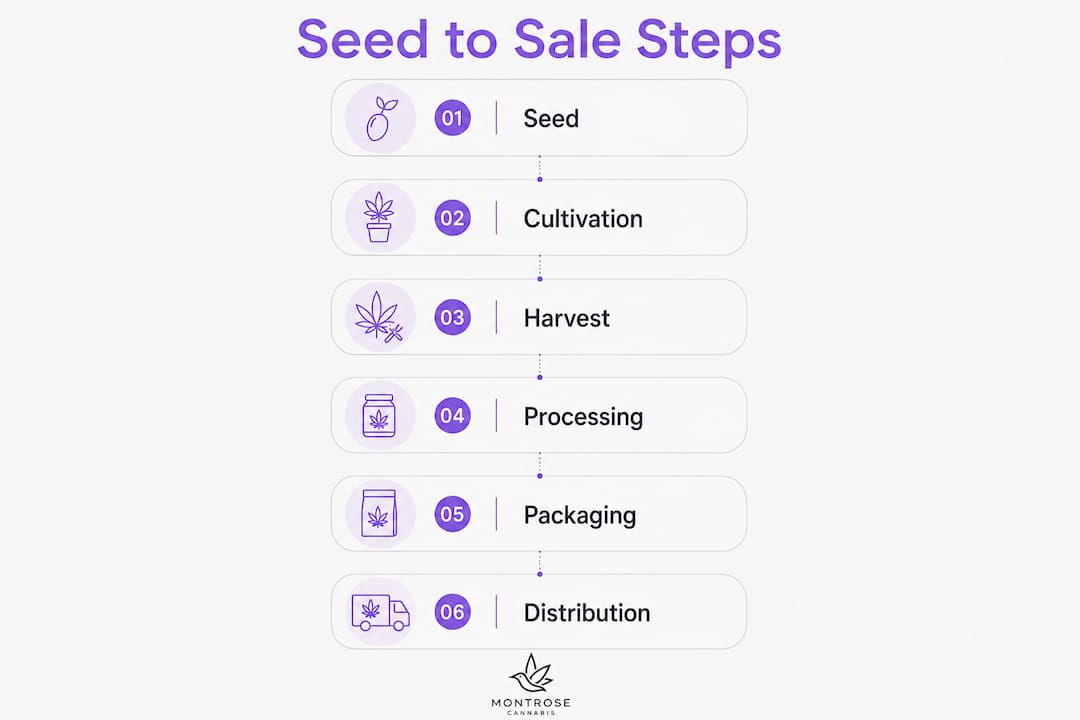
The seed-to-sale process covers six distinct stages, each requiring detailed tracking and reporting to Health Canada. Missing a single stage creates a gap that regulators can identify during audits.
-
Cultivation. Every seed planted and every plant growing must be counted and reported. This includes nursery operations, cloning, and mother plants. Plant numbers feed directly into your monthly CTLS submission.
-
Processing and manufacturing. Once harvested, cannabis moves into processing. This covers drying, trimming, extraction, and the production of concentrates, edibles, and other formats. Each batch receives a unique identifier that follows it through the rest of the supply chain.
-
Packaging and labelling. Products must meet Health Canada’s strict packaging requirements before they can move to distribution. Labels must include lot numbers, THC and CBD content, and licensed producer information.
-
Inventory management. All finished goods must be tracked by weight, unit count, and product category. CTLS records must match your physical stock at all times.
-
Distribution. Moving product to provincial distributors or retail partners triggers another reporting obligation. Each transfer must be logged with the receiving party’s licence number and the quantity shipped.
-
Final sale and point-of-sale reporting. Sales data, broken down by province, must be captured and submitted monthly. This is where the supply chain closes and the tracking loop is complete.
Pro Tip: Assign a dedicated compliance officer to own each stage of this process. Businesses that treat CTLS reporting as a shared responsibility often find gaps during audits.
How does the Cannabis Tracking and Licensing System (CTLS) work?
The CTLS is the federal government portal where all cannabis inventory and sales data must be reported and reconciled. Health Canada requires monthly reporting through CTLS even when no sales or inventory changes occur. In those cases, licence holders submit an attestation confirming their status. This monthly cadence applies to every active licence holder without exception.

A critical point that trips up many operators: CTLS is not an inventory management system. It is a regulatory reporting portal. Businesses must maintain their own internal inventory systems and then reconcile that data against what they submit to CTLS. Discrepancies between reported and actual inventory can trigger a licence suspension.
| CTLS reporting category | What you report |
|---|---|
| Plants and seeds | Count of active plants, seeds in storage, and nursery stock |
| Processed inventory | Weight of dried flower, extracts, and finished products by category |
| Sales data | Units and weight sold, broken down by province or territory |
| Transfers | Shipments to other licence holders or provincial distributors |
| Recalls and isolations | Batch numbers flagged for safety or quality issues |
The system also supports batch isolation and forensic traceability, which means regulators can trace any product back to the specific cultivation batch if a safety issue arises. This is what makes rapid product recalls possible. A contamination event that might take weeks to investigate in an untracked industry can be resolved in hours when full traceability exists.
Pro Tip: Reconcile your internal inventory against your CTLS data weekly, not monthly. Catching discrepancies early is far less painful than explaining them to a Health Canada inspector.
What regulatory updates affect seed-to-sale compliance in 2025 and 2026?
The federal government made meaningful changes to cannabis regulations starting in march 2025, with the goal of reducing administrative burden on licence holders without weakening oversight. These changes affect cultivators, processors, and retailers differently.
Key changes that took effect in 2025 and carry into 2026:
- Product notices removed. Licence holders no longer need to submit notices of new products before bringing them to market. This removes a significant pre-launch delay for producers.
- Promotional expense reports eliminated. Annual reports on promotional spending are no longer required, reducing financial reporting obligations.
- Plant trimming waste reporting removed. Cultivators and processors no longer need to report plant trimmings waste in their monthly submissions. This was a particularly burdensome requirement for large-scale growers.
- Packaging flexibility expanded. Regulations now permit different coloured lids and transparent packaging materials, giving producers more branding options while staying compliant.
- Cannabis pollen distribution rules updated. New licensing provisions clarify how pollen can be distributed between licence holders, supporting breeding programmes.
These changes reflect a broader recognition that reducing reporting burdens supports the long-term sustainability of small and medium cannabis businesses. Fewer administrative requirements mean more resources directed toward cultivation quality, product development, and compliance where it counts most.
How do federal and provincial rules interact in the seed-to-sale process?
The Cannabis Act sets the federal baseline through CTLS, but provinces and territories layer their own distribution and retail tracking requirements on top. Federal licence holders do not automatically have retail access. They must navigate each province’s retail rules and reporting systems alongside their CTLS obligations.
This creates a dual compliance reality. A licensed producer in Ontario selling to British Columbia must satisfy both CTLS federal reporting and the provincial distributor’s tracking requirements in each market. Provincial systems introduce extra compliance layers that vary significantly by jurisdiction.
| Jurisdiction | Distribution model | Key compliance layer |
|---|---|---|
| Ontario | Ontario Cannabis Store (OCS) controls wholesale | OCS inventory and sales reporting |
| British Columbia | BC Cannabis Stores handles distribution | BC-specific product listing and tracking |
| Alberta | Private retail with AGLC oversight | AGLC reporting and product registration |
| Quebec | SAQ subsidiary manages distribution | Société québécoise du cannabis (SQDC) systems |
Understanding provincial delivery regulations is particularly relevant for businesses operating direct-to-consumer models, where the final distribution leg triggers both federal and provincial reporting obligations. The practical advice here is straightforward: treat each province as a separate compliance environment and build your reporting workflows accordingly.
What practical steps help businesses maintain seed-to-sale compliance?
Compliance is not a one-time setup. It is an ongoing operational discipline that requires systems, training, and regular review.
-
Build an internal inventory system first. CTLS is a reporting portal, not a management tool. Choose a dedicated cannabis inventory management platform that tracks batch numbers, weights, and transfers in real time, then use that data to populate your monthly CTLS submissions.
-
Reconcile weekly. Match your physical stock counts against your internal system and your CTLS data every week. Weekly reconciliation catches errors before they become reportable discrepancies.
-
Monitor regulatory updates through official channels. Health Canada publishes regulatory amendments on Canada.ca. Subscribe to their cannabis industry updates and review the cannabis lot number system to understand how batch traceability connects to recall obligations.
-
Train every staff member who touches inventory. A single mislabelled batch or unrecorded transfer can create a compliance failure. Training is not a one-time event. Run refresher sessions whenever regulations change.
-
Document everything. Keep records of every transfer, every batch isolation, and every reconciliation. Health Canada can request historical data during inspections, and gaps in documentation are treated as compliance failures.
Key takeaways
Seed-to-sale compliance in Canada requires businesses to maintain accurate internal inventory systems, submit monthly CTLS reports, and satisfy both federal and provincial tracking obligations simultaneously.
| Point | Details |
|---|---|
| CTLS is mandatory for all licence holders | Monthly reporting is required even when no sales or inventory changes occur. |
| Internal systems must match CTLS data | Discrepancies between physical stock and reported data can trigger licence suspension. |
| 2025 amendments reduced reporting burden | Plant trimming waste and product notices are no longer required in monthly submissions. |
| Provincial rules add compliance layers | Each province operates its own distribution tracking system alongside federal CTLS obligations. |
| Batch traceability enables rapid recalls | Lot number tracking allows Health Canada to isolate safety issues within hours, not weeks. |
Seed to sale in practice: what I’ve actually seen work
After watching businesses navigate the CTLS system through multiple regulatory cycles, the single biggest mistake I see is treating compliance as a back-office function. Operators who assign CTLS reporting to a junior administrator and check in once a month are the ones who get caught with inventory discrepancies. The businesses that stay clean are the ones where compliance sits at the operations table, not in a filing cabinet.
The 2025 regulatory changes are genuinely good news for smaller producers. Removing plant trimming waste reports and product notices cuts hours of monthly administrative work. But I’ve noticed that many operators haven’t updated their internal workflows to reflect these changes. They’re still collecting data they no longer need to submit, which wastes time and creates confusion.
The future of seed-to-sale tracking is moving toward greater automation. Inventory platforms that integrate directly with CTLS reporting are becoming the standard, and businesses that invest in that infrastructure now will have a real advantage when the next round of regulatory changes arrives. The compliance burden is not going away. The tools for managing it are just getting better.
— Nick
Compliant cannabis sourcing with Montrosecannabis
Seed-to-sale compliance starts with sourcing from licensed producers who take traceability seriously. Montrosecannabis works exclusively with top-tier, fully licensed growers whose products carry complete batch documentation from cultivation to delivery.
Whether you’re a business looking for wholesale cannabis options or a consumer who wants to know exactly where your product came from, Montrosecannabis has you covered. Every product in our catalogue is sourced through compliant supply chains, and our team is here to answer questions about Health Canada cannabis regulations and what they mean for your purchases. Quality and compliance are not trade-offs at Montrosecannabis. They go together.
FAQ
What is cannabis seed to sale in Canada?
Cannabis seed to sale is the federally mandated tracking system that monitors every stage of cannabis production and distribution, from cultivation through to the final consumer sale. Health Canada administers this system through the Cannabis Tracking and Licensing System (CTLS).
Who is required to report through CTLS?
All federally licensed cannabis producers, processors, and distributors must submit monthly reports through CTLS. Reporting is required even in months when no sales or inventory changes occur.
What happens if CTLS data does not match physical inventory?
Discrepancies between reported and actual inventory are treated as compliance failures and can result in licence suspension. Weekly reconciliation between internal systems and CTLS data is the most reliable way to prevent this.
Did the 2025 regulatory changes reduce compliance requirements?
Yes. As of march 2025, licence holders no longer need to submit product notices, annual promotional expense reports, or plant trimming waste data. Packaging rules were also updated to allow coloured lids and transparent materials.
Do provincial rules apply on top of federal CTLS requirements?
Yes. Each province and territory operates its own distribution and retail tracking systems, which licence holders must satisfy alongside their federal CTLS obligations. Ontario, British Columbia, Alberta, and Quebec each have distinct compliance requirements for cannabis sales and distribution.


