CBN (cannabinol) is a cannabinoid people in Canada use in the evening, and the early human research is promising but unfinished. One 2024 trial found that 20 mg taken nightly reduced awakenings. Other trials found no clear change in the main sleep measures. Nobody has set a proven dose. In Canada, Health Canada also treats CBN as an intoxicating cannabinoid, so it is handled like THC, not like CBD.
Below we go through what the studies found, what doses they used, the Canadian rules and the safety points that matter. We also cover how to build a calm evening routine with products we carry.
TL;DR
- The best human trial so far found that 20 mg of CBN for seven nights reduced awakenings and sleep disturbance versus placebo. Its effect on overall sleep quality was not statistically significant.
- There is no research-based dose for CBN as a sleep aid, according to the Sleep Foundation. Study doses are not dosing advice.
- Health Canada lists CBN among the intoxicating cannabinoids, so treat it with the same care as THC.
- Medicines, alcohol and other sleep aids can stack with cannabinoids. Talk to your doctor or pharmacist first if you take any.
Table of Contents
- Is it CBN that helps you sleep?
- How much CBN do people take for sleep?
- What CBN means legally in Canada
- Side effects and safety
- A calm evening routine, built carefully
- What to look for on the label
- Our perspective
- Shop for your evening routine
- FAQ
- Sources
Is it CBN that helps you sleep?
The honest answer is: possibly, and the evidence is still being built.
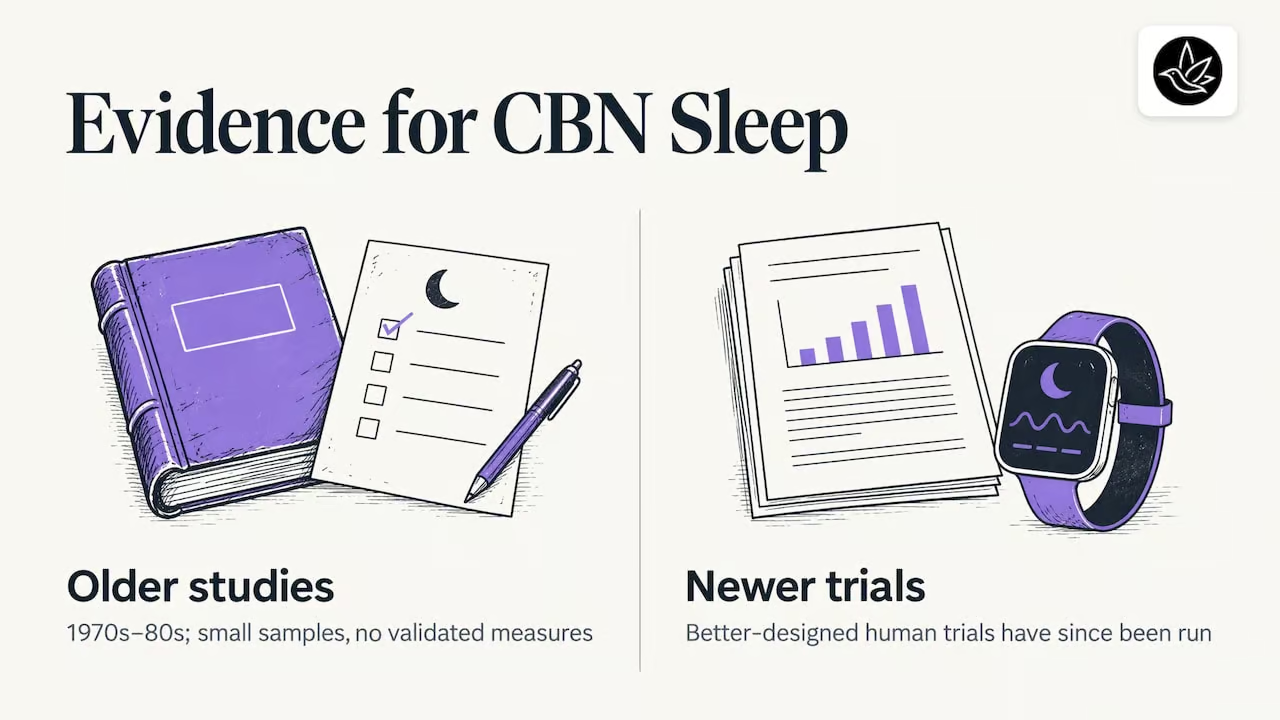
CBN gets its reputation from old claims that it is “the sleepy cannabinoid”. A 2021 narrative review by Jamie Corroon looked at where that idea came from. It found that published evidence was insufficient to support sleep claims for CBN. Most human work dated from the 1970s and 1980s, used small samples, and had no validated sleep questionnaires or polysomnography (a sleep-lab recording).
That review was a starting line, not a verdict. Newer, better-designed trials have since been run.
The 2024 trials
Bonn-Miller and colleagues (2024). This was a double-blind, randomized, placebo-controlled study with 293 participants. It tested 20 mg of CBN nightly for seven nights. The group’s sleep quality improved in a way that was nonsignificant but potentially meaningful. The same trial found significantly fewer awakenings and less overall sleep disturbance than placebo. Adding CBD at 10, 20 or 100 mg did not boost the CBN effect.
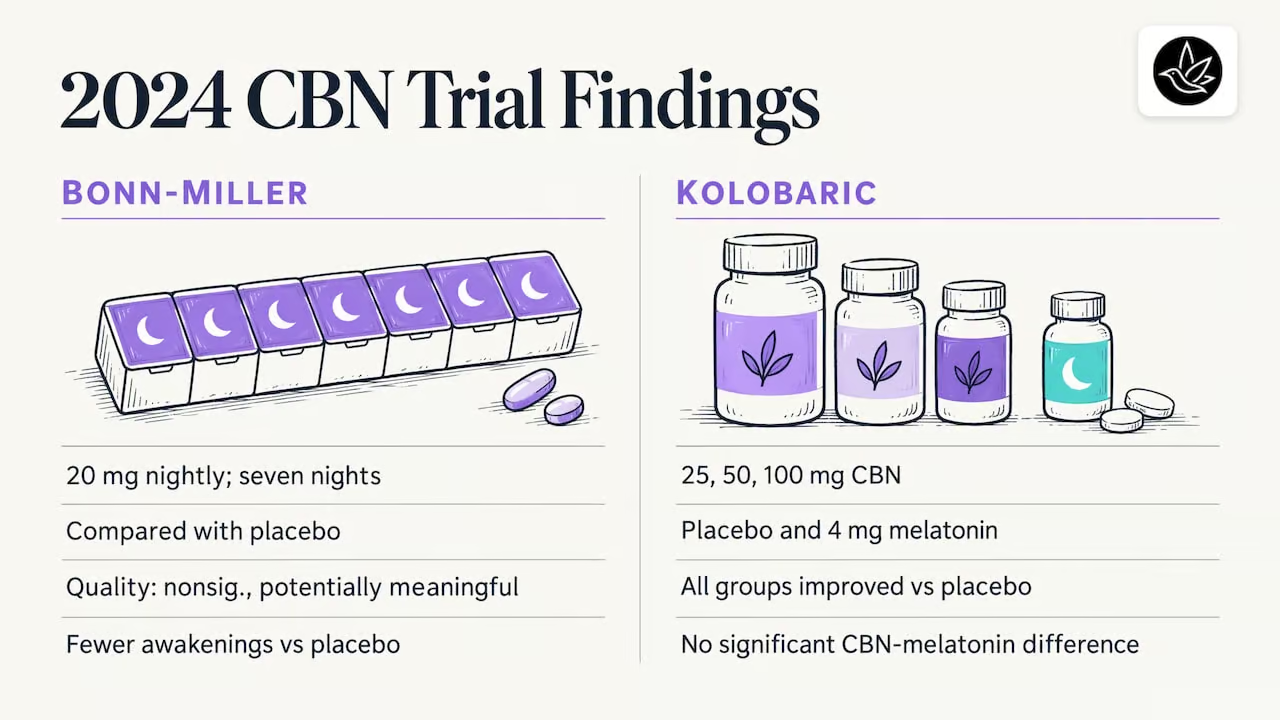
Kolobaric and colleagues (2024). This randomized, double-blind trial tested hemp-derived CBN at 25, 50 and 100 mg against placebo and 4 mg of melatonin. All groups improved on sleep quality relative to placebo. No CBN group differed significantly from the melatonin group.
The insomnia trial design
A separate Australian team (Lavender et al.) set up a crossover study of 20 adults with clinician-diagnosed insomnia. They tested single oral doses of 30 mg and 300 mg of CBN against placebo, measuring wake after sleep onset with polysomnography. Its published protocol shows how seriously researchers are now treating the question. Sleep-lab studies like this are the kind of evidence the 2021 review called for.
A fair way to read it all
- CBN looks like it may help with staying asleep, such as fewer awakenings, more than with falling asleep.
- Results differ between trials, products, doses and participants.
- Short trials of a week or a single night cannot tell us about long-term nightly use.
So CBN is a reasonable thing to be curious about, and a reasonable thing to approach carefully.
How much CBN do people take for sleep?
There is no established answer. The Sleep Foundation states that there are no research-based dosing guidelines for CBN as a sleep aid.
Here is what we can say about the numbers you will see:
| Source | CBN amount | What it was |
|---|---|---|
| Products marketed for sleep (Corroon review) | Typically 5 mg or less | Commercial products |
| Bonn-Miller 2024 | 20 mg nightly for 7 nights | Randomized, placebo-controlled trial |
| Kolobaric 2024 | 25, 50 and 100 mg | Randomized trial against placebo and melatonin |
| Lavender protocol | 30 mg and 300 mg, single dose | Crossover trial in adults with insomnia |
The Corroon review recommended that future trials use amounts significantly higher than what retail products contain. The amounts in the table are research settings with monitoring. They are not a target for you to hit at home. If you are thinking about CBN, ask your doctor or pharmacist what makes sense for you, particularly if you take other medicines.
A 2026 meta-analysis author wrote in a Marijuana Moment op-ed that CBN doses of 20 to 100 mg were linked to the most consistent sleep improvements. The same piece said low-dose CBD products, under 50 mg, generally showed little benefit unless combined with CBN. That is an author’s summary, and it sits alongside the 2024 trial where CBD did not add to CBN. The picture on combinations is still open.
What CBN means legally in Canada
This is the part many Canadians miss. CBN is not the same as CBD in the eyes of Health Canada.
- Health Canada’s guidance lists CBN among cannabinoids that bind to and activate the CB1 receptor, alongside delta-8-THC, HHC and others. It recommends licensed processors apply the delta-9-THC controls to these cannabinoids.
- The guidance includes a worked example. An edible with 2 mg of CBN and 8 mg of delta-9-THC fits the 10 mg limit on total intoxicating cannabinoids. One with 3 mg of CBN and 8 mg of THC would exceed it.
- Health Canada’s About cannabis page says the risks of CBN are probably similar to those of delta-9-THC, though not every intoxicating cannabinoid causes the same level or type of effect.
In practice, that means CBN counts toward the same per-package limits as THC in legal edibles. If you want to understand how the cap works, see our guide to Canada’s 10 mg edible THC limit.
It also means you should buy from licensed sources. Legal cannabis sold in Canada is regulated, labelled and tested. Health Canada also notes that legal cannabis products have not been reviewed to determine if they are safe or effective to treat specific diseases or symptoms. Read the label, because that is where you will find what is actually in the product.

Side effects and safety
Health Canada says side effects from other cannabinoids such as CBN, CBG, CBC and THCV are not well known. It also says information on side effects from medical cannabis is limited. Its page lists several possible causes of side effects: using too much, another ingredient in the product, sensitivity to cannabinoids, a pre-existing health condition, or an interaction with other medications or substances.
In the 2024 Bonn-Miller trial, the most common nonserious events were somnolence (6.8%), headache (4.8%), sleep disorder (4.8%) and dysgeusia, a changed sense of taste (3.4%). Rates of nonserious events were comparable across placebo and CBN groups.
Medicines, alcohol and other sleep aids
This is where we ask you to slow down and check.
- Health Canada’s medical cannabis page lists things cannabis may interact with, including alcohol, blood thinners, antidepressants and anti-anxiety medications, anti-seizure medications, grapefruit, and sleeping pills or tranquilizers.
- A Canadian-authored review of drug interactions with cannabinoids explains that THC and CBD are processed by liver enzymes (CYP3A4, and CYP2C9 for THC). Drugs that block these enzymes can raise cannabinoid levels. Combining cannabis with CNS depressants such as alcohol or opioids can add drowsiness and unsteadiness.
- The Sleep Foundation notes that mixing cannabinoids with L-tryptophan, valerian, melatonin or alcohol may raise the risk of excessive sleepiness.
If you take warfarin or other blood thinners, benzodiazepines such as clobazam, antipsychotics or seizure medication, speak to your doctor or pharmacist before using any cannabinoid for sleep. Health Canada also advises telling your provider about every substance you take, including natural health products and non-prescription medicines.
Plan on the same caution for pregnancy, breastfeeding, and use under 25 or over 65. If any of those apply, your health care provider is the right first call.
A calm evening routine, built carefully
No product is a magic switch. Sleep tends to respond to a routine, and a cannabinoid can be one part of it if it suits you and your doctor agrees.
- Check your medicines first. Ask your pharmacist whether anything you take interacts with cannabis.
- Read the label for total THC, CBD and CBN. Know what is in the product, and keep other sleep aids such as melatonin in mind.
- Start low. For THC edibles, we recommend starting at 2.5 mg. Our guide to starting at 2.5 mg for sleep in Canada walks through it.
- Be patient. Edibles can take a while to kick in. Our edible onset guide explains the timing so you do not take a second dose too early.
- Skip the alcohol. It adds to drowsiness and can fragment sleep.
- Keep a short log. Note the product, amount, bedtime and how you felt the next morning. That is useful to show your doctor.
- Take one change at a time. Don’t stack a new product with other sleep aids on the same night.
If next-day grogginess shows up, you took too much or the product does not suit you. Scale back or stop, and talk to your health care provider.
CBN, CBD or THC?
They are not interchangeable.
- CBN has the early trial signals described above and is classed as intoxicating by Health Canada.
- CBD is a non-intoxicating option many people use in an evening routine. In the 2024 CBN trial, adding CBD did not improve on CBN alone, but that does not tell us how CBD performs on its own. See our CBD for sleep guide and our overview of what the evidence supports for CBD.
- THC is the most studied cannabinoid for intoxication, and small doses are the usual starting point. The Sleep Foundation notes that in one small 1970s to 1980s study, participants felt drowsier when CBN was taken together with THC, though CBN alone had little effect.
For how THC and CBD edibles compare, see THC vs CBD edibles.
What to look for on the label
When a product is marketed for sleep, check these things on the package or product page:
- Cannabinoid amounts per serving, in milligrams, for THC, CBD and CBN.
- Total THC per package. The legal edible cap applies, and CBN counts toward intoxicating cannabinoids.
- Other ingredients, such as melatonin or botanicals, so you know if you are stacking sleep aids.
- Licensed producer information, which shows the product went through the legal system.
- Format. Edibles and drinks are slower and longer-lasting. Vapes act faster. Our guide to how edibles compare with smoking shows why that matters for timing.
Jamie Corroon’s review advises skepticism toward manufacturers’ sleep claims. That is a good habit with any wellness product, and the label is where you can verify what you are actually getting.
Our perspective
We get asked about CBN more and more, and we like to answer it the way we would for a friend. The research is moving. The 2024 trials are a real step up from the old studies, and it is fair to be curious about it.
What we care about most is that you choose with good information. That means knowing Health Canada groups CBN with intoxicating cannabinoids, reading every label, and starting low. It also means talking to a pharmacist or doctor if you take medication.
This is why we focus on a curated range of licensed craft products and clear product details. We offer flower, pre-rolls, vapes, extracts, edibles, drinks and CBD, and our team is happy to point you to the details you need. If something is not right for your evening routine, the label and your health care provider are your best guides.
We also deliver within an hour across Durham Region and the GTA, so you can plan a quiet night without a last-minute store run.
Nick
Shop for your evening routine
If you are building a wind-down routine, start with our shop. It covers edibles, drinks, CBD, vapes, flower, pre-rolls and extracts from licensed producers, with product details on each page. We deliver in one hour across Durham Region and the GTA.

Not sure about delivery options? Our guide to cannabis delivery in Canada covers how it works. For medical orders, see our page on medical cannabis shipping in Canada.
FAQ
How much CBN should I take for sleep?
There is no research-based dose. The Sleep Foundation says guidelines do not exist for CBN as a sleep aid. Trials have used 20 mg and up in controlled settings, but those are not recommendations. Ask your doctor or pharmacist, and start low with any product.
Is it CBN that helps you sleep?
It might, but the evidence is early. A 2024 trial found fewer awakenings with 20 mg of CBN, though overall sleep quality was not significantly better. Another 2024 trial saw improved sleep quality against placebo, with results similar to melatonin. More long-term research is needed.
What are the negative side effects of CBN?
Health Canada says side effects of CBN are not well known. In the 2024 trial, reported events included drowsiness, headache, a changed sense of taste and sleep disorder, at rates similar to placebo. Health Canada also says CBN’s risks are probably similar to those of THC, so use the same care.
Is CBN legal in Canada?
Yes, through the licensed system. Health Canada lists CBN among intoxicating cannabinoids and recommends THC-style controls, which includes the 10 mg per package limit on total intoxicating cannabinoids in edibles. Buy from licensed sellers and read the label.
Can I take CBN with other sleep aids or medication?
Check first. Alcohol, melatonin, valerian, sleeping pills and many prescription drugs can add to drowsiness or interact with cannabinoids. Tell your doctor or pharmacist everything you take, including natural health products, before you try it.
Sources
- Cannabinol and Sleep: Separating Fact from Fiction (PMC)
- Bonn-Miller et al., double-blind placebo-controlled CBN study (2024)
- Kolobaric et al., randomized trial of hemp-derived CBN (PubMed)
- Lavender et al., CBN 30 and 300 mg protocol (PMC)
- Sleep Foundation: CBN for Sleep
- Health Canada: Guidance on cannabis products with intoxicating cannabinoids
- Health Canada: About cannabis
- Health Canada: Cannabis for medical purposes, side effects
- Health Canada: Cannabis for medical purposes, general information
- Drug interactions with cannabinoids (PMC)
- Marijuana Moment: new study on cannabis and sleep (op-ed)