TL;DR:
- Proper sanitation in Canadian cannabis facilities depends on validated procedures, environmental monitoring, and independent QA oversight.
- Escalate to professional remediation when repeated lab failures, visible mould, pest infestations, or water damage occur, and in-house cleaning is insufficient.
A validated deep clean, environmental swab programme, and a documented SOP-driven schedule under QA oversight are the three non-negotiable pillars of compliant cannabis facility sanitation in Canada. If your facility has just failed a lab test, spotted visible mould, or received a Health Canada notice, here is what to do in the next 24–72 hours:
- Isolate affected zones immediately. Stop production in any batch linked to the contaminated area and quarantine product pending investigation.
- Collect environmental swabs from all suspect surfaces, HVAC return points, and personnel contact areas before any cleaning begins. Pre-cleaning samples establish your baseline for root-cause analysis.
- Engage your QA person to document every observation, time-stamp every action, and open a corrective action record.
- Review your batch logs and cleaning history for the affected zone. Missing or incomplete records are themselves a compliance finding.
- Escalate to a professional remediation provider if swab results confirm microbial positives, if visible mould or pest evidence is present, or if your in-house team lacks validated procedures.
Industry reporting notes that approximately 72% of facility violations relate to insufficient sanitation procedures and poor record-keeping rather than physical cleanliness alone. That figure tells you something important: a spotless room with no paperwork is still a violation. The Health Canada GPP guide requires that all activities be conducted under written SOPs, and inspectors will ask to see them. Montrosecannabis covers the broader compliance picture in its Canadian compliance guide for operators who want the full regulatory context.
Table of Contents
- When should you call a professional decontamination service?
- What cleaning agents and methods actually work?
- How do you map contamination and find the root cause?
- How do you build a GPP-aligned cleaning schedule?
- What does Health Canada actually require for sanitation?
- How do you choose a professional remediation provider?
- What does a remediation engagement look like?
- Evidence-based practices that reduce future remediation risk
- Key takeaways
- Why sanitation matters to us at Montrosecannabis
- Useful sources for operators
- FAQ
When should you call a professional decontamination service?
In-house cleaning handles routine maintenance well. It does not handle everything. There are clear thresholds where escalating to a professional remediation provider is the right call.
Signals that in-house cleaning is not enough:
- Repeated failed microbial lab tests on product from the same room or line
- Visible mould, powdery mildew, or unexplained biofilm on walls, HVAC ducts, or equipment
- Active pest infestation (fungus gnats, spider mites, rodents)
- Fire, flood, or water-intrusion damage affecting production areas
- Persistent odour or air quality complaints that do not resolve after routine cleaning
- Your team has no validated written procedures or lacks the equipment for environmental clearance testing
Service types to know:
- Emergency disaster response: rapid containment and decontamination after fire, flood, or catastrophic contamination event
- Flower-room turnover: full post-harvest deep clean and sanitisation between crop cycles
- HVAC and air-handling decontamination: duct cleaning, coil sanitisation, and filter replacement with pre/post air sampling
- Extraction-equipment deep clean: solvent-safe procedures for closed-loop systems, rotary evaporators, and processing lines
- Environmental validation and clearance testing: swab programmes, settle plates, and lab confirmation that a space is cleared for re-entry
When triaging which rooms to prioritise, put post-harvest flower rooms and extraction suites at the top. These areas carry the highest contamination risk and the greatest regulatory exposure if a batch fails.
Pro Tip: Keep a pre-vetted remediation provider on a standing service agreement before you need one. A pre-negotiated agreement reduces your response time from days to hours and protects product value when every hour of downtime costs money.
What cleaning agents and methods actually work?
The right chemistry depends on the surface, the contamination type, and whether you are working in a cultivation room or an extraction suite. Getting this wrong creates residue risks and, in solvent-handling areas, genuine safety hazards.
Surface cleaning sequence
Remove gross soil first with a detergent, rinse thoroughly, then apply your disinfectant or sanitiser. Skipping the detergent step and going straight to a sanitiser is one of the most common errors in cannabis facilities. Organic matter neutralises most disinfectants before they can work. Follow the manufacturer’s contact time, concentration, and temperature instructions precisely. Rotating active ingredients periodically also reduces the risk of microbial resistance building up over time.

Common active ingredients: pros and cons
| Active Ingredient | Best Use | Key Advantage | Key Limitation |
|---|---|---|---|
| Quaternary ammonium (quats) | Hard surfaces, walls, floors | Broad-spectrum, residual activity | Residue risk on product-contact surfaces; watch concentration |
| Hydrogen peroxide / peracetic acid | Broad surface and air applications | Breaks down to water and oxygen; low residue | Corrosive at high concentrations; handle with PPE |
| Ethanol / isopropyl alcohol | Small surfaces, tools, spot treatment | Fast-acting, no rinse required | Flammable; not suitable for large-scale extraction-suite use |
| Chlorine bleach | Floors, drains, non-stainless surfaces | Effective and low cost | Corrosive to stainless steel without passivation; strong odour |
Industry guidance is clear that for extraction suites, solvent safety and validated cleaning procedures take priority over simple surface disinfection. Ethanol is fast and effective on small surfaces but carries real flammability risk in a room with residual hydrocarbon or ethanol vapour. Peracetic acid and hydrogen peroxide are the preferred broad-spectrum options because they break down to safer residues and are compatible with stainless-steel equipment when used at correct concentrations.
Extraction-equipment specific notes
Always follow validated SOPs for closed-loop systems. Control ignition sources and static before introducing any flammable cleaning agent. Confirm ventilation is adequate and that solvent-safe procedures are in place before disassembly. Never introduce incompatible chemicals into closed solvent lines.
Pro Tip: For cannabis equipment hygiene in extraction suites, post a laminated chemical compatibility chart at every cleaning station. It takes five minutes to make and prevents the kind of incident that shuts a facility down for weeks.
How do you map contamination and find the root cause?
Treating contamination without finding its source is like patching a leak without turning off the water. Contamination mapping gives you a spatial picture of where positives cluster so you can remove the source rather than just clean around it.
What contamination mapping involves:
- Collecting targeted environmental swabs from surfaces, equipment contact points, and HVAC return air grilles
- Placing settle plates in airflow paths to capture airborne spore loads
- Reviewing personnel movement patterns and PPE compliance records
- Inspecting the building envelope for water ingress, cracks, or gaps near HVAC penetrations
- Correlating all findings with batch failure data and cleaning history
The stepwise methodology is straightforward:
- Map — identify all suspect zones based on lab failures, visual observations, and airflow patterns
- Sample — collect swabs and settle plates from mapped locations before any remediation begins
- Analyse — send samples to an accredited lab; review results against your batch logs and cleaning records
- Remove the source — address the root cause (repair water ingress, replace contaminated insulation, fix HVAC seals)
- Validate clearance — collect post-remediation swabs and confirm negative results before restarting production
Checklist items to record during mapping:
- Exact sample locations with GPS coordinates or room diagrams
- Cleaning agents used in the zone in the prior 30 days
- Any recent maintenance, construction, or equipment moves
- Worker entry/exit patterns and PPE compliance observations
- Product flow paths through the affected area
Environmental monitoring and validation are core to proving sanitation effectiveness under GPP frameworks. Without documented pre- and post-remediation swab results, you cannot demonstrate to a Health Canada inspector that your corrective action actually worked.
How do you build a GPP-aligned cleaning schedule?
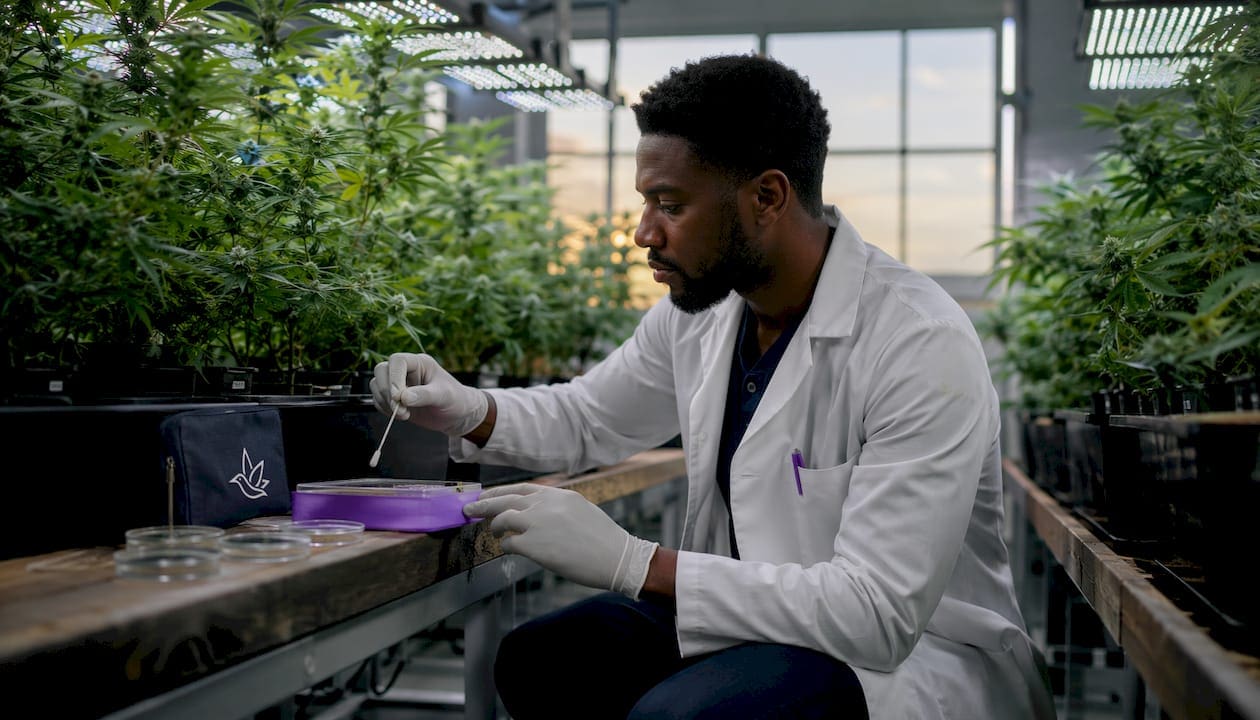
A cleaning schedule that lives in someone’s head is not a cleaning schedule. Health Canada expects a written sanitation programme with documented records, and inspectors will ask to see both the SOPs and the completed logs.
Cleaning frequency tiers:
- Daily: high-touch surfaces (door handles, light switches, equipment controls), floors in production areas, hand-sanitising stations
- Weekly: equipment disassembly and component cleaning, drain sanitisation, spot checks on walls and ceilings
- Monthly: HVAC filter inspection and replacement, deep surface sanitisation of walls and ceilings, drain line treatment
- Annual: full room turnover with validation swabbing, equipment qualification runs, SOP review and update
A practical schedule table gives your team clarity on who does what and when:
| Area | Task | Frequency | Responsible Role | Validation Required | Record Location |
|---|---|---|---|---|---|
| Flower room floors | Mop with approved sanitiser | Daily | Production technician | None (routine) | Cleaning log binder |
| Equipment contact surfaces | Disassemble, wash, sanitise, reassemble | Weekly | Equipment operator | Swab on request | Batch record |
| HVAC filters | Inspect and replace as needed | Monthly | Facilities technician | Visual inspection log | Maintenance log |
| Drains | Flush and sanitise | Weekly | Production technician | None (routine) | Cleaning log binder |
| Full room turnover | Deep clean, sanitise, validate | Post-harvest / Annual | QA-supervised team | Environmental swabs | QA validation record |

Pro Tip: Attach a timestamped photo to every cleaning log entry. A photo takes ten seconds and becomes your fastest audit defence when an inspector questions whether a task was completed.
Documentation must-dos:
- SOPs must reference specific products, concentrations, contact times, and temperatures
- Completed logs must be signed, dated, and retained for the period required under the Cannabis Regulations
- Any deviation from the SOP must be documented with a corrective action note
What does Health Canada actually require for sanitation?
The Cannabis Regulations lay out the sanitation requirements in sections 84–88.2. Section 87 requires a written sanitation programme covering cleaning procedures for buildings and equipment, handling of substances used in production, and hygiene requirements for personnel. Section 87.1 requires hand-cleaning and sanitising stations and lavatories where necessary to prevent contamination.
Key regulatory requirement (section 81.1, Cannabis Regulations): Any sanitiser, agronomic input, or non-food chemical agent present at a site must be properly identified, suitable for its intended use, and handled in a manner that does not present a risk of contamination. Manufacturer’s instructions on contact time, temperature, and concentration must be followed.
Buildings must be designed, constructed, and maintained to permit effective cleaning of all surfaces and to prevent contamination (section 84). HVAC systems must provide sufficient air exchange to remove unclean air and must be capable of being disassembled for cleaning (section 85). Equipment must be designed and maintained to permit effective surface cleaning and to prevent contamination (section 86).
Practical compliance checklist for operators:
- Safety Data Sheets (SDS) on-site for every cleaning chemical
- Written SOPs that reference specific products, manufacturer contact times, concentrations, and temperatures
- Segregation of cleaning chemicals from cannabis product storage areas
- Validated environmental monitoring programme with documented results
- Hand-cleaning and sanitising stations accessible to all personnel in production areas
- PPE requirements documented and enforced (section 88.92 requires appropriate clothing, gloves, hairnets, and smocks)
Improper use of a sanitiser — wrong concentration, insufficient contact time, or failure to follow the manufacturer’s instructions — is a regulatory violation under section 81.1, not just a cleaning error. For a broader overview of what Health Canada inspectors focus on, Montrosecannabis has a dedicated Health Canada regulation guide worth bookmarking.
This article is general information for facility operators, not legal or regulatory advice. Confirm current requirements with Health Canada or a qualified regulatory professional for your specific situation.
How do you choose a professional remediation provider?
Not every cleaning company understands cannabis GPP. The wrong provider can leave you with inadequate documentation, incompatible chemistries, and a facility that fails its next inspection anyway.
Core evaluation checklist:
- Documented experience with Canadian cannabis facilities and Health Canada GPP requirements
- Written SOPs for all services offered, available for review before engagement
- Environmental testing capability: named lab partner, swab methodology, and clearance reporting
- QA separation of duties: their QA personnel must be separate from the cleaning crew
- WHMIS training and SDS management for all chemicals used on-site
- Insurance coverage appropriate for cannabis facility work
- Emergency response capability with a defined turnaround commitment
Questions to ask every vendor:
- Can you provide case studies or references from Canadian cannabis facilities?
- What environmental swab methodology do you use, and which accredited lab processes your samples?
- How do you document results for a Health Canada audit?
- What is your emergency response turnaround time for a critical contamination event?
- How do you handle flammable solvents and solvent-safe cleaning in extraction suites?
- What PPE protocols do your technicians follow on-site?
- Can you provide a written scope of work and itemised quote before starting?
Red flags to walk away from:
- Refusal to share environmental swab data or clearance reports
- No written SOPs or inability to explain their cleaning methodology
- No evidence of Canadian regulatory familiarity (GPP, Cannabis Regulations)
- Mixing incompatible chemistries or dismissing SDS requirements
- Poor PPE practices or no solvent-safety controls for extraction areas
Willow Industries recommends frequent self-audits, regular staff training, and digital documentation tools as the baseline for a GPP-compliant sanitation programme. A remediation provider who cannot meet that same standard for their own work is not the right partner.
What does a remediation engagement look like?
Understanding the typical flow of a professional remediation job helps you plan downtime, budget accurately, and prepare your team. Here is a representative four-step engagement:
Triage and containment (0–24 hours): The provider assesses the affected area, reviews your batch logs and cleaning history, and implements containment measures to prevent cross-contamination spread. You should have HVAC plans, SDS for all chemicals on-site, and access credentials ready before they arrive.
Targeted cleaning and remediation (24–72+ hours): Scope-dependent. A single flower room turnover may complete in 24 hours. A full HVAC decontamination combined with extraction-suite cleaning can run 72 hours or longer. Expect production downtime in affected zones throughout this phase.
Environmental sampling and lab testing (48–96 hours): Post-remediation swabs are collected and sent to an accredited lab. Results typically return within 48–96 hours depending on the lab and the organisms being tested. Do not restart production in the affected zone until clearance is confirmed in writing.
Clearance reporting and SOP updates (1–2 weeks for complex jobs): The provider delivers a written clearance report with all swab results, cleaning records, and chemical documentation. Your QA team updates the relevant SOPs and corrective action records before the zone returns to production.
Factors that affect cost:
- Total area size and number of rooms or zones involved
- Type of contamination (microbial remediation is more involved than chemical residue removal)
- Required validation testing and number of swab locations
- Equipment disassembly complexity (extraction suites cost more than open grow rooms)
- Emergency premium for rapid response outside business hours
Always request an itemised scope of work before signing anything. A line-by-line quote lets you compare providers accurately and gives you a baseline if scope changes during the job.
What to prepare before the vendor arrives:
- Batch logs and cleaning history for the affected zone (last 90 days minimum)
- SDS for all chemicals currently stored on-site
- HVAC plans and equipment schematics
- Access credentials and security clearance for all areas to be remediated
- Your QA person available on-site or on call throughout the engagement
Evidence-based practices that reduce future remediation risk
The facilities that spend the least on remediation over time are not the ones that clean the hardest. They are the ones that build contamination resistance into their design and operations from the start.
GrowerIQ’s facility design guidance points to non-porous surfaces, negative air pressure, and air curtains as the most effective passive controls. Non-porous wall and floor finishes eliminate the micro-crevices where pathogens harbour between cleaning cycles. Negative air pressure in production rooms prevents contaminated air from migrating into clean zones. Air curtains at entry points reduce the particulate load that staff and equipment bring in from outside.
Keeping QA separate from production is the single most effective operational control for objective sanitation oversight. When the same person who does the cleaning also signs off on the cleaning record, errors go undetected. QA personnel who oversee validation and clearance reporting independently of the production crew catch problems before they become inspection findings.
Digital documentation tools for batch and cleaning logs reduce audit friction significantly. Paper logs get lost, damaged, or filled in retrospectively. A digital system with timestamps and user authentication creates an audit trail that is difficult to dispute and fast to retrieve when an inspector arrives unannounced.
Pro Tip: Combine rapid microbial testing (ATP swabs or lateral flow assays) with your scheduled validation swabbing. Rapid tests give you a same-day signal that something is off before it shows up in a product failure. Use them as a trend tool, not a replacement for accredited lab confirmation.
Operational improvements worth prioritising:
- Schedule self-audits quarterly using your own SOP checklist before Health Canada visits
- Train all production staff on WHMIS and the specific cleaning agents used in their area
- Review and update SOPs annually or after any significant contamination event
- Use software tools that support digital cleaning logs, batch records, and corrective action tracking
Key takeaways
Effective cannabis facility sanitation comes down to three things: validated cleaning procedures, documented environmental monitoring, and QA oversight that is genuinely separate from production.
| Point | Details |
|---|---|
| Documentation is the priority | Approximately 72% of facility violations relate to poor records, not physical cleanliness. |
| Follow manufacturer instructions | Contact time, concentration, and temperature requirements under section 81.1 are regulatory obligations, not suggestions. |
| Map before you clean | Collect pre-remediation swabs to establish root cause; post-remediation swabs confirm clearance. |
| QA must be independent | QA personnel should oversee validation and sign off on clearance separately from the production team. |
| Design reduces long-term cost | Non-porous surfaces, negative air pressure, and air curtains lower daily cleaning labour and pathogen harborage risk. |
Why sanitation matters to us at Montrosecannabis
Every product Montrosecannabis delivers to customers in Durham Region and the GTA starts with a licensed producer who has passed Health Canada’s scrutiny. That is not a coincidence. We source from cultivators and processors who take GPP seriously, and we believe that the quality customers experience in every order reflects the sanitation standards maintained at every step of the supply chain.
Our 4.9-star Google rating is built on trust, and trust starts with product safety. When a facility’s sanitation programme fails, the risk does not stay at the facility. It travels downstream to the consumer. That is why we care about this topic and why we publish practical guidance for operators who are doing the hard work of keeping Canadian cannabis clean and compliant.
Whether you are looking for craft cannabis products from producers who meet the highest standards, or you want to explore our cultivation class resources for staff training, Montrosecannabis has you covered. Our one-hour delivery service across Durham Region and the GTA means premium, compliant cannabis is never far away. Browse our full selection at montrosecannabis.ca.
Useful sources for operators
These are the primary Canadian sources you should have bookmarked for remediation planning, audit preparation, and regulatory validation:
- Good production practices guide for cannabis (Health Canada) — the authoritative GPP guidance document covering SOPs, sanitiser requirements, and documentation expectations
- Cannabis Regulations, section 87 (sanitation programme) — the legal text for sanitation programme requirements, hand-cleaning stations, and building/equipment standards
- Good production practices guide (PDF version) — downloadable reference for on-site use and SOP development
- GrowerIQ: Facility sanitation, cleaning and disease — practical operational guidance on contamination prevention, facility design, and environmental monitoring
- Willow Industries: Canada cannabis GPP guide — QA and sanitation programme recommendations for Canadian licence holders
- Cannabis Science & Technology: Practical cleaning solutions for extraction and processing — technical guidance on cleaning agents and solvent-safe procedures for extraction suites
FAQ
How do you clean a cannabis cultivation facility?
Start by removing gross soil with a detergent, rinse all surfaces, then apply an approved sanitiser following the manufacturer’s contact time, concentration, and temperature instructions. Document every step in your sanitation programme as required under section 87 of the Cannabis Regulations.
What does Health Canada require for cannabis facility sanitation?
Health Canada requires a written sanitation programme covering building and equipment cleaning procedures, substance handling, and personnel hygiene under section 87 of the Cannabis Regulations. All sanitisers must be identified, suitable for their use, and applied per manufacturer instructions under section 81.1.
When should a cannabis facility call a professional remediation service?
Call a professional when you have repeated failed microbial lab tests, visible mould or pest activity, fire or water damage, or when your in-house team lacks validated procedures and environmental clearance testing capability.
What is contamination mapping in a cannabis facility?
Contamination mapping is the process of collecting environmental swabs, settle plates, and inspection data from suspect zones to locate the source of contamination before remediation begins. The goal is to remove the root cause, not just clean the visible symptoms.
How long does professional cannabis facility remediation take?
A single flower-room turnover typically takes 24–72 hours. Complex jobs involving HVAC decontamination, extraction-suite cleaning, and full environmental validation can take one to two weeks from initial triage to final clearance reporting.