
Health Canada cannabis regulation: what you need to know

Health Canada cannabis regulation is the federally mandated legal framework governing the production, distribution, sale, and possession of cannabis across Canada. Built on the Cannabis Act and Cannabis Regulations, which took effect on october 17, 2018, this framework sets national licensing standards and public health objectives that every producer, retailer, and consumer must follow. Understanding these rules is not optional. Whether you are buying for recreational use or running a licensed operation, Canada cannabis laws affect you directly. This guide breaks down the full regulatory picture, including the 2025 amendments that changed how the system works.
What is Health Canada cannabis regulation and its core framework?
Health Canada cannabis regulation is defined as the federal system of rules that controls every stage of the cannabis supply chain in Canada. It covers who can grow it, how it must be packaged, where it can be sold, and how much you can legally possess. The two foundational documents are the Cannabis Act and the Cannabis Regulations, both administered by Health Canada.
The Cannabis Act sets the legal authority. It defines what is permitted, what is prohibited, and what penalties apply for violations. The Cannabis Regulations fill in the operational details, covering areas like security requirements, packaging standards, labelling rules, and record-keeping obligations.

Health Canada issues licences to producers, processors, sellers, and researchers. Without a valid licence, no commercial cannabis activity is legal in Canada. The licensing system is the primary tool Health Canada uses to maintain control over the legal supply chain.
Key areas covered by the Cannabis Regulations include:
- Packaging and labelling: Products must display standardised health warnings, THC and CBD content, and lot numbers. You can learn more about how lot numbers protect buyers when shopping for legal cannabis.
- Security requirements: Licensed facilities must meet physical and personnel security standards to prevent diversion to the illicit market.
- Record-keeping: Licence holders must maintain detailed records of production, inventory, and sales.
- Reporting obligations: Regular reports to Health Canada are mandatory for all licence holders.
Pro Tip: If you are buying cannabis in Canada, always check that the product carries a standardised excise stamp and proper labelling. These are visible signs that the product comes from a federally licensed source.
How do federal, provincial, and municipal rules interact?
Three levels of government share responsibility for cannabis regulation in Canada: federal, provincial or territorial, and municipal. Each level controls a distinct part of the system. Understanding where one ends and another begins saves both consumers and businesses from costly mistakes.
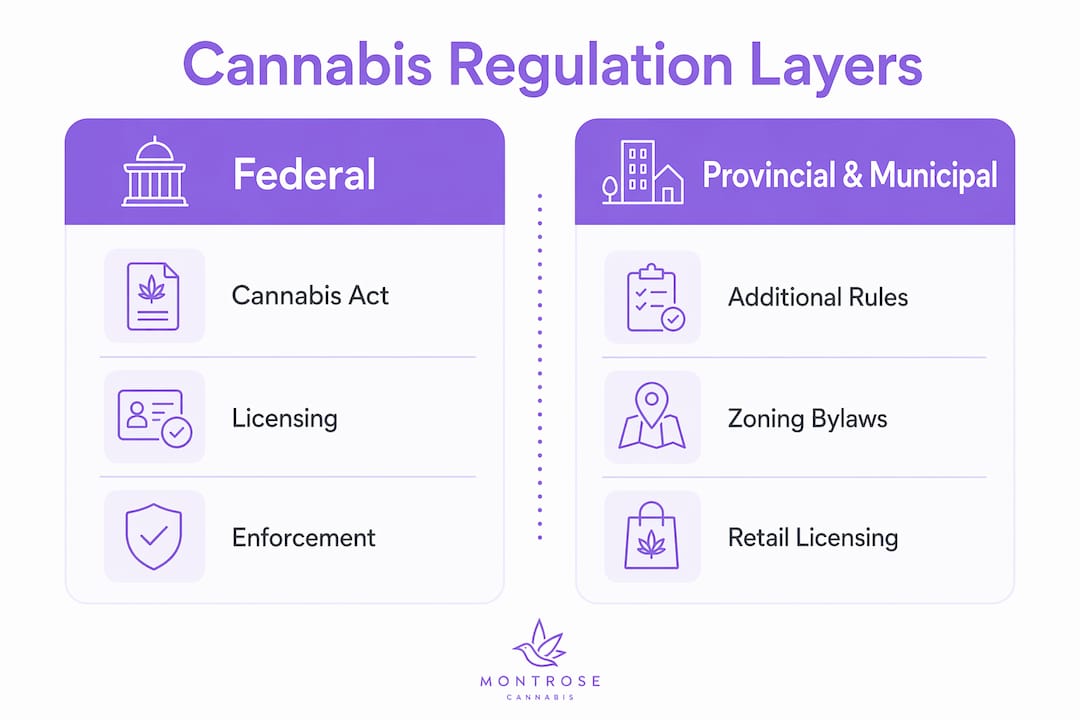
The federal government, through Health Canada, sets the national framework. It controls licensing, product standards, and public health requirements. No province or municipality can override federal rules.
Provinces and territories layer their own rules on top of the federal foundation. They control retail distribution models, minimum age requirements, and possession limits within their borders. Here is how that plays out across the country:
- Ontario operates a private retail model through the Alcohol and Cannabis Commission of Ontario (AGCO), with a minimum age of 19. Provincial retail frameworks shape what programmes and services licensed retailers can offer customers.
- British Columbia uses a hybrid model combining government and private retail, also with a minimum age of 19.
- Quebec operates government-run retail stores through the Société québécoise du cannabis (SQDC) and sets the minimum age at 21.
- Alberta runs a fully private retail model with a minimum age of 18, the lowest in the country.
“Provincial frameworks heavily influence the retail experience, requiring licensees to adapt their business models across provinces.” — Fasken, Cannabis Law in Canada
Municipal authorities add a third layer that many people overlook. A municipality can use zoning bylaws or business licensing rules to block a cannabis store from opening, even if that business holds valid federal and provincial licences. This means a retailer can clear every federal and provincial hurdle and still be stopped at the local level. For consumers, this explains why cannabis retail availability varies so much from one town to the next.
What changed with the 2025 Health Canada cannabis amendments?
On march 12, 2025, Health Canada published major amendments to the Cannabis Regulations. These changes targeted five areas: licensing, security, product innovation, packaging, and record-keeping. The goal was to reduce administrative burden on licence holders without weakening public health and safety protections.
The table below summarises the key areas of change and their practical impact:
| Area of change | What changed | Impact on licence holders |
|---|---|---|
| Licensing | Simplified application and renewal processes | Faster approvals, less paperwork |
| Security | Updated physical security thresholds | Some facilities may reduce security spending |
| Product innovation | Expanded allowances for ethyl alcohol use in processing | More product formats now permitted |
| Packaging | Adjusted requirements for certain product categories | Reduced packaging compliance costs |
| Record-keeping | Streamlined reporting timelines and formats | Less administrative time per reporting cycle |
The amendments do not change the fundamental objectives of the Cannabis Act. Public health and safety remain the non-negotiable priorities. Licence holders still must meet all security, reporting, and product standards. The changes simply remove duplication and outdated requirements that had built up since 2018.
One critical point that many operators miss: Health Canada does not automatically update a licence holder’s internal compliance documents after regulatory changes. Every operator must review the amendments and revise their site-specific procedures manually. Failing to do this creates a compliance gap that can trigger enforcement action.
Pro Tip: Set a calendar reminder to review the Canada Gazette every quarter. Regulatory amendments are published there first, and staying ahead of changes gives your team time to update procedures before deadlines hit.
What do individuals and businesses need to know about compliance?
Compliance with Health Canada cannabis guidelines is an ongoing obligation, not a one-time achievement. The regulatory environment is dynamic. Cannabis regulations are frequently updated to address new industry developments, and operators who treat compliance as a static checklist tend to fall behind.
Health Canada holds significant enforcement powers. Key risks for licence holders include:
- Licence suspension: Health Canada can suspend a licence for contravention of the Cannabis Fees Order, which means financial compliance is just as critical as operational compliance.
- Licence revocation: Serious or repeated violations can result in permanent loss of licence.
- Monetary penalties: Administrative penalties apply for specific regulatory breaches.
- Criminal prosecution: The Cannabis Act includes criminal offences for the most serious violations.
For businesses, the most common compliance pitfall is assuming that federal licensing is the finish line. Industry experts recommend building a culture of compliance through regular internal audits and ongoing staff training. Regulations change, and your team needs to change with them.
For individual consumers, compliance is simpler but still real. Possession limits, public consumption rules, and age restrictions all apply. Buying from a federally licensed retailer is the clearest way to stay on the right side of Canada cannabis laws. Licensed retailers carry products that meet all federal packaging and labelling requirements, including the certificate of analysis standards that verify product safety and potency.
Key takeaways
Health Canada cannabis regulation is a multi-layered federal framework that governs every stage of the cannabis supply chain, and compliance requires active, ongoing attention at the federal, provincial, and municipal levels.
| Point | Details |
|---|---|
| Federal framework is foundational | The Cannabis Act and Cannabis Regulations set national standards that all producers, retailers, and consumers must follow. |
| Three levels of government apply | Federal, provincial or territorial, and municipal rules all interact, and each level can affect your rights or business operations. |
| 2025 amendments reduced red tape | March 2025 changes streamlined licensing, security, and record-keeping without weakening public health objectives. |
| Compliance documents are your responsibility | Health Canada does not update your internal procedures after regulatory changes. Operators must do this themselves. |
| Financial compliance carries real risk | Contravening the Cannabis Fees Order can result in licence suspension, making fee compliance as critical as operational compliance. |
Why proactive compliance is the only real strategy
From where I sit, the biggest mistake I see people make with Health Canada cannabis regulation is treating it as a bureaucratic hurdle to clear once and forget. The regulatory framework is genuinely alive. It has been amended multiple times since 2018, and the 2025 changes are not the last ones coming.
The federal versus provincial confusion trips up consumers more than most people realise. I have spoken with people who assumed that because cannabis is federally legal, the rules are the same everywhere. They are not. Quebec’s minimum age of 21, Ontario’s private retail model, and municipal zoning restrictions all create a patchwork that catches people off guard. Knowing your province’s specific rules is not optional.
For anyone operating in the industry, my honest advice is to hire a compliance officer or retain a cannabis law specialist before you need one. The cost of proactive legal guidance is a fraction of the cost of a licence suspension. Staying current on cannabis strains and product categories also matters, because product innovation rules change alongside licensing rules.
The 2025 amendments are a positive signal. Health Canada is listening to industry feedback and removing friction where it can. That goodwill goes both ways. Operators who engage seriously with compliance tend to have smoother relationships with regulators and fewer enforcement surprises.
— Nick
Compliant cannabis, delivered to your door by Montrosecannabis
Knowing the rules is the first step. Buying from a source that follows them is the second.
Montrosecannabis operates as a fully compliant retailer serving the Durham Region and GTA, with one-hour delivery and a curated selection of craft cannabis from licensed Canadian growers. Every product on the Montrosecannabis menu meets Health Canada packaging, labelling, and safety standards. Whether you are looking for same-day delivery in Toronto or want to stock up with wholesale cannabis options, Montrosecannabis makes it easy to buy legal, buy quality, and buy with confidence. Check out the latest arrivals and find something you will love.
FAQ
What is the Cannabis Act?
The Cannabis Act is the federal law that legalised recreational cannabis in Canada on october 17, 2018. It sets the national rules for production, distribution, sale, and possession of cannabis.
How does Health Canada enforce cannabis regulations?
Health Canada can suspend or revoke licences, issue administrative monetary penalties, and refer serious violations for criminal prosecution. Financial non-compliance with the Cannabis Fees Order is also grounds for licence suspension.
Do provincial cannabis rules override federal rules?
No. Federal rules set the national floor. Provinces and territories add their own rules on top, such as minimum age, retail models, and possession limits, but they cannot override federal standards.
Can a municipality block a licensed cannabis store?
Yes. Municipal authorities can use zoning bylaws or business licensing requirements to prevent a cannabis store from opening, even if the operator holds valid federal and provincial licences.
What changed in the 2025 Health Canada cannabis amendments?
The march 2025 amendments streamlined licensing, security, product innovation, packaging, and record-keeping requirements. The changes reduced administrative burden but did not alter the core public health and safety objectives of the Cannabis Act.


