
Broad spectrum cannabis is defined as a cannabis extract that retains multiple cannabinoids and terpenes but has had Δ9-THC reduced to non-detectable or near-zero levels, typically below 0.01%. The industry term you will see on lab reports and product pages is “broad spectrum extract,” and it sits between two other well-known categories: full spectrum and isolate. The core appeal is straightforward. You get the potential therapeutic benefit of several plant compounds working together, without meaningful intoxication risk. For Canadians navigating the cannabis aisle or a delivery menu, understanding this distinction is the first step toward choosing a product that actually fits your needs.
What is broad spectrum cannabis and how does it differ from other types?
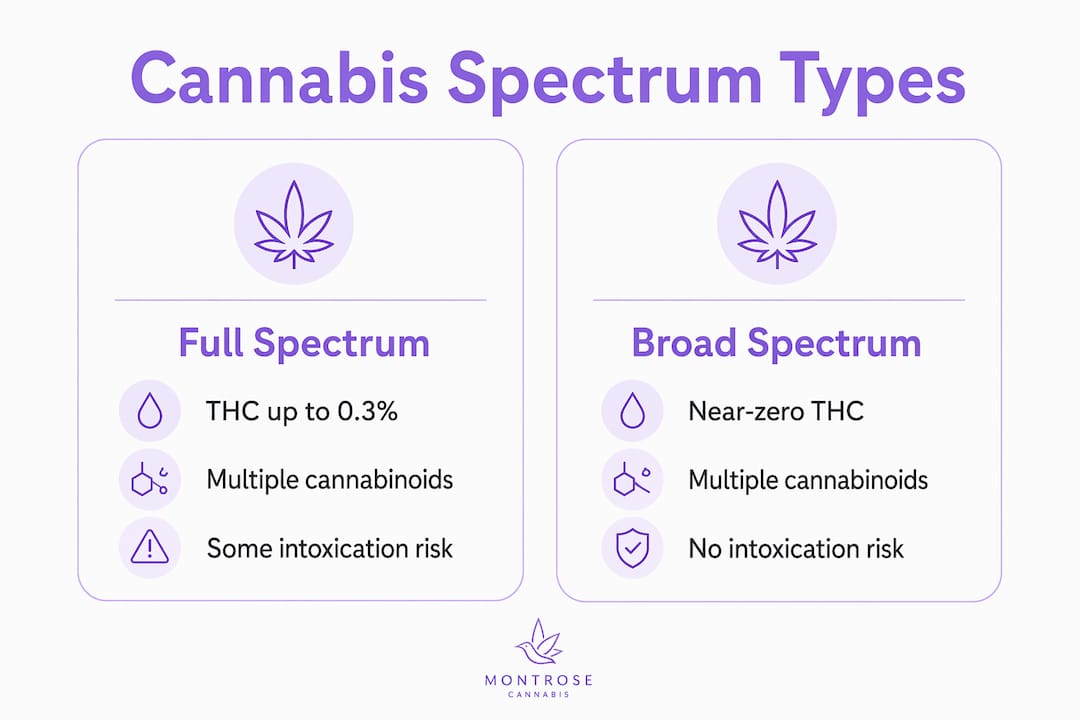
Full spectrum, broad spectrum, and isolate are the three main spectrum categories, and the difference between them comes down to which compounds survive the extraction process.
Full spectrum cannabis contains THC up to the legal limit of 0.3%, along with CBD, minor cannabinoids like CBG and CBN, and terpenes. Broad spectrum products reduce THC to near zero while preserving most of the other cannabinoids and terpenes. Isolate is a single purified cannabinoid, usually CBD, with everything else removed.

The practical difference matters most for two groups: people who are subject to workplace drug testing, and people who are sensitive to THC’s psychoactive effects. Broad spectrum products appeal to both groups because they offer multi-cannabinoid support without significant intoxication risk.
| Spectrum type | THC level | Cannabinoid variety | Intoxication risk | Best suited for |
|---|---|---|---|---|
| Full spectrum | Up to 0.3% | High | Moderate | Experienced consumers, maximum entourage effect |
| Broad spectrum | Near zero (below 0.01%) | High | Very low | THC-sensitive consumers, drug testing concerns |
| Isolate | None | Single compound | None | Precise dosing, allergy to other cannabinoids |
One thing worth knowing: “spectrum” terms are marketing categories, not regulated botanical definitions. Prioritise reviewing the product’s third-party Certificate of Analysis (COA) over the label alone.
How is broad spectrum cannabis processed?
Producing a broad spectrum extract requires removing THC while keeping the rest of the plant’s chemistry as intact as possible. That is harder than it sounds, and the method used affects the final product’s quality significantly.
The three most common processing approaches are:
-
Chromatography: A separation technique that isolates THC molecules from the extract using a solvent or gas medium. It is the most precise method and tends to preserve minor cannabinoids and terpenes well.
-
Chilled crystallization: Cooling the extract causes THC to crystallise and separate. Effective, but some terpenes and minor cannabinoids can be lost in the process.
-
Catalytic conversion: THC is chemically converted into a non-psychoactive compound. Less common and more controversial in terms of preserving the natural cannabinoid profile.
Because some minor cannabinoids and terpenes may be lost during any of these processes, some manufacturers take a different route entirely. They start with a CBD isolate and then add specific cannabinoids and terpenes back in. These are called “reconstructed” broad spectrum extracts. Their chemical profile can differ from a naturally derived broad spectrum extract, which may alter the synergistic effects you experience.
Quality assurance is where this all comes together. Up to 69% of online cannabinoid products were mislabelled in 2017 studies. That figure shows why a third-party COA from an ISO 17025 accredited lab is not optional. It is the only reliable way to confirm what is actually in your product. You can learn more about reading a COA before you buy.
What are the potential benefits of broad spectrum cannabis?
The central theory behind broad spectrum’s appeal is the entourage effect. This is the idea that cannabinoids and terpenes work better together than any single compound does alone. The entourage effect theory suggests broad spectrum extracts provide synergistic therapeutic benefits beyond what an isolate can deliver, while still falling short of the full intensity you get from a full spectrum product with THC intact.
The evidence base is still developing, but the direction is encouraging. Here is what current research and user data suggest:
-
Anxiety and stress relief: Surveys indicate nearly 50% of CBD users report improved stress and anxiety outcomes with cannabinoid products, including broad spectrum formulations. CBD’s interaction with serotonin receptors is the most studied mechanism.
-
Sleep support: The same survey data points to improved sleep as one of the most commonly reported benefits. Cannabinoids like CBN, which are retained in broad spectrum extracts, are associated with sedative effects.
-
Pain management: Minor cannabinoids such as CBG and CBC, both typically present in broad spectrum products, show early promise in pain and inflammation research. You can read more about minor cannabinoids and their specific roles.
-
Clear-headed function: Because THC is reduced to near zero, broad spectrum products let you pursue therapeutic goals without cognitive impairment. Canadian patients frequently select broad spectrum for this reason, particularly those who need to remain sharp at work or while caring for others.
Formal clinical trials on broad spectrum formulations specifically are limited. Most evidence comes from studies on individual cannabinoids or from user surveys. That does not mean the benefits are not real. It means the science is catching up to what many consumers already report.
Pro Tip: If you are using broad spectrum cannabis for sleep, look for products that also contain CBN. CBN is a minor cannabinoid retained in many broad spectrum extracts and is one of the most studied for its calming properties. Check the COA to confirm it is present.
What should Canadian consumers know before buying?
Choosing a broad spectrum product in Canada requires a bit of homework, but it is not complicated once you know what to look for.
-
Review the COA first. Every reputable product comes with a third-party lab report. Check that THC is listed as non-detectable or below 0.01%, and confirm the cannabinoid profile matches what the label claims.
-
Understand the drug testing risk. “THC-free” labelling does not guarantee zero THC. Lab detection limits typically sit around 0.01%, so trace amounts may remain. Sensitive drug screenings can still return a positive result. If you are subject to regular testing, discuss this with your employer or a healthcare provider before starting.
-
Choose the right format for your goals. Broad spectrum products come in oils, vapes, edibles, and topicals. Oils and vapes act faster (typically within 15–30 minutes). Edibles take longer to kick in (up to 2 hours) but effects last longer. Topicals work locally and do not enter the bloodstream in meaningful amounts.
-
Start with a low dose. Even without significant THC, cannabinoids affect people differently. Begin with the lowest recommended dose and adjust gradually over several days.
-
Buy from licensed Canadian retailers. Health Canada’s licensing framework requires testing and labelling standards that unlicensed online sellers do not follow. Purchasing from a licensed retailer protects you.
Pro Tip: If you are new to cannabinoid products, oils are the easiest format to control. You can measure drops precisely, adjust your dose easily, and track how your body responds before committing to a higher dose or a different format.
For Canadians exploring CBD specifically for sleep or anxiety, the best CBD for sleep options include broad spectrum oils and gummies that combine CBD with CBN for added effect.
Key takeaways
Broad spectrum cannabis is the clearest path to multi-cannabinoid therapeutic support for Canadians who want to avoid THC’s intoxicating effects and minimise drug testing risk.
| Point | Details |
|---|---|
| Definition | Broad spectrum retains multiple cannabinoids and terpenes with THC reduced to below 0.01%. |
| Entourage effect | Multiple cannabinoids working together may produce greater therapeutic benefit than CBD alone. |
| Processing matters | Chromatography, crystallization, and reconstructed extracts each produce different cannabinoid profiles. |
| COA verification | Always confirm THC and cannabinoid levels through a third-party ISO 17025 accredited lab report. |
| Drug testing caution | Trace THC may remain in broad spectrum products and can trigger sensitive drug screenings. |
My honest read on where broad spectrum cannabis is headed
I have watched the Canadian cannabis market evolve since legalisation, and broad spectrum is one of the categories I find genuinely interesting right now. Not because of the marketing, but because of the gap it fills.
Most consumers I talk to are not looking for a high. They want something that helps with sleep, takes the edge off anxiety, or supports recovery after a long week. Full spectrum products with THC do that, but they also come with baggage: impairment, legal grey zones in certain workplaces, and the anxiety that THC itself can trigger in sensitive people. Isolate products sidestep all of that, but they also strip out the compounds that make cannabis therapeutically interesting in the first place.
Broad spectrum sits in the middle, and that middle ground is exactly where a lot of Canadians need to be. What I find underappreciated is how much the quality of broad spectrum products varies. A reconstructed extract built from isolate plus added terpenes is not the same thing as a naturally derived broad spectrum extract. The entourage effect, if it exists as described, depends on the full chemical complexity of the plant. A product assembled in a lab from individual compounds may not replicate that.
My advice: do not buy broad spectrum based on the label. Buy it based on the COA. Look for a product from a licensed Canadian retailer, check that the lab is ISO 17025 accredited, and confirm the cannabinoid profile is what you actually want. The transparency is there if you know where to look.
— Nick
Montrosecannabis has broad spectrum products ready for you
If you are ready to try broad spectrum cannabis, Montrosecannabis makes it straightforward. They serve the Durham Region and GTA with one-hour delivery, a curated selection of craft cannabis from licensed growers, and a 4.9-star Google rating that reflects genuine customer satisfaction.
Every product in their catalogue comes from licensed Canadian producers and meets Health Canada’s testing and labelling standards. Their team is knowledgeable and happy to help you find the right format and dose for your goals. Whether you are after a broad spectrum vape, an oil, or something to support sleep, you will find verified options ready to ship. Browse the full cannabis product catalogue or check out the cannabis strains guide to keep learning before you buy.
FAQ
What is broad spectrum cannabis in simple terms?
Broad spectrum cannabis is an extract that contains multiple cannabinoids and terpenes but has had THC reduced to near-zero levels, typically below 0.01%. It offers potential therapeutic benefits without meaningful intoxication.
Is broad spectrum the same as CBD oil?
No. CBD oil can be made from isolate (pure CBD only), broad spectrum, or full spectrum extract. Broad spectrum CBD oil contains multiple cannabinoids and terpenes alongside CBD, while a CBD isolate oil contains only CBD.
Can broad spectrum cannabis cause a failed drug test?
Yes, it is possible. “THC-free” labelling does not guarantee zero THC, and trace amounts can accumulate with regular use. Sensitive drug screenings may return a positive result even with broad spectrum products.
What is the difference between broad spectrum and full spectrum cannabis?
Full spectrum cannabis contains THC up to 0.3%, while broad spectrum reduces THC to near zero. Both retain multiple cannabinoids and terpenes, but full spectrum carries a higher intoxication risk.
What formats does broad spectrum cannabis come in?
Broad spectrum cannabis is available as oils, vapes, edibles, and topicals. Each format has a different onset time and duration, so the best choice depends on your lifestyle and therapeutic goals.


