Most people feel an edible within 30 minutes to 2 hours, hit the peak somewhere between 2 and 4 hours, and are done with the main effects after 4 to 8 hours. Plan for more, though. Ontario’s guidance notes effects can last up to 12 hours, and some lingering effects can run 12 to 24 hours. That’s a long stretch compared with smoking or vaping, and it’s why timing matters as much as dose.
We’re Montrose Cannabis, and we deliver edibles across Durham Region and the GTA. This guide covers the full timeline, what stretches or shortens it, how long THC stays detectable, and whether edibles expire.
TL;DR
- Onset: 30 minutes to 2 hours. Peak often lands at 2 to 4 hours.
- Duration: commonly 4 to 8 hours, up to 12 hours for some people. Lingering effects can last 12 to 24 hours.
- The big mistake: taking more because “nothing’s happening.” Wait the full window, up to 4 hours, before even thinking about a second dose.
- Start at 2.5 mg THC or less if you’re new or sensitive. Canada’s 10 mg package limit is a cap, not a recommended dose.
- Don’t drive until you’re fully clear. There’s no reliable waiting time that guarantees it’s safe.
Table of Contents
- The edible timeline, hour by hour
- Why edibles last so much longer than smoking
- What changes how long your edible lasts
- How long do gummies last?
- The biggest mistake: redosing during the delay
- Driving and the next morning
- How long do edibles stay in your system?
- Do edibles expire?
- Our take on edibles timing
- Shop edibles with a plan
- When to get help
- FAQ
- Sources
The edible timeline, hour by hour
Here’s what a typical experience looks like. Treat it as a map, not a stopwatch. Your body sets the real clock.
| Stage | Typical timing | What it feels like |
|---|---|---|
| Onset | 30 minutes to 2 hours | Subtle shift, or nothing at all yet |
| Build | 1 to 3 hours | Effects ramp up, sometimes in waves |
| Peak | 2 to 4 hours | Strongest effects; most impairment |
| Come-down | 4 to 8 hours after eating | Effects fade; you may feel tired or foggy |
| Lingering | Up to 12 to 24 hours | Mild residual effects, such as drowsiness or slowed thinking |
The onset, peak and duration ranges come from Ontario’s health guidance on edibles, which also notes the 12 to 24 hour lingering window. Health Canada says the full effect may not arrive until about 4 hours, as described on its page about using a cannabis product.
If you want a deeper look at the early part of that curve, we wrote about how Canadian edibles kick in and why you should wait.
Why edibles last so much longer than smoking
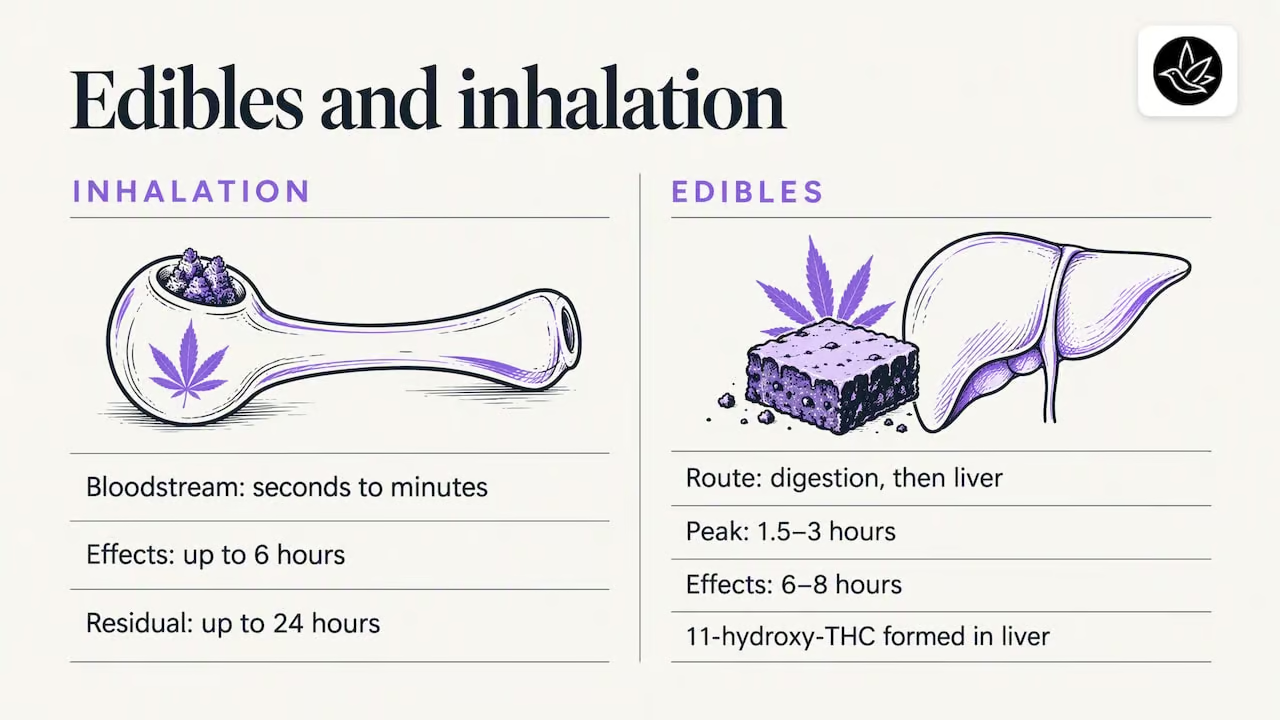
When you inhale cannabis, THC reaches your bloodstream within seconds to minutes. With an edible, it has to go through digestion and your liver first. There, oral THC is converted into 11-hydroxy-THC, a compound that’s part of why edibles feel different and linger.
In a controlled study of oral cannabis in healthy adults, subjective and cognitive effects peaked at about 1.5 to 3 hours and lasted 6 to 8 hours. In the same research, blood THC and 11-hydroxy-THC generally returned toward baseline within 8 hours. Those are lab results from specific participants and doses, not a promise for everyone, but they line up with the 4 to 8 hour range most people report.
Compare that with Health Canada’s figures for inhalation: effects can last up to 6 hours, with some residual effects up to 24 hours, per its consumer guidance. Edibles often arrive later and stay longer. Our piece on why edibles hit harder than smoking goes further.
What changes how long your edible lasts
Two people can eat the same gummy and have very different evenings. These are the main reasons.
Dose
A higher dose generally means stronger and longer effects. Health Canada’s categories treat 2.5 to 10 mg as requiring caution and 10 mg or more as requiring the most caution, and a 10 mg package is the legal maximum in Canada. That’s not a target. If you’re new, 2.5 mg or less is the lowest-risk starting point.
Food in your stomach
Health Canada names the amount and type of food in your stomach as a factor in timing. A full meal can slow the start. An empty stomach can speed things up, which can make the peak feel sharper. Neither is wrong, but know which one you’re choosing.
Product format
A gummy, a chocolate, a drink and a capsule don’t behave identically. One study of five commercial 10 mg products measured peak plasma THC anywhere from 35 to 90 minutes, and another found blood THC peaking around 1.5 to 2 hours. Even among controlled studies, there’s real product-to-product variation. Beverages and fast-acting formats may feel quicker than a baked good.
Tolerance and body
Regular users usually feel less per milligram than occasional users. Newer or sensitive users can feel effects longer. The same research that tracked commercial edibles also looked at body composition as a possible influence, so your own physiology plays a part.
Medications and alcohol
Health Canada lists orally taken medications as a timing factor. If you take prescription medication, ask your pharmacist or doctor how cannabis might interact. Mixing with alcohol is a separate issue: Ontario says impairment can last longer when cannabis is combined with alcohol.

How long do gummies last?
Gummies are the format most people ask about, and the answer is the same as for other edibles. Expect roughly 4 to 8 hours of main effects, with a peak around 2 to 4 hours. Some people, especially lower-tolerance users, feel it up to 12 hours.
Two things make gummies easy to misjudge. First, they look and taste like candy, so it’s tempting to eat a few. Second, a gummy that’s a quick, friendly experience for one person is a long night for another. Cut a gummy into halves or quarters if the label allows, and keep each portion to a known number of milligrams.
If you want to browse gummies and other formats, our edibles and gummies from Pearls by Grön page is a good place to start.
The biggest mistake: redosing during the delay
This is the one we’d tattoo on every package if we could. Because the effects are slow to appear, it’s easy to think the edible “didn’t work” and take more. Then both doses land at once.
Health Canada warns that taking more before the full effect, which can take up to 4 hours, can cause adverse effects or cannabis poisoning. The delay, more than the strength on the label, is what makes edibles risky.
A simple routine:
- Start with 2.5 mg THC or less if you’re new or sensitive.
- Set a timer for 4 hours, not 45 minutes.
- Eat something light, drink water, and stay somewhere comfortable.
- If you still feel nothing after the full window, wait for another day and adjust then.
Our guides on safe edible dosing in Canada and avoiding couch lock by starting at 2.5 mg walk through this in more detail.
Driving and the next morning
It’s natural to ask how long to wait before driving. The honest answer: there’s no reliable universal waiting time that guarantees it’s safe. Ontario states that impairment can last 6 hours or more, and longer for a new user, after a large amount, or when combined with alcohol. Don’t drive or operate equipment while impaired.
So plan before you eat. Arrange a ride, stay in, or choose a night when you have nowhere to be. Also think about the next day. If lingering effects can run 12 to 24 hours, a big morning meeting or a long drive after a late-evening edible deserves a second thought.
How long do edibles stay in your system?
This is a different question from “how long do they last,” and it’s the one most people search. Feeling the effects and having THC detectable in the body are two separate things.
In the controlled research, blood THC and 11-hydroxy-THC generally returned toward baseline within about 8 hours. But the researchers also noted that oral-fluid THC can reflect residue in the mouth rather than circulating intoxication. A test result isn’t the same as a measure of how impaired you are right now, as the oral cannabis study explains.
Detection windows for urine and other tests depend on how often you use, your dose and the type of test. We won’t hand you a number we can’t back up. If you face a workplace or medical test, ask the testing body or your doctor what applies to you.
Do edibles expire?
Yes. Edibles are food products, and they degrade over time. Cannabis edibles sold in Canada carry packaging with date information, so check the label on your product before you eat it. Beyond that:
- Store them in their original sealed packaging, in a cool, dry, dark place.
- Chocolate-based and baked products are more perishable than hard candies and gummies. Follow the storage directions on the package.
- Throw out anything that smells off, looks mouldy or has changed texture.
- Potency can drift over time, so an old edible may not feel like the same product.
For safety, the storage rule that matters most isn’t about freshness. Health Canada warns that edibles can poison children, with severe cases including hospitalization for breathing difficulties, seizures or coma, especially in children under 5. Keep every edible locked up and out of reach of kids and pets.
Our take on edibles timing
We talk to a lot of customers across Durham Region and the GTA, and the same story repeats. Someone has a first edible, feels nothing after an hour, eats another, and spends the evening wishing they hadn’t. It’s rarely about a bad product. It’s about the clock.
We think the most useful thing a retailer can do is be straight about timing. That’s why we publish detailed product information, why we stick to compliance, and why we’d rather you buy a lower-milligram product and enjoy it than push to a limit because it’s the maximum. Our customers tell us they value the fast delivery, with a 4.9-star Google rating behind it, but speed is for convenience. It’s no reason to rush your dose.
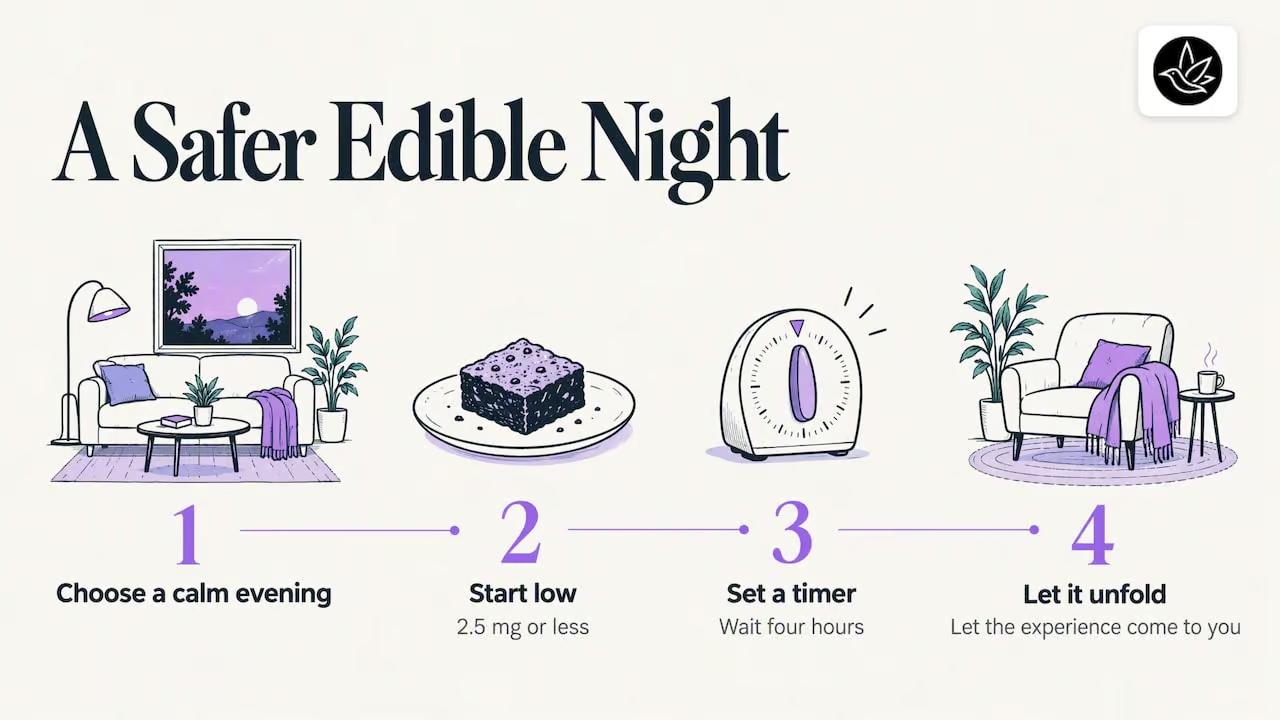
If you’re planning an edible night, here’s how we’d do it: pick a calm evening, start at 2.5 mg or less, set a four-hour timer, and let the experience come to you. If you want to understand how labels work, our guide to the 10 mg THC limit and safe dosing is a good companion.
— Nick
Shop edibles with a plan
When you’re ready, our shop carries edibles, drinks, CBD and more, with one-hour delivery in Durham Region and the GTA. Check each product’s THC content per package before you add it to your cart, and start with the lowest dose that makes sense for you. You must be an adult of legal age to order.
When to get help
Most uncomfortable edible experiences pass with time, rest and water. But get help if you have severe anxiety, panic, extreme confusion, paranoia, hallucinations, fainting or other serious symptoms. Health Canada directs people who feel unwell after consuming too much to call 1-844-POISON-X, call 1-800-463-5060 in Quebec, call 9-1-1 or go to a hospital. If a child or pet has eaten an edible, don’t wait for symptoms.
FAQ
How long does an edible high last?
For most people, 4 to 8 hours of main effects, with the peak around 2 to 4 hours. Ontario guidance says effects can last up to 12 hours, and lingering effects can continue for 12 to 24 hours. Plan your whole day around that possibility.
How long do edibles take to kick in?
Typically 30 minutes to 2 hours, and the full effect may take up to 4 hours. Don’t take more in the meantime. Taking a second dose too early is the most common avoidable mistake.
Can I make an edible wear off faster?
There’s no reliable way to speed it up. Rest, water, a light snack and a calm, familiar place help you ride it out. If you feel seriously unwell, contact poison control or emergency services using the numbers above.
Do edibles expire?
Yes. Check the date information on the package, keep edibles sealed in a cool, dry, dark place, and throw out anything that smells or looks off. Potency can change over time, so an old product may not feel the same.
Is it safe to drive after an edible?
No waiting time is guaranteed safe. Ontario says impairment can last 6 hours or more, and longer in some situations. If you’ve had an edible, arrange another way home.
Sources
- Health effects of consuming cannabis edibles, Ontario.ca
- Cannabis and driving, Ontario.ca
- Cannabis laws, Ontario.ca
- Cannabis for medical purposes: Using a cannabis product, Canada.ca
- What you need to know if you choose to consume cannabis, Canada.ca
- Cannabis health warning messages, Canada.ca
- Consumer information: Cannabis, Canada.ca
- Pharmacokinetic Profile of Oral Cannabis in Humans, PMC
- Pharmacokinetic Investigation of Commercially Available Edible Marijuana Products, PMC