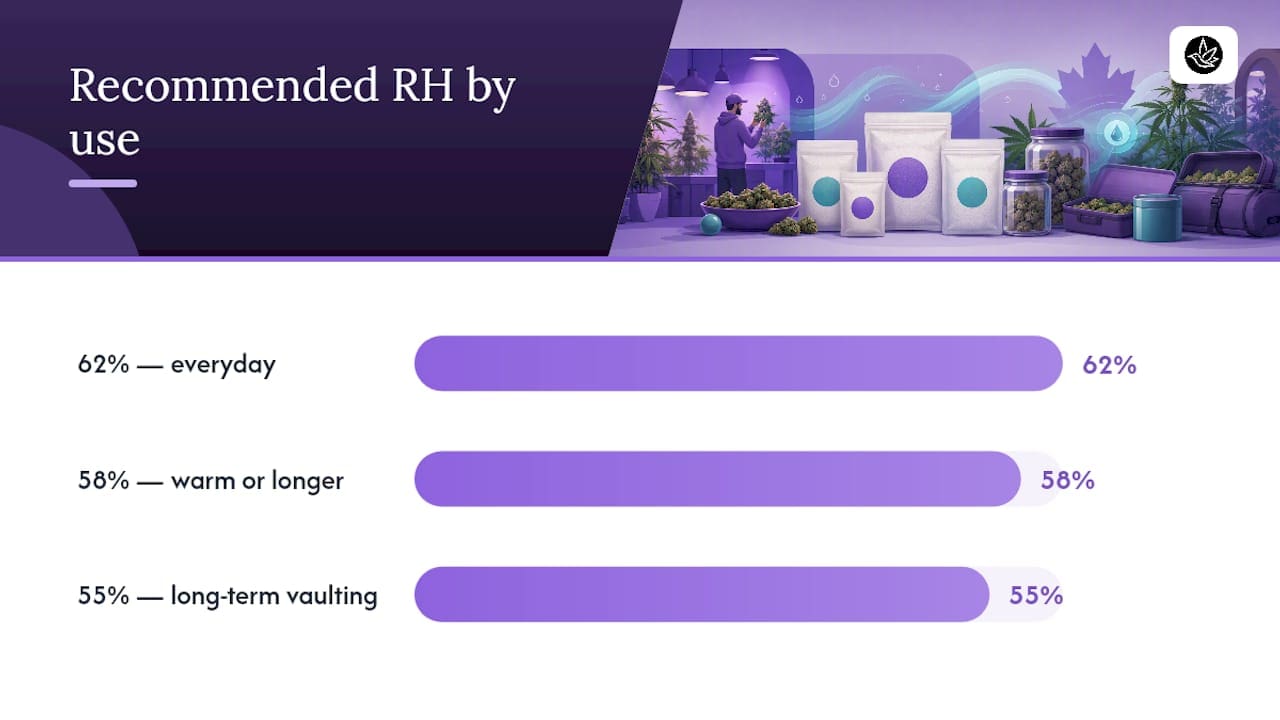
The sweet spot for stored cannabis sits between 55% and 62% relative humidity, with 62% as the everyday default unless your storage spot runs warm or humid. Pick a pack sized to your container (roughly 4 to 8 grams for a small jar, up to 60 grams for bulk storage), drop it in, seal the jar, and give it 24 to 48 hours to settle before you judge the results.
TL;DR:
- Humidity packs should be chosen based on storage size, with 4 to 8 grams for small jars and 60 grams for bulk storage, to maintain around 55-62% RH.
- Salt-based packs like Boveda offer the most consistent RH control, lasting 2 to 4 months, with lifespan shortened by frequent jar opening.
- Adjust storage humidity to 58% for warmer or longer-term storage and keep at 62% for short-term, fresh flower to preserve aroma and pliability.
- Packs do not restore lost flavor or potency; they stabilize moisture levels for already cured and properly stored cannabis.
- Consistency in storage conditions and routine checking outweigh brand choice or precise RH percentage, ensuring maximum preservation.
Table of Contents
- What are humidity packs for weed and how do they work?
- Which RH should you pick: 55, 58, or 62?
- What size humidity pack for weed should you buy?
- Boveda vs. Integra Boost vs. regenerable plant-fibre packs
- How do you use humidity packs from curing through long-term storage?
- Montrose Cannabis: what we’ve learned handling flower day to day
- Our take: the humidity number matters less than the habit around it
- Where to buy quality flower and the accessories to store it right
- Sources
- FAQ
What are humidity packs for weed and how do they work?
A two-way humidity pack is a small sachet that either releases or absorbs water vapour depending on what your jar needs. It holds the air inside at a fixed relative humidity instead of letting it drift with the weather. That “two-way” behaviour is the whole point. A silica gel packet only pulls moisture out. A two-way pack pushes back in the other direction too, which is why it can sit in a jar for months and keep nudging the air back toward its target number instead of just drying everything out.
Most packs on the market rely on one of three mechanisms. Boveda uses a saturated salt solution sealed inside a vapour-permeable membrane. The salt solution has a fixed equilibrium point, so the pack pulls moisture in when the jar is too dry and releases it when the jar is too wet, always chasing the same set RH. Boveda’s own technical explanation describes this as a rapid equilibration process, and independent chemistry backs up why salt solutions behave this predictably: the salt concentration, not the pack’s size, sets the target humidity.
Integra Boost packs use a glycerin-based gel instead of a saturated salt solution. They function similarly and often ship with a colour-changing indicator card so you can eyeball the moisture level without opening the jar. Glycerin systems tend to be a touch less locked to their set point than salt solutions, since gel-based media can drift slightly with age and temperature swings.
The third category, regenerable plant-fibre inserts like the ruksak or Humidi-Cure style products, uses a fibre composite instead of salt or gel. These are reusable: once spent, you recharge them with water and a specific RH solution rather than tossing them out. Lab testing cited by one manufacturer through MCRLabs reports tight RH control in these fibre-based designs, positioning them as a legitimate third option alongside salt and gel packs.
Here’s what none of these technologies do: restore flavour or potency that’s already gone. Cannabis storage research is clear that two-way packs are a stabilisation tool, not a repair tool. Once terpenes have evaporated off dried-out bud, or THC has started converting to CBN from age and light exposure, a humidity pack can’t reverse either process.
- Salt-based (Boveda): fixed set points, strong track record for holding steady RH over time
- Glycerin/indicator (Integra Boost): visual feedback via colour card, slightly more prone to drift
- Regenerable plant-fibre (ruksak/Humidi-Cure style): reusable design, lab-tested claims on RH precision
One figure worth sitting with: cannabis kept in controlled 55 to 65% RH storage retained over 90% of its THC and terpenes after six months in one peer-reviewed comparison, against roughly 70% retention in uncontrolled storage over the same period. That gap is the entire business case for spending a few dollars on a pack instead of just tossing dried flower in a mason jar and hoping.
Which RH should you pick: 55, 58, or 62?
Start at 62% and adjust down from there. Mood’s storage guidance puts the general long-term target at 58 to 62%, and that range covers most home storage situations without much thinking required.
62% RH is the everyday choice for finished, cured flower you plan to use within a few weeks or months. It keeps buds pliable, preserves aroma, and matches how most dispensary-grade flower is packaged and sold. Industry guides on humidity packs point to 62% as the standard recommendation for exactly this reason: it’s the humidity level flower actually tastes and smells best at.
58% RH makes more sense when your storage spot runs warm, or when you’re storing flower for longer than the usual few weeks. Warmer air holds more moisture at a given RH reading than cool air does, so a jar sitting near a window or above a fridge will trend wetter than the same jar in a cool closet, even at an identical relative humidity setting. Dropping to 58% builds in a buffer against that mould risk without drying the bud out enough to hurt terpene retention.
It trades a small amount of pliability and aroma intensity for a meaningfully lower mould risk over long timeframes.
Temperature is the variable most people miss entirely. Relative humidity is exactly what it says: relative to temperature. Don’t just trust the RH number without asking what temperature it was measured at.
Here’s how that plays out by product type:
- Pre-rolls: 58 to 62% keeps the paper from drying and cracking while protecting flavour, since pre-rolled paper wicks moisture differently than a sealed nug.
- Concentrates: most concentrates don’t need humidity packs at all; moisture control matters far less than oxygen and light exposure for extracts.
- Fresh cured flower: 62% for the first month or two after curing wraps up, when terpene protection and pliability matter most.
- Long-term vaulting (6+ months): 55% paired with a cool, dark space, and consider whether vacuum-sealed mylar or frozen storage makes more sense than relying on a pack alone.
Run them in identical jars from the same harvest, check both after two weeks, and let your own nose settle the argument. Every storage space has its own microclimate, and that’s the fastest way to find yours.*
For readers building out a full storage setup rather than just buying packs, Montrosecannabis’s guide on storing cannabis properly walks through the container, light, and temperature side of the equation that pairs with whatever RH pack you choose.
What size humidity pack for weed should you buy?
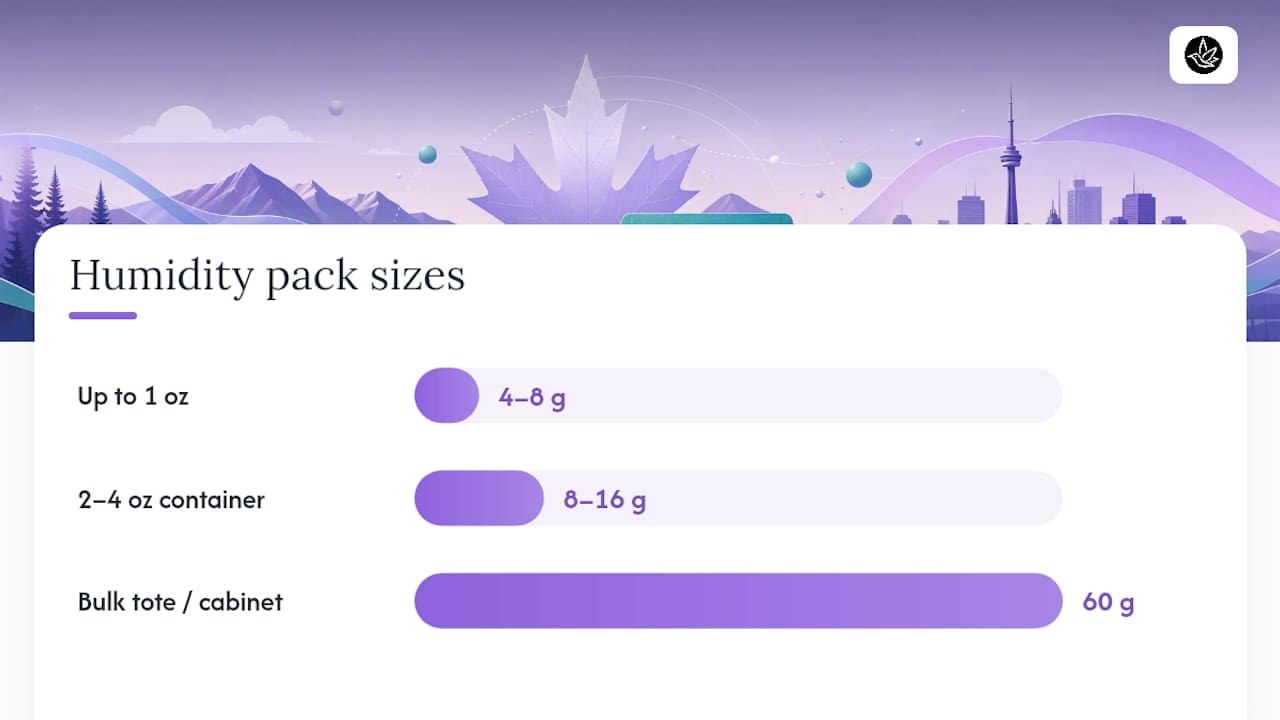
Match the pack’s gram weight to your container’s air volume, not to how much flower is inside it. An 8 gram pack is the standard choice for anything up to a 1 ounce mason jar. Step up to a 60 gram pack once you’re managing bulk storage, a full tote, a larger humidor-style box, or several ounces kept together in one sealed container.
Sizing guidance from retail and storage sources also references a “1:500” rule of thumb for larger enclosures: roughly one gram of pack capacity for every 500 cubic inches of sealed air space. That rule matters more once you’re outside mason-jar territory and into humidors, totes, or cabinet-style storage where the empty air volume, not just the flower weight, is what the pack actually has to condition.
- Small jars (up to 1 oz / 28 g of flower): one 4 to 8 gram pack per jar.
- Medium containers (2 to 4 oz): one 8 to 16 gram pack, or two smaller packs spaced apart.
- Bulk totes or cabinet storage: 60 gram packs sized to the 1:500 cubic-inch guideline, checked with a standalone hygrometer.
- Humidors or wide, flat containers: favour multiple smaller packs distributed across the space over a single large one, since two-way packs work fastest when air can actually circulate around them.
Placement matters almost as much as size. Set the pack upright against the side of the jar or resting loosely on top of the flower, never buried underneath dense buds. A background insight worth repeating here: packs equilibrate faster when there’s open headspace around them, so burying one under tightly packed nugs just slows down the whole process for no benefit.
Watch for these signs that a pack is spent and needs swapping:
- Boveda packs go hard and crystallized to the touch when they’re done; a fresh one stays soft and pliable.
- Integra Boost packs shift colour on the indicator card, which is the entire reason that card exists.
- Regenerable plant-fibre inserts need recharging on a schedule rather than a hard replace, since the fibre itself doesn’t wear out the same way.
Lifespan varies a fair amount in real-world use: many Boveda users report 2 to 4 months per small pack under normal conditions, while some regenerable and glycerin packs run longer in similar setups. The single biggest factor shortening a pack’s life isn’t the brand, it’s how often you crack the seal. Every time you open the jar, moist or dry outside air rushes in and the pack has to work overtime to correct it. Frequent opening or a lid that doesn’t seal tight can cut a pack’s usable life dramatically compared to a jar that stays closed.
Boveda vs. Integra Boost vs. regenerable plant-fibre packs
Here’s how the three main pack styles actually stack up once you line up RH options, lifespan, and what you’re getting for your money.
| Feature | Boveda | Integra Boost | Plant-fibre regenerable inserts |
|---|---|---|---|
| RH set points available | 55%, 58%, 62% | Multiple points, commonly 55% to 65% range | Wide claimed RH range, adjustable via recharge solution |
| Typical real-world lifespan | 2 to 4 months per pack | Comparable to slightly longer in similar conditions | Longer, since recharging extends usable life |
| Regenerable or single-use | Single-use | Single-use | Regenerable (recharge with water/solution) |
| Sizing guideline | 4 to 8 g for jars up to 1 oz; 60 g for bulk | Similar gram-to-volume matching | Similar gram-to-volume matching, insert-based |
| Accuracy / claimed tolerance | Tight, saturated-salt equilibrium claimed | Good, slight drift possible with gel media | Tight control claimed in third-party lab testing |
| Availability in Canada | Widely stocked at dispensaries and online retailers | Common in retail and hobbyist supply channels | Growing availability, more niche/specialty retailers |
If you want predictable set points and a product you can grab at nearly any dispensary counter, this is the safest default pick for everyday finished flower.
Integra Boost earns its following mostly through the indicator card. Being able to glance at a colour change instead of opening the jar or reaching for a separate hygrometer is a real convenience, especially for hobbyists managing several jars at once. The trade-off is that glycerin-based media can drift a little more over its lifespan than a saturated salt solution, so it rewards slightly more attentive replacement habits.
Regenerable plant-fibre inserts like the ruksak or Humidi-Cure style products appeal to anyone bothered by tossing a spent sachet every few months. Recharging the insert instead of replacing it cuts down on waste, and the lab testing referenced by Atmosiscience through MCRLabs gives this category a real data point to point to rather than just a marketing claim. Generic regenerable plant-fibre two-way packs sold under similar branding follow the same basic design logic: a reusable fibre core you recharge on a schedule rather than replace outright.
- Boveda: best for everyday finished flower where you want a proven, widely available set point
- Integra Boost: best for users who like visual confirmation without cracking the seal
- Plant-fibre regenerable inserts: best for anyone prioritizing lower waste and willing to manage a recharge cycle
When you’re shopping, check the product page for the actual RH percentage stamped on the pack (not just “humidity control”), the gram weight, and whether it’s rated for the container size you’re actually using. If eco-minded storage matters to you beyond the pack itself, pairing any of these with a properly compliant, resealable container does more for long-term freshness than switching pack brands ever will. And if you’re curious about humidity control materials outside the cannabis space, humidity beads used in cigar humidors work on a related principle, worth a look if you’re managing a larger multi-jar setup and want a bulk humidification option.
How do you use humidity packs from curing through long-term storage?
- Finish the cure first. Don’t drop a pack in wet, freshly trimmed flower expecting it to fix improper drying. Continue burping jars daily for the first one to two weeks of cure even with a pack inside, since a 62% pack helps maintain pliability during cure but isn’t a substitute for the initial dry and burp routine.
- Add the pack once cure has settled, typically after the first two weeks, when jar humidity has stabilized and you’re not seeing condensation on the glass anymore.
- Seal the jar and wait 24 to 48 hours before judging results. Packs need time to pull the headspace toward their set point; checking too early just leads to second-guessing a process that’s working fine.
- Check periodically with a standalone hygrometer if you want confirmation beyond an indicator card, especially for bulk or long-term storage where a wrong reading costs you more.
- Swap the pack when it hardens, changes colour, or hits the recharge point for regenerable inserts, and replace more often in jars you open frequently.
Troubleshooting the two most common problems:
- Jar reads too wet: crack the lid and vent for a few hours, or pull the flower out briefly to air dry before resealing. If you’re consistently overshooting, you likely need a lower RH pack (drop from 62% to 58%) rather than a bigger fight against the humidity.
- Jar reads too dry: add a 62% pack and give it 48 to 72 hours before reassessing. Resist the urge to add moisture directly with water or a damp cloth, since that risks localized mould pockets that a pack alone won’t create.
A short checklist worth keeping on your phone: airtight container, cool and dark storage location, occasional hygrometer spot-check, and a replacement cadence that matches how often you actually open the jar. Readers building this routine from scratch might find Montrosecannabis’s guide on keeping weed fresh for months useful for the container and lighting side of things that a pack alone doesn’t cover.
Pro Tip: Label your jars with the pack’s install date using a piece of tape and a marker. It sounds unnecessary until you’re three jars deep and genuinely can’t remember if that pack went in three weeks ago or three months ago.
Montrose Cannabis: what we’ve learned handling flower day to day
Handling flower for same-day and next-day delivery gives you a different perspective on humidity than long-term storage advice usually accounts for. Flower moving quickly doesn’t need the same pack strategy as flower sitting in a vault for six months.
It protects aroma and pliability without the mould-risk considerations that matter more for multi-month storage.
A few things worth keeping in mind if you’re managing more than one or two jars at home:
- Fast turnover (days to a couple weeks): 62% pack, standard sizing for your jar
- Slower storage (a month or more): drop to 58%, especially in warmer rooms
- Multi-month vaulting: 55% and consider whether vacuum-sealed or frozen storage makes more sense than a pack alone
If you’re outfitting a home storage setup or just want to see what a curated flower selection looks like when freshness is baked into the process from harvest onward, Montrosecannabis’s resource hub has more on both the product and storage side.
Our take: the humidity number matters less than the habit around it
Most of the advice floating around treats RH selection like the hard part. It isn’t. The part people actually get wrong is treating a humidity pack as a one-time fix instead of an ongoing habit, cracking the jar open daily, forgetting to check the pack for months, storing it somewhere that swings ten degrees between day and night.
If there’s one thing worth prioritizing over brand loyalty or the exact percentage on the pack, it’s consistency: a stable location, a container that actually seals, and a replacement schedule you stick to. A $3 pack sitting in a jar that gets opened eight times a day and left on a sunny windowsill will lose to a $3 pack sitting untouched in a cool cupboard, every single time. The chemistry inside these packs is genuinely solid. The follow-through is where most people lose the freshness they paid for.
— Nick
Where to buy quality flower and the accessories to store it right
Getting the RH number right only helps if what’s going into the jar was fresh to begin with. That’s the piece a lot of storage advice skips: no pack fixes flower that was already stale or poorly cured before it reached your door.

Curated flower is available for delivery across Durham Region and the GTA, with Canada-wide delivery options for medical orders. That speed matters for freshness in a way storage tips alone can’t fix: the less time flower spends in transit or sitting on a shelf before it reaches you, the less work your humidity pack has to do to bring it back to spec. Check out Montrosecannabis’s delivery guide to see coverage areas and place an order for delivery to your door today.
FAQ
Is using two Boveda packs in one jar too much?
For a standard 1 ounce jar, one properly sized pack (4 to 8 grams) is usually enough; adding a second pack of the same RH won’t push humidity past that set point, since two-way packs stop at their equilibrium regardless of quantity, but it’s unnecessary for small containers and better saved for bulk storage.
How long does a 60 gram Boveda pack actually last?
Real-world reports suggest 2 to 4 months per pack under normal conditions, though frequent jar opening or a poor seal can shorten that considerably.
What size humidity pack for weed do I need for a small jar?
A 4 to 8 gram pack covers most jars holding up to 1 ounce of flower; move up to 60 gram packs for bulk totes or larger sealed containers.