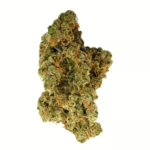
What Does CBD Do?
CBD is everywhere—but the honest answer is more useful than the hype. Learn how cannabidiol interacts with the body, what the evidence actually supports, how CBD differs from THC, and how to choose a format that fits your routine.
The short answer
CBD, or cannabidiol, is a cannabis compound that can influence several signalling systems involved in stress response, pain processing, sleep, inflammation and nervous-system activity. It does not typically produce the intoxicating “high” associated with THC. Its effects vary widely by person, dose, product, timing and the reason it is being used.
The strongest clinical evidence is for specific prescription CBD medicines used for certain seizure disorders. Research into anxiety, sleep, pain and inflammation is promising in places, but it is not conclusive enough to treat every CBD product as a proven therapy. CBD is pharmacologically active: it can cause side effects and interact with medications.
What is CBD—and how does it work?
Cannabidiol (CBD) is one of more than 100 cannabinoids found in cannabis. Unlike THC, CBD has little affinity for the CB1 receptor responsible for much of cannabis intoxication. Instead, researchers believe CBD affects the body more indirectly, influencing cannabinoid signalling and other targets involved in serotonin signalling, pain perception, inflammation and the breakdown of the body’s own endocannabinoids.
This network is often called the endocannabinoid system (ECS). It helps regulate processes including mood, sleep, appetite, immune function, memory and pain response. CBD is not simply “adding calm” to the system. Its actions are complex, dose-dependent and still being studied.
Does CBD get you high?
CBD itself is not considered intoxicating in the way THC is. That does not mean every product labelled “CBD” is THC-free. Full-spectrum products and balanced formulas can contain enough THC to impair some users, especially at higher amounts or when taken orally. Always read the cannabinoid amounts on the label—not just the product name.
How long does CBD take to work?
It depends mainly on the format. Inhaled CBD can be felt within minutes and tends to wear off sooner. Oils held under the tongue may begin sooner than swallowed products, while capsules and edibles can take one to several hours because they pass through digestion. Topicals are applied locally and are not normally chosen for a whole-body effect. Food, metabolism, previous cannabis exposure and the product formula can all change the timing.
What does CBD feel like?
There is no single CBD feeling. Some people describe a subtle reduction in tension, a quieter mind or less awareness of discomfort. Others notice drowsiness. Some notice nothing at all. Unlike THC, a suitable CBD-dominant product usually does not produce euphoria, altered perception or obvious intoxication.
Expectations matter. CBD is often marketed with dramatic language, but the real-world effect can be quiet and difficult to separate from normal day-to-day changes. A useful test is to keep the product, amount and timing consistent for several days, record the outcome you care about, and change only one variable at a time.
What does the evidence say CBD may do?
CBD research ranges from laboratory experiments to small human trials and approved prescription medicines. Those forms of evidence are not interchangeable. A finding in cells or animals does not prove that a retail CBD product will produce the same result in a person.
CBD and seizures
The clearest evidence is for purified, prescription cannabidiol used under medical supervision for certain rare seizure disorders. This does not mean over-the-counter or recreational-market CBD products are substitutes for prescribed treatment. Product purity, dose and clinical monitoring matter.
CBD and anxiety or stress
Small studies suggest CBD may affect anxiety in specific situations, but studies have used different populations and often much larger doses than everyday retail products. There is not yet a universal dose or enough high-quality evidence to say CBD reliably treats anxiety disorders. If anxiety is persistent or affecting daily life, speak with a healthcare professional.
CBD and sleep
CBD is not automatically a sedative. Some people report better sleep when CBD helps with another issue that keeps them awake, while others feel alert or notice no change. Research remains mixed, and many “sleep” products also contain THC, CBN, melatonin or calming botanicals. That makes it important to attribute the effect to the whole formula—not CBD alone.
CBD and pain
People commonly use CBD for discomfort, but evidence for CBD by itself is limited and varies by pain type. Some cannabis studies showing benefit use combinations of THC and CBD, making it difficult to isolate CBD’s contribution. Topicals can be useful as a targeted, non-inhaled format, but they should not be described as proven cures for arthritis, injury or chronic pain.
CBD and inflammation
CBD shows anti-inflammatory activity in preclinical research, but consumer claims often run ahead of human clinical evidence. “May support recovery” is more accurate than promising CBD will eliminate inflammation. New, severe or persistent swelling and pain deserve medical assessment.
CBD vs. THC: what is the difference?
CBD and THC come from the same plant, but they do not act the same way.
| Question | CBD | THC |
|---|---|---|
| Intoxicating? | Usually no | Yes, depending on amount and tolerance |
| Typical experience | Often subtle; may feel calming or neutral | Euphoria, altered perception, relaxation or anxiety |
| Drug interactions? | Yes | Yes |
| Can it impair driving? | Possible through drowsiness or hidden THC | Yes |
CBD may change some effects of THC, but it should not be treated as a guaranteed “off switch” for intoxication. Balanced products can still impair you.
Which CBD format is right for you?
The best format is the one that matches your goal, preferred timing and comfort with cannabis—not simply the product with the biggest number.
CBD oils
Oils make it easier to adjust the amount in small steps. They can be swallowed or, where the label permits, held briefly under the tongue. Check the amount per millilitre and use the supplied measuring device. Oils are a strong starting point for people who want flexibility without inhalation.
CBD capsules and softgels
Capsules offer consistent, discreet amounts with no cannabis taste. The tradeoff is slower onset and less dosing flexibility. Montrose carries high-potency options, including Emprise CBD-dominant softgels; 50 mg per capsule is not a beginner amount for many people.
CBD edibles
Gummies and other edibles are portable and easy to understand, but effects can be delayed. Avoid taking more simply because you do not feel anything right away. Read the label carefully: many CBD edibles also contain THC, CBN or CBG.
CBD flower and pre-rolls
Inhaled CBD flower generally has a faster onset and shorter duration than swallowed products. It can also contain THC and carries the respiratory risks of smoke. For people avoiding combustion, an oral or topical product may be a better fit.
CBD vapes
Vaping also has a fast onset, which can make effects easier to assess in real time. It still exposes the lungs to aerosol and is not risk-free. Choose regulated Canadian products and never use unregulated vape liquids or additives.
CBD topicals
Creams, balms, roll-ons and massage oils are applied to a specific area. They are useful for people seeking a localized format without swallowing or inhaling cannabis. Do not apply to broken skin unless the label specifically allows it, and wash your hands after use.
How much CBD should you take?
There is no validated one-size-fits-all CBD dose for general wellness. Research doses can be far higher than amounts in consumer products, and more is not always better.
- Read the label in milligrams. Know the CBD and THC per unit or per millilitre.
- Start with the lowest practical amount. This is especially important for oral products and formulas containing THC.
- Wait for the full onset window. Oral cannabis can take several hours to peak.
- Increase slowly, if needed. Make one small change at a time.
- Track the result. Record amount, time, food, effect and side effects.
Ask a pharmacist, nurse practitioner or physician before using CBD if you take prescription medication, have liver disease, are pregnant or breastfeeding, are preparing for surgery, or are using CBD for a diagnosed condition. Do not stop prescribed treatment in favour of CBD without medical guidance.
Is CBD safe? Side effects and interactions
CBD is often well tolerated, but “natural” does not mean risk-free. Reported side effects include drowsiness, fatigue, diarrhea, reduced appetite, dry mouth, nausea and changes in mood. Higher or prescription-level doses can affect liver enzymes.
CBD can interact with medication
CBD can change how liver enzymes process certain drugs, potentially raising or lowering medication levels. Important examples can include blood thinners, anti-seizure medicines, immunosuppressants and medications that cause drowsiness. Alcohol and other sedating substances can increase sleepiness.
Driving and work
Do not drive, operate machinery or perform safety-sensitive work if you feel drowsy, slowed or impaired. A CBD-labelled product may contain THC, and regular CBD use does not guarantee a negative drug test.
Who should get medical advice first?
Speak with a healthcare professional before using CBD if you are pregnant or breastfeeding, under 19, have liver disease, take prescription medication, have a history of serious mental illness, or are planning surgery. Keep cannabis locked away from children and pets.
How to choose a CBD product in Canada
Start with the label, not the front-of-pack promise. Compare the milligrams of CBD and THC per dose, the total amount in the package, the format and the ingredients. Decide whether you want CBD isolate, broad-spectrum extract or a full-spectrum formula containing other cannabinoids. Then check the package date and current inventory.
- For flexible amounts: consider an oil.
- For convenience: consider capsules or gummies.
- For localized use: consider a topical.
- For faster onset: inhaled formats act sooner but carry lung-related risks.
- For THC avoidance: look for a THC-free claim and verify the cannabinoid table; no product can guarantee a drug-test outcome.


Frequently asked questions about CBD
Sources and editorial standard
This guide prioritizes Canadian regulatory guidance and peer-reviewed clinical evidence. Key references include:
- Health Canada: Review of cannabidiol
- Health Canada: About cannabis
- Brown & Winterstein: CBD adverse events and drug interactions
- Systematic review of adverse effects of oral CBD
Last reviewed: August 10, 2026. Educational information only. Product availability and formulations can change; confirm details on the product page and package label.
Still figuring out your CBD lane?
Start with the outcome, choose the simplest format, and go low and slow. Montrose carries regulated CBD oils, capsules, edibles, flower, vapes and topicals across recreational and medical collections.